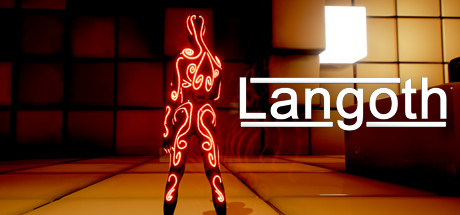
Langoth, developed by Atum Software and published by Sometimes You, is an ambitious yet flawed attempt at crafting a surreal 3D platforming experience within a digital world teetering on collapse. Released in 2017, the game presents itself as a science fiction journey through a corrupted simulation where all organic life has been eradicated by a viral infection. The player assumes the role of a lone being tasked with purging the virtual realm of this corruption, restoring balance to a digital paradise that has long since decayed. The concept holds an intriguing philosophical foundation—touching on themes of isolation, creation, and the loss of perfection—but the execution reveals a project that feels more like a prototype of ideas than a fully realized vision.
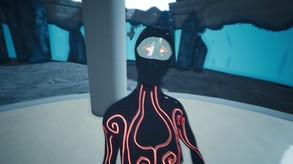
At first glance, Langoth immediately stands out through its aesthetic choices. The game uses Unreal Engine 4 to create a stylized, artificial landscape made up of angular structures, reflective surfaces, and disjointed architecture that gives the impression of a world built and then broken apart by its own code. The environments are vast yet barren, echoing the desolation of a corrupted system. Light flickers off metallic textures, and the horizon stretches into a digital void, giving players the sensation of wandering through an abandoned simulation rather than a traditional platforming world. The art direction is conceptually strong—minimalist, haunting, and deliberately cold—but the technical execution undermines its ambition. Textures appear flat in some areas, level geometry repeats too often, and the sense of emptiness that should inspire awe instead turns to monotony. The visuals often feel like an unfinished tech demo, full of promise but lacking refinement.
Gameplay in Langoth revolves around platforming, exploration, and basic combat against virus-like enemies. Players can choose between two characters, Adam or Eve, though the difference between them is purely cosmetic. The movement mechanics include running, jumping, dashing, and throwing energy bombs, but the controls are loose and imprecise, which creates constant frustration in a genre that depends on accuracy. Jumps feel weightless, collision detection is unreliable, and the camera can become a frequent enemy when trying to navigate narrow platforms or elevated structures. What should be moments of exhilaration—leaping across broken bridges or scaling towering structures—often devolve into irritation due to the game’s inconsistent physics and frequent clipping issues. Enemies, meanwhile, provide little challenge or variation, serving more as distractions than genuine threats. The combat, consisting mostly of ranged attacks and simple dodges, quickly becomes repetitive and does little to enhance the experience.
Despite these mechanical shortcomings, Langoth tries to distinguish itself through atmosphere. The world is devoid of life, and that emptiness becomes the central emotional tone of the experience. The soundtrack, composed of ambient electronic pieces and haunting synthetic tones, successfully conveys a feeling of melancholy and isolation. Combined with the sterile visuals and minimal environmental storytelling, the game evokes a strange sense of existential sadness. There are no spoken words, no clear explanations, only the soft hum of machinery and the echo of your own footsteps in an empty digital wasteland. This approach gives the game a meditative quality that can be appreciated by players who value mood and setting over action. However, for many, the lack of narrative substance or evolving gameplay makes the atmosphere feel hollow rather than profound. The sense of purpose that the premise promises—a struggle to reclaim a lost paradise—never fully manifests in the moment-to-moment experience.
The idea behind Langoth carries symbolic depth. The title itself refers to a kind of yearning—a longing for something once glimpsed but lost forever. In that sense, the game seems to be reaching for a metaphorical representation of humanity’s nostalgia for perfection, or perhaps a divine state of order that has since been corrupted. Yet the storytelling is so sparse and the gameplay so underdeveloped that these ideas never fully crystallize. Hints of lore and thematic intent are scattered throughout the environments, but without context or emotional anchors, they fade into background noise. It feels as though the game wants to be both a philosophical exploration of a dying world and a traditional 3D platformer, but it never fully commits to either.
From a technical standpoint, Langoth also struggles to maintain consistency. Performance can be unstable, with occasional frame drops and awkward animations breaking immersion. The camera system, while functional, often works against the player in tight spaces or during jumps, and the physics engine occasionally produces unpredictable results. These issues, coupled with the repetitive level design and short runtime, make the game feel incomplete. It’s the kind of experience that demonstrates strong artistic ambition but lacks the mechanical polish or design maturity to bring its vision to life.
In the end, Langoth is a game defined by contrasts: striking ideas weighed down by rough execution, intriguing themes undermined by shallow mechanics, and visual ambition undone by technical inconsistency. It is not without merit—its haunting aesthetic and melancholic atmosphere offer moments of quiet beauty—but it feels more like an experiment than a finished product. For players who enjoy obscure, contemplative indie titles that focus on mood rather than challenge, Langoth may hold a certain fascination. However, those expecting tight platforming, engaging combat, or a rich narrative will likely find the experience frustrating and underwhelming. It stands as an example of how strong conceptual design can still falter without refinement, leaving behind a digital wasteland that, like its own world, feels haunted by the memory of what it could have been.
Rating: 5/10