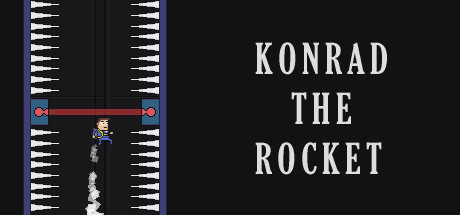
Konrad the Rocket: A hardcore platformer inspired by Orwell's 1984 and jetpacks.
Modeled estimate, not a reported figure. How we estimate →
Media

About
Genres
Stats
All-time low is the lowest price we've recorded for this game since we started tracking it.
Languages: English, Portuguese - Brazil
Reviews
Konrad the Rocket is a punishing retro-inspired precision platformer that transforms something as simple as controlling a jetpack into a tense, frustrating, and surprisingly rewarding survival challenge. Developed and published by Leonardo Alexandrino, the game blends difficult movement mechanics, oppressive dystopian themes, and old-school arcade design into an experience that feels intentionally hostile toward the player from the very beginning. Unlike modern platformers that often soften failure through generous checkpoints and forgiving controls, Konrad the Rocket proudly embraces a far harsher philosophy where mastery comes only through repetition, patience, and relentless persistence. Beneath its minimalist presentation lies a carefully constructed platforming experience that constantly pushes players to improve their movement precision while simultaneously immersing them in a bleak Orwell-inspired world where human lives are disposable tools used by an authoritarian government. The game’s premise immediately establishes a tone of hopelessness and oppression. Players take control of Konrad, a factory worker living under the rule of a totalitarian regime obsessed with national superiority and technological advancement. The government introduces an experimental project involving dangerous rocket-powered flight technology and recruits ordinary citizens as expendable test subjects in the name of patriotic progress. Konrad is selected as one of these unwilling participants and forced into a series of deadly trials involving prototype rocket equipment that appears barely functional and highly unstable. The regime glorifies the experiments as heroic sacrifices for the nation while showing little concern for whether the test subjects survive. This setup creates an atmosphere that feels heavily inspired by dystopian fiction such as George Orwell’s 1984, where propaganda, control, and the dehumanization of individuals become central themes underlying the gameplay experience. The narrative remains subtle and minimalist throughout the game, but the oppressive tone constantly reinforces the feeling that players are trapped inside a cruel system designed around suffering and obedience. Visually, Konrad the Rocket embraces a minimalist pixel-art aesthetic that prioritizes gameplay readability and environmental clarity over visual complexity. The environments consist largely of industrial testing facilities, mechanical laboratories, underground corridors, and dangerous obstacle courses filled with deadly traps and harsh mechanical architecture. The art style is intentionally simple, but that simplicity works in the game’s favor because precision platforming requires players to instantly recognize hazards and navigate tight spaces without visual distractions. Spikes, lasers, moving obstacles, collapsing platforms, and narrow passages remain clearly visible at all times, which becomes absolutely essential during later levels where the gameplay demands near-perfect movement control. The sterile industrial environments also reinforce the game’s dystopian atmosphere, making every stage feel like part of a government-controlled death trap disguised as scientific progress. The core gameplay revolves entirely around mastering the game’s rocket-powered movement system. Unlike traditional platformers focused mostly on jumping, Konrad the Rocket forces players to control unstable jetpack-like propulsion mechanics that rely heavily on momentum, fuel management, and directional precision. The rocket controls intentionally feel difficult and somewhat unpredictable at first. Movement requires careful bursts of propulsion, constant adjustments in positioning, and a deep understanding of how momentum affects navigation through hazardous environments. Early on, the controls can feel awkward and even frustrating because small mistakes frequently lead to instant death. However, this difficulty is entirely intentional. The game is designed around the idea that mastery must be earned gradually through repeated failures and growing familiarity with the mechanics. One of the game’s most impressive achievements is how effectively it creates tension through movement alone. There are no enemies chasing the player, no combat systems, and very little narrative interruption. The challenge comes almost entirely from the environment itself and the constant risk of losing control for even a fraction of a second. Navigating narrow corridors lined with spikes while managing unstable rocket momentum creates an unusual kind of anxiety rarely found in more traditional platformers. The game constantly forces players to remain focused because every movement input matters. A single mistake can instantly destroy progress, especially during later stages where obstacle density and precision requirements become extreme. The level design is easily one of the strongest elements of the experience. Across seventy-five levels, the game gradually introduces increasingly dangerous combinations of hazards, movement challenges, and environmental mechanics that constantly evolve the gameplay without abandoning its central focus. Some levels emphasize careful momentum control through tight corridors, while others require rapid reactions and split-second adjustments while navigating moving traps or shifting platforms. Certain sections almost resemble intricate mechanical puzzles where players must carefully study obstacle patterns before attempting movement. The gradual escalation of difficulty is handled extremely well because each new challenge builds naturally upon mechanics introduced earlier in the game. What makes Konrad the Rocket especially satisfying is the strong sense of progression tied directly to player skill rather than character upgrades or unlock systems. Early levels may initially feel almost impossible due to the awkward rocket controls and unforgiving hazards, but over time players begin developing genuine mastery over the movement mechanics. Areas that once seemed unfair gradually become manageable through practice and memorization. The game consistently rewards persistence, and successfully completing difficult stages creates an intense sense of accomplishment precisely because victory feels fully earned. This focus on skill-based progression strongly resembles classic arcade games and modern hardcore platformers where improvement comes entirely from the player rather than external progression systems. The dystopian atmosphere enhances the gameplay surprisingly well despite the minimal storytelling. Government propaganda, references to sacrifice for the nation, and the casual disregard for human life all create a bleak background that gives the difficult platforming thematic purpose. Players are not simply overcoming obstacle courses for entertainment; they are surviving deadly experiments imposed by an authoritarian regime that treats failure as acceptable collateral damage. The sparse dialogue and environmental presentation leave much of the world open to interpretation, but that ambiguity actually strengthens the oppressive atmosphere because players are constantly left imagining the larger system controlling Konrad’s fate. For players who enjoy hardcore platformers, difficult movement systems, retro arcade challenge, and experiences that reward persistence and mechanical mastery, Konrad the Rocket offers an intense and surprisingly immersive journey filled with frustration, tension, and eventual satisfaction. Its punishing difficulty, repetitive environments, and unforgiving design philosophy will not appeal to everyone, but players willing to fully engage with its systems will likely discover one of the more distinctive and rewarding precision platformers in the indie scene. The game ultimately succeeds as a focused tribute to classic hardcore arcade games while adding enough dystopian atmosphere and unique movement mechanics to establish an identity entirely its own Rating:6/10
Related
Related
Trends
Concurrent players on Steam, sampled daily since tracking started.
"Konrad the Rocket" is a GameMaker Studio copy+paste job where you have a jetpack and fly through various 2D levels. The jetpack mechanic sucks a lot more than the regular GMS engine jumping mechanics. This is just more basic amateur shovelware polluting Steam with no real value for gamers. From a technical perspective, the game doesn't meet basic minimum requirements that most PC gamers expect as standard. A choice was made to use obsolete, decades old retro pixel "art" as a substitute for contemporary PC graphics. It's unclear if this is due to lack of budget or talent, regardless, the overall visual quality of the game is extremely low as a result. There's no option to change the resolution and no useful graphics tweaks. There's no way to ensure this is running at the native resolution of your display. There's no guarantee this game will look right on any PC as a result of this hamfisted design decision. The controls can't be customised, which will be an annoyance for many, but it can also render the game unplayable for differently-abled gamers, or gamers using AZERTY or other international keyboard layouts. PC gamers will be insulted by the demand from the developer that a console peasant children's toy controller should be used, despite this being on PC. Developers should try to be aware which platform they're developing for, and must never, under any circumstances dictate to gamers how their games are to be experienced. Some of the defects in the game can be attributed to the choice of using the GameMaker Studio construction kit/toolset. This is a very poor quality toolset favoured by amateur developers as it's cheap and requires little in the way of development skill, but unfortunately has very limited capabilities. Just as you can't make a silk purse out of a sows ear, you can't make a great video game if you use a terrible engine. GameMaker Studio is most commonly used to make retro pixel shovelware and cash grabs. A strong argument can be made that construction kits like GameMaker Studio should never be used to make games for profit, as the "developer", Leonardo Alexandrino has done here. These construction kits are intended to teach people some of the basic principles of game development, and to make small demos to pass around with friends. They're not intended to replace to actual work of real, professional game developers. So it's inappropriate when amateurs try to use these for profit, without any actual, real game development effort taking place. This doesn't result in products that have any real meaningful value for gamers. The very poor quality of this game puts it squarely on-par with ancient 1990's Flash/Java games, and given it's 2023 (and this was released not so far back in 2017), gamers and the industry expect and deserve better than this kind of low effort shovelware. These technical defects push this game below acceptable standards for any modern PC game. The poor quality of this game is reflected by how many people spent time with it. At the time of this review, SteamDB shows the all-time peak player number was only 2 players. This is a remarkably low number, and now, the only player activity occurs once or twice a month, presumably someone loading it up to see what it is then quickly uninstalling it. Considering there's over 120 million gamers on Steam and well over 50,000 games for gamers to choose from (over 9,000 completely free titles), the overwhelming lack of interest in this low quality game is to be expected. "Konrad the Rocket" is relatively cheap at $1 USD, but it's not worth it. Given the defects and quality issues with the game, coupled with the unrealistic price, this is impossible to recommend.
Very addictive indie game. The graphics and music are basic, but are quite fitting to the game. The gameplay is tight, and quite challenging, and there is a constant "one more try" feeling. Finished it in around 5-6 hours, don't regret buying it.
This game has some very solid mechanics. Love the art style, simple but effective. I've only played 5 minutes of this game but It gave me a good first impression! Keep up the good work man
A really fun platformer with interesting jetpack mechanics. One of the less frustrating deathless achievement i've had to do
Just finished the game, feels pretty responsive actually with my only issue to do with controls/movement being that a few things feel weird as when you start flying there is no initial "jump" momentum making things have different timings to what I expect but other than that a pretty good 60-90 minute game for one run and and not attempting achievements (I can't see myself getting Konrad the Immortal any time soon) So in summary, if you have some time free and enjoy games with difficulty greater than a good portion of modern nintendo games give this a try. TL;DR Try this game it is fun
Jeux qui se fini en quelques heures si vous avez du mal avec ce genre de Die and Retry (pour ma part fini en 2H30) Conseillé de jouer à la manette, car le jeu répond très bien aux deux sticks (voir trop) Seul bémol c'est la musique répétitive. Mais s'oublie si on est concentré.
Una de las joyas ocultas que tiene Steam. Muy buen plataformero. Muy buen diseño de niveles y una dificultad progresiva que tiene el jugador. Recomendado. Además muy barato.
Momentum
Pace estimated from the game's recent review growth (our daily snapshots) at its own sales-per-review ratio — a momentum signal, not booked sales.
Related
| Bongo Quest | $315.6 | 51 | 45% | $0.49 |
| Food and Girls | $315.6 | 51 | 86% | $0.99 |
| Glasses and Girls | $315.6 | 51 | 82% | $0.99 |
| Dances and Girls | $322 | 52 | 83% | $0.99 |
| Anime Sunset Ride | $334.4 | 54 | 67% | $0.49 |
| Carnival and Girls | $334.4 | 53 | 85% | $0.99 |
Related
| 7 Days to Die | $425.3M | 403.5K | 87% | $44.99 |
| Mount & Blade II: Bannerlord | $309.8M | 293.9K | 88% | $49.99 |
| Palworld | $279.6M | 445.8K | 94% | $20.99 |
| Clair Obscur: Expedition 33 | $263.7M | 178K | 95% | $47.99 |
| The Forest | $254.8M | 678.5K | 96% | $19.99 |
| Ready or Not | $238.1M | 338.9K | 78% | $49.99 |