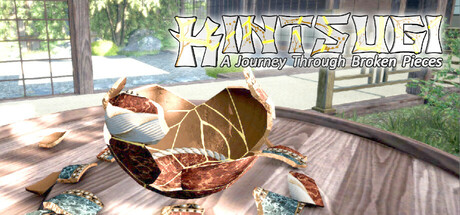
KINTSUGI is a 3D puzzle game inspired by the ancient Japanese art of repairing ceramics, which transforms cracks into decorative features, highlighting their beauty with gold.
Modeled estimate, not a reported figure. How we estimate →
Media

About
KINTSUGI is a 3D puzzle game inspired by the medieval Japanese art of repairing ceramics, which turns cracks into decorative elements, highlighting their beauty with gold.
The goal is to assemble broken vessels from fragments, like 3D puzzles. This process not only restores the integrity of objects but also reflects the philosophy of Kintsugi, which considers imperfection, impermanence, and traces of the past as sources of beauty and value.
This philosophy suggests that a completed project is a symbol of rebirth – a repaired object gains a new uniqueness and story it did not have before. It encourages reflection on one’s life experiences, showing that difficulties and changes, instead of weakening us, can become the foundation of our growth. It reveals that beauty can be found even in something that has undergone a difficult transformation.
In the game, there are 4 (for now) randomly selected locations where the table for assembling pots (and more) is placed.
The game offers 5 difficulty levels:

Pieces that don’t fit with the currently assembled ones disappear, eliminating any “guesswork” about which piece fits and which doesn’t yet.
Additionally, assembly is very easy as even slight connections between pieces will be detected, and the piece will snap into place. There’s no need to aim precisely; being close is enough.
In this mode, pieces are not rotated.
Pieces disappear only in this mode.
The game moves the assembly location to random spots on the level.
For now, there are 4 (the demo has only 1).

Here, pieces no longer disappear, and “weak” connections won’t work anymore. Pieces must have solid connections to stick together.
Pieces are not rotated.

In this mode, pieces are now randomly rotated, but only on 2 of the 3 axes. Additionally, their rotation is in 45-degree increments, so it’s not too hard to find the correct position.
A piece will only attach to the rest if it’s correctly oriented.

From now on, pieces will rotate smoothly, so precision is required.
How precise? Pieces still rotate on 2 of the 3 axes, but a 10-degree difference is enough for them to fit with the assembled ones.
I’m terrible at this game, so the example image is a bit imperfect ;)

This is the same as NORMAL+ mode, except that instead of 10 degrees, the precision is now 5 degrees.
You need to align the pieces more accurately.
Warning! This mode may give the impression that the game “cheats” or that pieces “really don’t fit.” It doesn’t cheat, and “it just works” TM ;)

In this final mode, pieces rotate on all axes, making it extremely demanding and patience-draining. Here, the precision is still 5 degrees (I didn’t dare make it less), and assembly sets “quality” requirements higher than one might expect.
Really, only play this mode if you “know” that easy times are behind you ;)
You need to align the pieces more carefully. And slowly.
Warning! This mode may convince you that the previous one was fair. This one is too.
Let me repeat—“it just works” TM :)
Why isn’t there a “HARD” mode?
Because real Kintsugi art is hard.
It requires patience, precision, time, thoughtfulness, composure, and the ability to find beauty in broken porcelain.
That’s why :)
This game has 3 separate profiles, each allowing independent game progress saves.
POINTS FROM THE DEMO CARRY OVER TO THE FULL GAME.
Each pot has its “price” and the number of points you can earn by completing it.
The price is GRAY if the cost of the pot is higher than the points available.
The price is RED if you have enough points to purchase it.
What’s GREEN are the reward points for completing it.
Short on points?
Assemble a pot again, but using a harder method—you won’t run out of points then :)
Stats
All-time low is the lowest price we've recorded for this game since we started tracking it.
Languages: English, French, Italian, German, Spanish - Spain, Traditional Chinese, Simplified Chinese, Japanese, Korean, Polish, Russian
Reviews
Kupiłem tę grę w keyshopie za 3,5 zł (a jeszcze musiał zarobić reseller) tylko po to aby wystawić negatywną opinię. Polacy "nie chcą" kupować twojej gry? "Nie chcą" bo jest absurdalnie droga względem tego co oferuje. Za 20 zł to ja mam w promocji tytuł AAA z czasem gry na poziomie 40-100-500 godzin a nie indyka z powtarzalnością każdego poziomu na 1-2-5 godzin. A potem jeszcze zaczynasz bredzić że my się nie znamy że to wina Valve i ich przelicznika walut. Owszem częściowo to wina przelicznika ale każdy wydawca / producent gry może ustawić indywidualną cenę dla każdego kraju. Innym zarzucasz lenistwo a samemu ci się nie chce zmienić ceny abyśmy nie płacili najwięcej na świecie.
[h2]難度次第で大いに化ける立体パズルゲーム[/h2] 最初に難度を選び、壺を購入し、目の前でバラバラにされて、それを立体的にくっつけるゲーム。 くっつきの判定は(超難度ではない限り)自動で吸い付いてくれるので結構心地よい。 また壺が木っ端微塵になることはないので、壊れ方やピースの形で逆算するということもできる。 ただし全体的に操作に慣れるまで結構時間かかるし、壺の形次第では柄が見えないままやることもあるし、 場合によっては持った瞬間に引っ付いてしまう場面もあるため、 操作性が良いとはお世辞でも言えない。 それでも壺が徐々に完成したり、ピースの柄から逆算してハマったり、 壊れた壺の内側と外側が判らず四苦八苦するのは想像以上に楽しい。 これら完了した時に桜吹雪くのも風情ある演出だ。 またヒーリング系のBGMと環境音が心地よいので、是非心を落ち着かせながら作業して頂きたい。 ただし、くれぐれも考え無しに最高難度を選んではいけないが、 最高峰に頭を捻らせたいのであれば一考してみるのもアリ。 最後に謎の通貨システムがあるが、壺の初期購入がマイナス値、完成報酬がプラス値であり、 超簡単難度だけをやってると、2~3時間プレイ(または8個目ぐらい)まで資金が尽きる。 尽きたら過去の奴を繰り返せば良いだけなので焦らず。 また風情のある壺や、古風な壺以外にも、面白壺や皿や完全ネタ枠もあるので、 是非壺を眺めつつ、自分の難度に相応しい設定を選び、金継ぎ作業を楽しんで頂きたい。
At first glance, this is a deceptively simple game centered around restoring shattered ceramic pieces. Its presentation is minimal yet calming: your view is fixed to a table in the center of a traditional Japanese house, but you can rotate the camera to take in peaceful surroundings like distant mountains, swaying trees, and a serene Zen garden. Interestingly, each new object restoration begins in a different area of the house. Gameplay revolves around picking up broken ceramic fragments and reassembling them. The experience changes significantly depending on the difficulty level you choose. With six difficulty settings, the easier modes assist you by snapping pieces into place and rotating them correctly once you're close to the solution. On the other hand, higher difficulties strip away these aids and demand full manual control and high precision. There are 29 ceramic objects to restore, mostly bowls and pots. While all are technically available from the start, you'll need to unlock them by spending in-game currency. This currency is earned by completing restorations—less on easy mode and increasingly more on higher difficulties, with the hardest potentially yielding enough to unlock multiple objects in one go. This encourages players to take on tougher challenges, as playing solely on easy may require significant repetition to afford all content. The game doesn't offer much beyond the core experience. There are no achievements, unlockables, or progression incentives beyond the collection of objects. That said, it’s a game clearly focused on peaceful, meditative problem-solving, and it delivers on that front. You can make the experience as relaxed or as demanding as you like.
Pomysł na grę ciekawy, zawsze imponuje mi gdy ktoś w pojedynkę tworzy grę. Czuć że autor ma zajawkę na japońskie wyroby ceramiczne. Cieszę się że udało się przekonać polskiego twórcę gry do dostosowania polskiej ceny na steam. Dzięki!
It's a very calm and relaxing game. Nice to pull up and enjoy for a few minutes when I want a break. Getting the pieces aimed where you want them can be a little finicky sometimes but you get a feel for it the more you play. The new rotation hint glow really helps as well Has 27 different objects in the game at the time of this review and they are pretty replayable, especially with how different the difficulty levels feel.
I enjoy chill cozy games and this qualifies for the most part. The thing that was frustrating and made me stop playing after a little over an hour is the lack of explanation for controls and mechanics. "New game" means select a new vase. I thought it meant new game. What do the + and - above the pictures mean?? I can't choose and new vase why?? The controls to manipulate the pieces could also use a bit more explanation as well. I understand there is a single developer and this is a work in progress. The puzzle part of this game is awesome and I have a great deal of hope for the game as the developer makes some improvements to the explain the controls.
Unapologetically tranquil and satisfying. Kintsugi is not just a game of puzzles, it's an invitation to take a seat in a cozy courtyard to ease your troubled mind and restore your soul. I'd like to see a display of pots assembed so far:D + works on Ubuntu
조작감너무구려요; 어떻게하라는거야
自分の環境だけかもしれませんが、日本語フォントが文字化けしているのか■■■■といった具合に文字が全部四角形になってしまい読めません。せめて言語切り替えができればいいのですが、メニュー項目もすべて■■■■で言語切り替えが可能かどうかも不明だったため返品しました。
物にも魂ってえのが、宿ってンだよね…
Related
Related
Trends
Concurrent players on Steam, sampled daily since tracking started.
Related
| Nonozle | $664.9 | 64 | 97% | $0.79 |
| Hyper Simon X | $663.8 | 67 | 72% | $0.49 |
| 69 Hitomi Love | $662.8 | 53 | 83% | $0.99 |
| TouHou Music Recording | $662.8 | 53 | 89% | $0.99 |
| Derange | $668.6 | 67 | 67% | $0.79 |
| Hollow Steps | $668.9 | 90 | 62% | $0.49 |