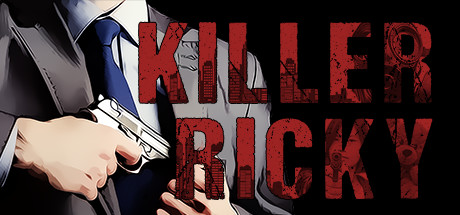
Play as Killer Ricky and avenge his family by killing all members of a bloodthirsty Mafia organization.
Modeled estimate, not a reported figure. How we estimate →
Media

About
Genres
Stats
All-time low is the lowest price we've recorded for this game since we started tracking it.
Languages: English**languages with full audio support
Engagement
Reviews
11 minutes is all I can muster up, the shooting mechanics are ridiculous and the time wasting when you die is irritating. gonna refund.
Heavy Sigh
Greetings, I really want to help with the development, and I can help with the translation into Russian, please contact me.
Related
Related
Trends
Modeled estimate over time, reconstructed from Steam's monthly review histogram.
Hours played at review time, across 25 reviews with recorded playtime.
键盘操作很需要优化,期待成为John Wick模拟器
Killer Ricky, developed by QS and published by Koya Game, is a top-down shooter that tries to stand out in a crowded genre by introducing a genuinely unconventional control system and a focus on precision-driven combat. At first glance, it presents a familiar revenge story—one man taking on a criminal underworld after a personal tragedy—but the narrative quickly fades into the background, serving more as a thematic excuse for relentless firefights than as a deeply explored storyline. The real emphasis is on how the game plays, and in that regard, it makes some bold and unusual choices. The most defining feature of Killer Ricky is its dual-arm control mechanic. Instead of the standard twin-stick shooter approach, the game allows players to independently control each of the protagonist’s arms, enabling them to aim and fire in completely different directions at the same time. This adds a layer of complexity that immediately sets it apart from more conventional shooters. At first, the system can feel awkward and unintuitive, especially for players used to simpler control schemes. However, with practice, it opens up a level of precision and flexibility that allows for creative combat scenarios, particularly when dealing with enemies approaching from multiple angles. Combat itself is fast and often intense, with a strong emphasis on positioning and situational awareness. The game introduces a dynamic slow-motion effect that triggers when incoming bullets pose an immediate threat, giving players a brief window to react and dodge. This mechanic adds a cinematic quality to encounters, turning what could be chaotic firefights into moments of controlled tension. It also reinforces the game’s focus on skill, as survival depends on quick reactions and accurate decision-making rather than brute force. While this system works well in short bursts, it doesn’t always maintain its impact over longer sessions, as encounters can begin to feel repetitive. Environmental interaction plays a noticeable role in shaping the experience. Levels are filled with destructible objects that react to gunfire, adding a sense of physicality to combat. Debris, shattered glass, and dynamic blood effects contribute to a gritty, stylized atmosphere that fits the game’s tone. These details help make each firefight feel more impactful, even if the overall visual design remains relatively simple. The environments themselves, however, lack variety, and the repeated use of similar layouts can make progression feel somewhat monotonous. Enemy behavior attempts to add depth, with AI that can respond to noise, reposition, and attack from different directions. In some encounters, this creates moments of tension where players must stay alert and adapt quickly. However, the system is not always consistent, and once patterns become familiar, enemies can feel predictable. This reduces the sense of challenge over time, as players learn to anticipate and counter threats without needing to adjust their approach significantly. One of the biggest issues with Killer Ricky is its limited content. Released in Early Access, the game offers only a small portion of what was originally intended, with a handful of levels that can be completed relatively quickly. The lack of additional content or meaningful updates makes the experience feel incomplete, as though it never fully realized its potential. While the core mechanics show promise, there simply isn’t enough variety or progression to sustain long-term engagement. Visually, the game adopts a retro-inspired top-down style that prioritizes clarity over detail. This works well for gameplay, as it ensures that enemies and projectiles are easy to track, but it also results in a somewhat generic presentation. The art style lacks a strong identity, and while the effects during combat are satisfying, they are not enough to carry the overall visual experience. Sound design follows a similar pattern, with functional audio that supports the action without leaving a lasting impression. In the end, Killer Ricky feels like a game built around a strong central idea that never fully develops beyond its initial concept. The dual-arm shooting system is genuinely interesting and offers a level of control rarely seen in the genre, but it is held back by a lack of content, inconsistent execution, and limited progression. There are moments where the game feels inventive and engaging, but they are too few to overcome its shortcomings. Rating: 6/10
Momentum
Pace estimated from the game's recent review growth (our daily snapshots) at its own sales-per-review ratio — a momentum signal, not booked sales.
Audience
Estimated from the language of this game's reviews — a proxy for where players are, not official Steam demographics.
Related
| Ecchi Cards | $1.3K | 84 | 54% | $0.49 |
| Eternal Man: Mountain | $1.3K | 63 | 71% | $0.99 |
| The Rebel | $1.3K | 56 | 41% | $0.99 |
| A Lozenge | $1.3K | 50 | 98% | $1.99 |
| Blastboard | $1.3K | 50 | 96% | $1.99 |
| BISQUE DOLL | $1.3K | 50 | 82% | $1.99 |