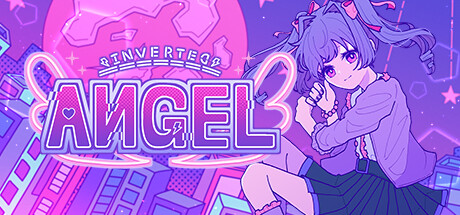
Inverted Angel, developed and published by SCIKA, is a uniquely experimental visual novel that blends psychological mystery, surreal tension, and a creative approach to player interaction. Released in July 2024, it positions itself as a “Kawaii Future Mystery,” a term that encapsulates its tonal duality: visually cute and emotionally disarming on the surface, yet deeply unsettling and ambiguous underneath. At its heart, the game tells the story of a mysterious girl who appears at the protagonist’s apartment, claiming to be his girlfriend—despite the fact that he has no memory of her. What unfolds is a slow unraveling of truth, identity, memory, and trust, as the player must deduce what is real and what is illusion, all while interacting with a narrative structure that actively resists simplicity.
What immediately sets Inverted Angel apart from most visual novels is its interaction system. Instead of relying on the typical binary or multiple-choice options, the game uses a free-text input mechanic. At key moments in the story, the player is prompted to type responses in natural Japanese, which the game then interprets using an AI-driven similarity model. This isn’t generative AI, but rather an inference system that compares the player’s input to a set of expected narrative responses. If the input aligns closely enough with what the game “expects,” the story progresses along different branches. This mechanic encourages players to think more deeply about their words, to roleplay their deductions or emotional responses, and to test the game’s ability to understand nuance. It can feel liberating at times—like having a conversation with the game rather than simply pressing buttons—but it also brings its own set of challenges.
The narrative structure complements the input system beautifully. Inverted Angel doesn’t hold your hand or offer easy answers. Much of the mystery is built through implication, body language, and subtle cues rather than overt exposition. The protagonist is as unreliable as the visitor who claims to know him, and the game leverages this to create a persistent sense of unease. The girl seems sweet, but off—there’s something uncanny about her familiarity, something slightly too rehearsed in her affection. The player’s own apartment, initially a place of comfort, becomes alien as details shift, conversations loop strangely, and messages from friends hint at timelines that may not match. The atmosphere builds like a dream you can’t quite wake from, enhanced by soft, pastel visuals and an ambient score that blurs the line between relaxing and disquieting.
Despite its relatively short playtime, Inverted Angel encourages multiple playthroughs. There are numerous narrative branches and endings, some dramatically different in tone, from tragic to hopeful to completely opaque. Unlocking all of them requires both experimentation and a willingness to test how the input system interprets different lines of thought. One ending might hinge on a moment of empathy, another on clinical logic, and others on more abstract reasoning. Players who enjoy piecing together lore and reverse-engineering narrative systems will find much to engage with here. At the same time, the open-endedness of the input system can be a double-edged sword. It’s not always clear what the game is looking for in your responses, and it can occasionally reject answers that feel perfectly reasonable. This can lead to minor frustration, especially for players trying to reach a specific outcome or struggling with the nuances of Japanese phrasing.
The biggest barrier for most players, however, is the language itself. As of now, Inverted Angel is only available in Japanese, and the input system also expects responses in Japanese text. This makes the game difficult to access for non-Japanese speakers, and while an English localization has been discussed, it has not yet materialized. That said, players have reported success using external tools or community guides to work around the language issue, though it naturally limits the accessibility of a game so deeply rooted in subtle wordplay and dialogue nuance. Those fluent in Japanese or with an intermediate reading ability will get the most out of the experience, as so much of the game’s emotional and narrative impact comes from tone and implication rather than overt explanation.
Still, Inverted Angel has garnered a strong reputation among players who have taken the plunge. Its Steam reviews are overwhelmingly positive, with many praising the game’s atmosphere, writing, and bold storytelling approach. It’s a rare example of a game that feels both personal and experimental, where the boundaries between game, story, and conversation blur. Developer SCIKA has shown an impressive level of care in crafting a narrative that challenges the player not just to think, but to reflect, and perhaps even project a bit of themselves into the mystery. The game’s updates—ranging from bug fixes to UI improvements—indicate a developer who is responsive and invested in improving the overall experience.
Inverted Angel is not for everyone. It demands patience, curiosity, and a willingness to operate within its unique limitations. It’s light on action and heavy on ambiguity. But for those who enjoy slow-burning psychological stories, games that reward introspection, and systems that allow creative expression within a structured mystery, it offers something quietly remarkable. It’s the kind of game that lingers after you’ve finished, not because of a shocking twist or bombastic climax, but because it makes you question what you saw, what you missed, and what you believed along the way. In a genre full of predictable formulas, Inverted Angel takes real risks, and while it doesn’t always land perfectly, it’s more than worth the effort for those willing to engage with its eerie, delicate world.
Rating: 9/10