
Imperial Ambitions
Discover and colonize the world, Allocate your labor force, Monopolize markets, Fight tactical battles, Survive the age of imperialism...
Estimated lifetime revenueMedium confidence
$84.4Kgross
$38Klow → high range$185.6K
Net to developer$56.1K
Modeled estimate, not a reported figure. How we estimate →
Est. copies sold
4.4K
mid estimate
About
About the game
Imperial Ambitions is a 4X strategy game where the players will take over one of the European superpowers that existed during the Age of Discovery and Renaissance and lead them to imperialism.
 Discover and colonize the world,
  Allocate your labor force,
  Monopolize markets,
 Fight tactical battles,
  Maintain order,
  Survive the age of imperialism.
link units together
Tactical Wars With Completely New Mechanics
Imperial Ambitions has a completely new strategy game design providing a unique 4X gameplay experience. Anyone who enjoys the Napoleonic wars will find the tactical thinking required for Imperial Ambitions to be much more rewarding. As you forge an empire, the battlefields will become more challenging. We've redesigned the way that armies move on a campaign map, so they act more like real-world military units. Large armies can move in column formation, making it harder to move and requires more tactical thinking to prepare for the battle. The regiments can be split from the main army for small tactical excursions, or sneak into enemy lines for crossfire. For the same reason, attention is required to avoid leaving gaps on your frontline.
units keep firing until end of turn
Social Classes
The society in the game is divided into classes, slaves, peasants, apprentices, artisans and masters. Besides slaves, the citizens will be allowed to progress through four tiers of classes, with each step providing increased capabilities, but also requiring different resources from you. The education is the key for most of your citizens to climb this social ladder. Higher classes will provide more labor, but will also require unique luxury resources. The citizens may stop working for several reasons, such as training, hunger, epidemic, criminal activities or rebellion. While higher classes are often preferable, they are also harder to maintain due to requirement of luxury. The units and agents are also required to be trained from respective classes. For that reason, the players need to find the optimal balance between these classes.
names are culture-dependent but skin tones are random, because it is!
Trait System
Imperial Ambitions features a dynamic Trait System where people, soldiers, agents, and populations are shaped by their experiences, culture, religion, wealth, health, and living conditions. Traits can affect behavior, loyalty, action points, migration, combat performance, and even whether units obey orders. A starving army, a persecuted population, or a bloodlusted soldier may not behave the way you expect, making every empire feel unstable, human, and morally complicated. Traits can also influence one another, turning Imperial Ambitions into a social simulation where every empire feels unstable, human, and morally complicated.


A food shortage can create hunger; hunger lowers efficiency, increases unrest, and can escalate into starvation.
Starving people are less reliable as workers, soldiers, or loyal subjects.
Hungry soldiers will start the game with decreased action points


Malnutrition can make disease more dangerous, turning a supply problem into a health crisis.
Plague is not only a health problem; it can destroy labor, spread fear, create refugees, and destabilize towns


Trade can lift people out of poverty, stabilize towns, and turn struggling settlements into prosperous centers.
Too much inequality can create a different crisis: greed, crime, resentment, vandalism, and unrest.


Not meeting demands of your people can make them tense, a lot tense!.. like me without my coffee! so, thank you!
Rich citizens can tolerate shortages better resisting protests, but they can also become targets when society starts to break. Distributing gold can buy temporary stability, but the long-term social consequences still depend on the town.


Protests usually grow from accumulated pressure, not a single event.
Protests can escalate into riots; riots can damage order, reduce labor, and destroy property and even people!
Hungry, sick, discriminated, or traumatized people are more likely to resist authority.
Military control can calm riots, but harsh repression can leave trauma and hatred behind.


Depending on the location, units and agents can be affected by the elements if remain in that situation for long. For example, sailing long periods of time leads to seasickness.


Wealth gap can create bandits, who spread fear, increase poverty, and makes the town target of smugglings operations.
Generals can convict bandits, integrating them back to society.
Convicted criminals can be forced into labor by entrepreneurs, solving one problem while creating moral and social consequences.


Differences between people cause discrimination. More differences cause stronger response.
Discrimination can push people into poverty and even violence.
Fearful minorities can choose to migrate.
Discriminated folk are less likely to resist enemy invasion.
Linguists can reduce cultural friction and help diverse towns hold together.
Zealots can turn belief into social pressure, and social pressure into violence.


Religion can unify communities, but conversion and religious division can also harden resistance.
Refugees carry more than population: they can bring trauma, poverty, faith, culture, and memory into new towns.
Unique Agents
 In Imperial Ambitions, much of your power is exercised through agents: individuals who move across the map, intervene in towns, command armies, open trade routes, spread faith, suppress unrest, sabotage enemies, and reshape society. There are 7 agent types: Merchant, Builder, Explorer, Shadowmaster, General and Gentleman. They are tools of administration, commerce, faith, violence, diplomacy, science, and subversion. The same crisis can often be solved in several ways: with gold, religion, repression, negotiation, migration, trade, crime, or reform.
Explorers can reveal the world, discover resources, negotiate peace, and even soften cultural divisions.
Generals can rally armies, improve marching and siege operations, impose harsh or lenient rules in occupied towns, but most importantly can be used as tools for chaos through plundering, slave raids and even massacres.
Builders can open new infrastructure paths, construct roads, farms, mines, plantations, forts.
Merchants can start trade routes, stabilize towns with gold, hire indentured settlers for new settlements and use economic influence to rescue struggling settlements.
Priests can convert populations, investigate or suppress religious threats, heal the sick, spread seeds, create pilgrims, and perform inquisitions. (also Pastors, Presbyters and imams)
Gentlemen can become patrons, professors, diplomats, linguists, physicians, plague doctors, herbalists, or antiquarians, making them a strong leaders of their time.
Shadowmasters can build criminal networks, raid by land or sea, sabotage towns, provoke unrest, manipulate populations, spread disease, and turn social instability into a weapon.
Production Chains
Your Empire will grow beyond the mountains and the seas. As it grows you will have access to more and endemic resources. The more you invest into your roads and docks, the more resources that produced around the corners of your empire will be transported into your capital. With abundance in your capital, you can allocate your laborers to produce to higher quality goods. Imperial Ambitions has more than 40 different resources that can be extracted, produced or imported. Your population will demand products depending on their level of education. You must manage your resources and customize your production chains, while ensuring the wellbeing of your population. Some key resources may just not be accessible to you. You can resolve either by trading with superpowers, replantation endemic plants, military invasion, or exploiting the black market.

There is an auto-allocator if you don't want to micromanage!
Black Market And Trade
For merchants and economic strategists, trade is a powerful way to enrich your empire. In Imperial Ambitions, every town except capitals has specific needs. Meeting those needs can earn you valuable gold.
Merchants must physically visit towns, make deals, and connect them through trade routes. A profitable route depends on choosing the right towns, arranging them in the right order, and maximizing revenue. Through these same routes, players can also purchase resources needed by their own empire.
However, trade is only possible if local rulers are not boycotting you. When diplomacy fails, smuggling offers another path. If a town has outlaws, it can become open to smugglers. Your Shadow Master can establish smuggling routes to buy resources for the right price, even from hostile territory. You do not need good relations with the owner of the town, and you do not need to pay taxes.
But smuggling has consequences. Corruption and criminal activity will spread along the route. To encourage corruption, players can send a Shadow Master to establish a crime syndicate. To fight smuggling, Inquisitors and Governors can convict outlaws and shut down illegal routes.
Upgrades
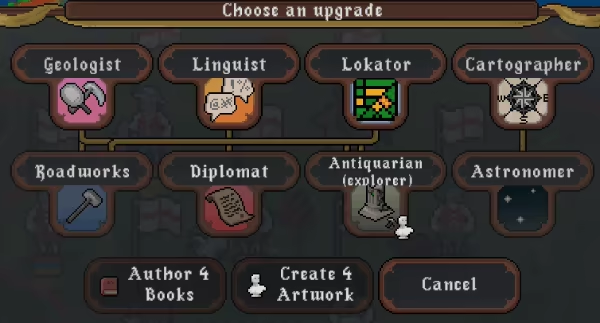
A merchant may begin as a simple trader, then grow into a banker, entrepreneur, or trade counselor who can reshape the economy of entire towns. A general can become better at command, occupation, discipline, or mass management, turning military force into a tool of order, fear, or recovery. Priests may specialize in conversion, healing, pilgrimage, or religious control, while diplomats and linguists can soften cultural divisions that would otherwise lead to unrest.
Upgrades are not just stronger versions of the same unit. They open new ways to solve problems. A struggling town might need a merchant to stimulate trade, a governor to capture criminals, a priest to calm religious tension, a linguist to reduce discrimination, or a general to restore order by force. The same crisis can be approached through wealth, faith, diplomacy, repression, migration, or social reform.
Undisclosed Tech Tree
 In Imperial Ambitions, the full technology tree is hidden from the player. You only see the technologies currently available to research, reflecting the uncertainty and unpredictability of historical innovation.
When agents are upgraded, they may author books or create artworks. These become intellectual resources that can be invested into unlocking new units, buildings, and production processes.
Somethings need a ledger
Diplomacy
Diplomacy in Imperial Ambitions is driven by a grudge system. Aggressive actions by rival powers increase tension, while distance and time can reduce it. When a grudge becomes too great, war may be declared automatically.
Peace is harder to achieve. When tensions fall below a certain level, your Diplomat can negotiate peace near enemy units. Negotiations may take time, and gold can sometimes make the process easier. It takes years to build bridges, but only seconds to destroy them.
Pixel Art Design
 We chose a pixelated art style for the game since it’s a fun and approachable way to communicate controversial events of our recent history such as post-colonial subversion. We also wanted a retro aesthetic design to assist players in imagining this alternate universe, mixing pop culture with classic cartoon representations of imperialism.