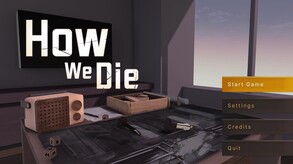
How We Die is a compact but inventive deck-building roguelite developed by Doublsb Soft and published by PsychoFlux Entertainment, built around a clever fusion of card strategy, dice manipulation, and board-game-style progression. What immediately sets it apart is its unusual premise: during a tabletop RPG session, a group of players accidentally summon a real alien invasion, and when they wake up, they find themselves thrown into a world where their casual game has become a genuine fight for survival. This self-aware, tongue-in-cheek narrative foundation gives the game personality without overwhelming it with heavy storytelling. Instead, the premise acts as flavor—an amusing justification for its mixture of dice, cards, maps, and combat encounters—while the core of the experience remains grounded in strategic decision-making and run-based progression.
The gameplay is structured around short, repeatable runs where you travel across compact maps filled with branching choices, enemy encounters, shops, upgrades, and special events. Each space on the map can alter your strategy in subtle or dramatic ways, and the pathing decisions you make influence not just what battles you’ll face, but what tools and modifiers you’ll have access to. At the center of this system lie the dice. Rather than serving simply as randomizers, they function as a primary resource: their faces can be upgraded, replaced, or fine-tuned to adjust your odds. This creates a satisfying meta-layer of strategy, as you’re not only constructing a deck of cards but actively reshaping the probability curve that determines your actions. It becomes a game about controlling chaos—building tools that reduce randomness while still embracing the unpredictability that drives the tension of each run.
Combat encounters balance accessibility with tactical depth. Cards represent attacks, defenses, utilities, and special effects, and each requires dice rolls to activate. Better dice faces increase reliability; poorly tuned dice turn even strong cards into risky gambles. This interplay gives every card a dynamic quality, influenced as much by your build decisions as by moment-to-moment luck. Enemies escalate in complexity as the run progresses, introducing pressure that forces meaningful choices about which modifiers to prioritize and when to push forward versus when to retreat or conserve resources. The core loop succeeds because it is simple to grasp but rich enough to sustain multiple runs. It rewards careful planning, but it never allows the player to fully eliminate uncertainty—an intentional design choice that reinforces the game’s theme of accidental catastrophe.
Visually, How We Die is modest but coherent. Its interface is clean, emphasizing clarity over spectacle, and the aesthetics lean toward functional minimalism. Cards, dice faces, icons, and map nodes are all easy to read, making the flow of information smooth even in tense situations. The alien-infested world is represented through stylized maps and event illustrations that reinforce the game’s mood without distracting from the mechanics. While not visually ambitious, the presentation is thoughtfully designed to support the gameplay systems, making it easy for players to focus on strategic choices rather than deciphering cluttered screens.
The game’s biggest limitation comes from its small scale. The pool of cards, dice upgrades, modifiers, and events is serviceable but not extensive, which means that after a number of runs, patterns begin to repeat. The novelty of tuning dice faces and experimenting with card synergies holds strong for the first several hours, but the lack of a broader content variety may leave some players wanting more. The progression system is also familiar to genre veterans: repeated failure is expected, and the path to completing a full run often involves gradually unlocking permanent upgrades. While this structure is typical of roguelites, it also means players must be willing to embrace repetition and grinding. Those seeking expansive narrative arcs or large branching storylines may find the narrative framing too light and the gameplay progression too linear.
Despite its limitations, How We Die succeeds in delivering a thoughtful and intriguing twist on the deck-building formula. Its dice modification system adds a refreshing layer of control over randomness, and its board-game-inspired structure makes every run feel like a self-contained challenge with tense decision points. The humor and light narrative framing give it personality without slowing the pace, and the strategic interplay between cards and dice is engaging enough to keep players returning for “just one more run.” It might not offer the sprawling variety of larger roguelites, but it compensates with focused design, clever mechanics, and an identity that feels distinct within the genre.
As an indie offering, How We Die provides a satisfying strategic experience for players who enjoy probability manipulation, incremental progression, and run-based experimentation. It may not become a long-term obsession for everyone, but for those who appreciate deck builders with a twist and value clever mechanics over flashy production, it is a thoughtful and rewarding experience well worth exploring.
Rating: 7/10