Hover Hazard is a stripped-down arcade survival game that focuses almost entirely on reflexes, spatial awareness, and the escalating pressure of staying alive in increasingly hostile arenas. Developed by David Mulder and published by SA Industry, it doesn’t attempt to build a narrative or layered progression system. Instead, it commits fully to a classic arcade philosophy: simple rules, immediate challenge, and a constant push to improve your performance through repetition and mastery.
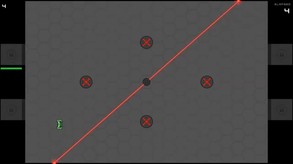
The core experience revolves around piloting a small hovering craft within confined spaces filled with hazards that grow more dangerous over time. At first, the environment feels manageable, with only a handful of threats to avoid, but the intensity ramps up quickly as new dangers are introduced and existing ones become more aggressive. The game relies on a steady escalation curve, where survival becomes less about reacting to individual obstacles and more about managing multiple threats simultaneously. This creates a satisfying tension, as players must constantly adapt to a battlefield that grows increasingly chaotic with each passing moment.
Mechanically, the game is intentionally minimal. Movement is smooth and responsive, which is crucial given how much precision is required to navigate tight spaces and avoid incoming hazards. There are no complicated inputs or layered systems to learn—everything comes down to positioning and timing. This simplicity makes the game easy to pick up, but it also means that long-term engagement depends heavily on how much you enjoy refining your skills within a fixed framework. Once the core mechanics are understood, the challenge shifts from learning how to play to learning how to play better.
One of the more notable aspects of Hover Hazard is how differently it feels when played alone versus with others. In single-player mode, the experience is focused and almost meditative, with each run serving as a test of endurance and concentration. However, the limited variety in hazards and environments can make solo sessions feel repetitive over time. In contrast, multiplayer introduces a layer of unpredictability that significantly enhances the experience. Competing or cooperating with other players in the same space adds tension, chaos, and a sense of spontaneity that the solo mode lacks, making it the more compelling way to engage with the game.
Visually, the game adopts a clean and functional style that prioritizes readability above all else. The arenas are designed to make hazards immediately recognizable, ensuring that players can react quickly without confusion. While this approach supports the gameplay effectively, it comes at the expense of visual personality. The environments and effects are serviceable but not particularly memorable, and the overall presentation leans toward utility rather than artistic expression. The audio design follows a similar pattern, offering basic sound cues that reinforce gameplay without standing out.
Content is where the game shows its limitations most clearly. There are few modes, minimal progression systems, and little in the way of unlockables or long-term goals. The primary motivation comes from improving your own performance—lasting longer, achieving higher scores, or outperforming others in multiplayer sessions. This arcade-style design works well in short bursts, but it doesn’t provide the kind of evolving experience that keeps players engaged over extended periods.
Despite these limitations, Hover Hazard succeeds in delivering a focused and consistent gameplay loop. It understands what it wants to be and executes that vision without unnecessary distractions. The challenge is fair, the controls are reliable, and the core mechanics are solid enough to support repeated play, especially for those who enjoy skill-based arcade experiences.
In the end, Hover Hazard is best viewed as a quick, accessible game designed for short sessions rather than long-term investment. It shines brightest when played with others, where its chaotic nature becomes a source of fun rather than repetition. While it lacks depth and variety, it offers a straightforward and satisfying test of reflexes for players willing to embrace its simplicity.
Rating: 6/10