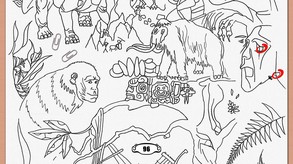
The strange cups are hidden on the paper. A difficult adventure for the eyes.
Modeled estimate, not a reported figure. How we estimate →
Media

About
Genres
Stats
All-time low is the lowest price we've recorded for this game since we started tracking it.
Languages: English
Engagement
Reviews
Themes across 41 recent reviews and how positive each mention is. A keyword signal, not full sentiment analysis.
Reviews
another terrible one
a good casual game. can recommend it. the price of this game is in offer for -40% good.
Esse foi estranhamente mais desafiador que os outros ksksksk
Related
Related
Trends
Modeled estimate over time, reconstructed from Steam's monthly review histogram.
Hours played at review time, across 41 reviews with recorded playtime.
positive critical· bar length = how often the theme comes up
Absolutely terrible.
Not a fan of games that don't have settings for basic stuff like music volume. it's worse than forcing full screen.
mehhh diğerlerine göre kötü benzemiyor bazı şekiller.
These were cups my ass.
The Dark Souls of "100 hidden [insert noun]". So much for evolutionary pattern regcognition. Like others have stated, this entry stands out as a more difficult, less fun version. I wouldn't reccomend it as your first game into the series.
100 hidden cups is a deliberately minimalist hidden-object experience developed by Anatoliy Loginovskikh and Igor Shalimov, and published by Anatoliy Loginovskikh. It strips the genre down to its most fundamental interaction—careful observation and clicking—presented within a single, densely packed, hand-drawn black-and-white illustration. Rather than offering multiple scenes, narrative framing, or guided progression, the game challenges players to locate exactly one hundred cups hidden throughout a surreal, sketch-like environment. This focused design immediately signals that the experience is meant to test patience and visual perception rather than provide traditional variety or spectacle. The core gameplay loop is as pure as it gets. Players are given one static image and asked to search it exhaustively for cup shapes, each subtly blended into the surrounding artwork. There are no hints, timers, or difficulty settings to ease the process, and no tutorial beyond the implicit instruction to start looking. This lack of hand-holding places the burden entirely on the player’s ability to recognize patterns and silhouettes, often requiring a shift in perception as the definition of what constitutes a “cup” becomes increasingly abstract. Some cups resemble conventional drinkware, while others are stylized, distorted, or cleverly disguised as parts of the background, forcing players to question assumptions and scrutinize every line of the drawing. The hand-drawn visual style plays a central role in shaping both the challenge and the tone. The monochrome illustration is busy and intentionally ambiguous, filled with overlapping forms, whimsical figures, and surreal elements that blur the boundary between object and decoration. Without color or depth cues, the eye must work harder to separate foreground from background, turning the act of searching into a slow, methodical process. For players who enjoy visual puzzles and eye-training exercises, this can feel oddly meditative, rewarding long stretches of focused attention. For others, the same aesthetic can become tiring or frustrating, especially as the remaining cups become increasingly obscure toward the end. Progression in 100 hidden cups is defined almost entirely by completion. Each cup found counts as a discrete achievement, making the game’s one hundred Steam achievements synonymous with its primary objective. This structure appeals strongly to completionists, as every correct click delivers immediate confirmation and tangible progress toward full completion. However, beyond this checklist, there are no secondary systems, unlockables, or escalating mechanics to diversify the experience. Once all cups are found, the game offers no additional content or replay incentive, reinforcing its identity as a one-off visual challenge rather than a repeatable puzzle game. The absence of audio, narrative, or interactive feedback beyond successful clicks further emphasizes the game’s stark simplicity. There is no music to guide mood or relieve tension, and no story context to justify the scene or the objects hidden within it. This silence can enhance concentration for some players, allowing them to fully immerse themselves in the act of searching, while others may perceive it as a lack of atmosphere or personality. The experience feels closer to a digital puzzle page than a conventional video game, intentionally blurring the line between interactive art and casual challenge. Player reception reflects this polarizing design philosophy. Those who appreciate minimalist experiments, hidden-object challenges, or inexpensive completion-focused titles often praise the game for delivering exactly what it promises with no unnecessary padding. Others criticize the ambiguity of the object designs, the potential for eye strain, and the absence of guidance, arguing that difficulty sometimes stems more from interpretation than from fair visual concealment. These contrasting responses highlight that enjoyment depends heavily on expectations; approaching the game as a compact visual test yields a very different reaction than expecting a traditional hidden-object adventure. In terms of length, the experience is brief but dense. Many players can complete the entire search in under an hour, while others may spend significantly longer hunting down the final few elusive cups. This variability speaks to the subjective nature of perception and persistence, two qualities the game actively challenges. The low time commitment and straightforward objective make it suitable as a quick diversion, yet its final stretch can feel disproportionately demanding, often prompting players to consult guides or community discussions for assistance. Ultimately, 100 hidden cups stands as a niche but purposeful entry in the hidden-object genre. It offers no story, no evolving mechanics, and no visual indulgence, instead committing fully to a single idea and executing it with uncompromising focus. For players who enjoy visual scavenger hunts, abstract illustration, and achievement-driven challenges, it provides a concise and mentally engaging puzzle. Those seeking variety, narrative depth, or a more forgiving approach may find it too austere, but within its narrow scope, the game delivers a clear, unapologetic test of observation and patience. Rating: 5/10
no
Momentum
Pace estimated from the game's recent review growth (our daily snapshots) at its own sales-per-review ratio — a momentum signal, not booked sales.
Audience
Estimated from the language of this game's reviews — a proxy for where players are, not official Steam demographics.
Related
| OR | $5.4K | 191 | 40% | $1.99 |
| ISOLAND: The Amusement Park | $5.4K | 98 | 90% | $2.99 |
| BORIS RUSSIAN BEAR | $5.4K | 437 | 86% | $0.49 |
| 育种村 | $5.4K | 87 | 71% | $4.99 |
| IHF Handball Challenge 12 | $5.4K | 83 | 63% | $2.99 |
| NAIR | $5.4K | 79 | 94% | $2.99 |
Related
| Human Fall Flat | $109.3M | 225.6K | 95% | $19.99 |
| Euro Truck Simulator 2 | $75.9M | 746.6K | 97% | $4.99 |
| Slime Rancher | $73.8M | 155.4K | 98% | $19.99 |
| DAVE THE DIVER | $66.9M | 158.7K | 97% | $19.99 |
| The Scroll of Taiwu : Beyond The Dome | $62.2M | 69.6K | 66% | $29.99 |
| House Flipper | $58.4M | 91.9K | 94% | $24.99 |