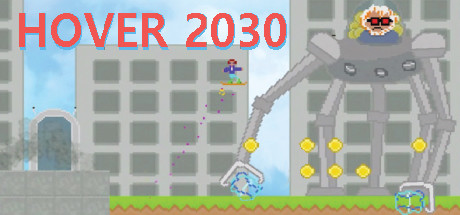
Hover 2030, developed and published by Russpuppy, is a minimalist 2D platformer that leans heavily on retro design principles while introducing a small twist through its hoverboard-based movement. It presents itself as a straightforward, challenge-driven experience where success depends less on exploration or narrative and more on precision, repetition, and learning through failure. The game’s scope is modest, but within that scope it delivers a focused, if somewhat uneven, platforming experience.
The premise places players in a distant future where humanity has been wiped out, leaving behind a lone survivor equipped with a hoverboard and a cloning system. This setup serves primarily as a gameplay justification rather than a fully developed story, framing each failure as part of an ongoing cycle of attempts rather than a setback. The narrative remains largely in the background, with only minimal context provided, allowing the game to concentrate almost entirely on its mechanics and level design.
Gameplay revolves around navigating side-scrolling levels filled with hazards, enemies, and collectible objectives that must be gathered before reaching the exit. The hoverboard mechanic introduces a subtle but important variation to traditional platforming. Instead of relying purely on jumping, players can glide and control their descent with more fluidity, creating a sense of momentum that differentiates it from standard platformers. This mechanic becomes the foundation of the game’s challenge, requiring players to carefully manage movement and timing, especially in tighter or more hazardous sections.
As the game progresses, levels become increasingly demanding, emphasizing precision and pattern recognition. The cloning system removes the penalty of limited lives, encouraging players to experiment and retry sections without restriction. However, this design also highlights the game’s reliance on repetition, as progress often comes from memorizing layouts and refining execution rather than discovering new mechanics. For players who enjoy mastering difficult sequences, this can be satisfying, but for others, it may feel repetitive or unforgiving.
Visually, Hover 2030 adopts a simple pixel-art style for characters combined with clean, minimal environments. While this approach ensures clarity and readability, it also results in a somewhat uniform appearance across levels. There is little variation in visual themes, which can make the experience feel repetitive over time. The aesthetic is functional rather than expressive, serving the gameplay without adding much in the way of atmosphere or identity.
The audio design follows a similar pattern, providing basic background music and sound effects that support the gameplay without standing out. While the sound design is consistent, it lacks variety, and extended play sessions can make its repetition more noticeable. Like the visuals, it fulfills its role but does not significantly enhance the overall experience.
One of the more notable aspects of the game is its pacing. Levels are relatively short, allowing for quick retries and a steady rhythm of attempts. This structure makes it well-suited for brief play sessions, as players can make incremental progress without committing to long stretches of gameplay. However, the limited variety in mechanics and level design means that this pacing does not always translate into long-term engagement.
The game’s limitations become more apparent as it progresses. The core mechanics remain largely unchanged, and there are few new ideas introduced to expand the experience. While the increasing difficulty provides some sense of progression, it does not fundamentally alter how the game is played. This can lead to a sense of stagnation, where the challenge increases but the gameplay itself does not evolve in meaningful ways.
Despite these shortcomings, Hover 2030 has a certain charm rooted in its simplicity. It does not attempt to be more than it is, offering a straightforward platforming experience that focuses on skill and persistence. For players who appreciate retro-inspired challenges and are willing to engage with its trial-and-error structure, it can provide moments of satisfaction as they overcome difficult sections.
In the end, Hover 2030 stands as a small, focused indie project that delivers a competent but limited take on the platforming genre. It offers a clear gameplay loop and a unique movement mechanic, but its lack of variety and refinement prevents it from leaving a stronger impression. It is best suited for players looking for a short, skill-based challenge rather than a deeply varied or polished experience.
Rating: 6/10