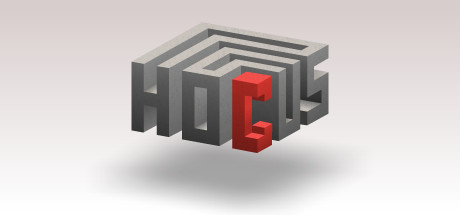
*hocus*, created by Yunus Ayyildiz and Sho Ohhira and published by Yunus Ayyildiz, is a quietly captivating puzzle game that builds its entire experience around perception rather than complexity. It doesn’t rely on elaborate mechanics, narrative hooks, or visual spectacle to draw players in. Instead, it offers a stripped-down, almost meditative environment where the challenge comes from rethinking how space itself works. The result is a game that feels both intellectually stimulating and strangely calming, a rare combination that defines its appeal from the very first level.
The central mechanic is elegantly simple: guide a cube along pathways that twist and intersect in ways that defy normal spatial logic. What initially appears impossible gradually becomes understandable as players learn to reinterpret the environment. Platforms that seem disconnected suddenly align when viewed from the right angle, and routes that look blocked reveal hidden continuity through perspective. The brilliance of the design lies in how it encourages players to stop thinking in conventional terms and instead embrace a more fluid understanding of geometry. Solutions often arrive not through trial-and-error brute force, but through a quiet moment of realization when everything clicks into place.
Progression in *hocus* is handled with a steady and thoughtful pace. Early puzzles introduce the concept in its simplest form, allowing players to build confidence and familiarity without feeling overwhelmed. As the game unfolds, new variations and increasingly intricate layouts are introduced, layering complexity without ever abandoning the core idea. This gradual escalation keeps the experience engaging, even as the fundamental mechanic remains unchanged. The absence of explicit tutorials reinforces a sense of discovery, making each solved puzzle feel like a personal achievement rather than a guided exercise.
The visual presentation plays a crucial role in supporting the gameplay. Clean, minimalist design ensures that nothing distracts from the puzzle itself, with soft color palettes and simple geometric forms creating an environment that is easy to read and pleasant to look at. There’s an intentional absence of clutter, which not only improves clarity but also contributes to the game’s relaxing tone. Paired with a subtle, ambient soundtrack, the overall atmosphere feels almost meditative, encouraging players to slow down and engage thoughtfully with each challenge.
One of the game’s strengths lies in its accessibility. The controls are intuitive, and the rules are consistent, making it easy for players of all experience levels to pick up and understand. At the same time, the puzzles themselves can become quite demanding, offering a satisfying level of challenge for those willing to invest the mental effort. The inclusion of a level editor and the ability to share custom creations adds another layer of depth, extending the experience beyond the built-in levels and giving players the opportunity to explore new ideas within the same framework.
However, the game’s commitment to a single core concept can also be its limiting factor. Because everything revolves around perspective-based puzzles, there is little variation in gameplay beyond increasingly complex arrangements. For players who thrive on diversity and evolving mechanics, this focus may begin to feel repetitive over time. The lack of narrative or additional systems means that long-term engagement depends almost entirely on how much the player enjoys the central idea.
Even with this limitation, *hocus* stands out as a refined and thoughtful example of minimalist game design. It demonstrates how a single well-executed concept can carry an entire experience, provided it is presented with clarity and care. The game doesn’t try to overwhelm or impress with scale; instead, it invites players into a quiet space where observation and insight are the keys to progress.
In the end, *hocus* succeeds by trusting its players to think differently. It offers a focused, introspective puzzle experience that rewards patience and creativity, delivering moments of genuine satisfaction through simple yet clever design. For those who appreciate games that challenge perception rather than reflexes, it provides a consistently engaging journey that lingers in the mind long after the puzzles are solved.
Rating: 8/10