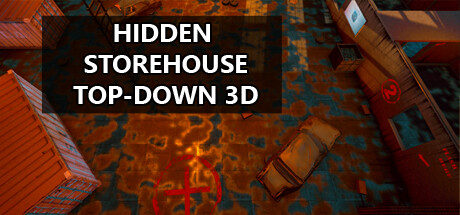
Hidden Storehouse Top-Down 3D is a very minimalistic entry in the hidden object genre that prioritizes simplicity and immediacy over depth, narrative, or mechanical variety. Developed by Top-Down Games and published by Hede, the game follows a formula that will be instantly familiar to anyone who has played similar titles from the same publisher. It presents a single, static 3D environment viewed from a top-down perspective and asks the player to locate a predefined number of hidden items scattered throughout the scene. There is no story context or framing device to guide the experience; the game exists purely as a visual scavenger hunt.
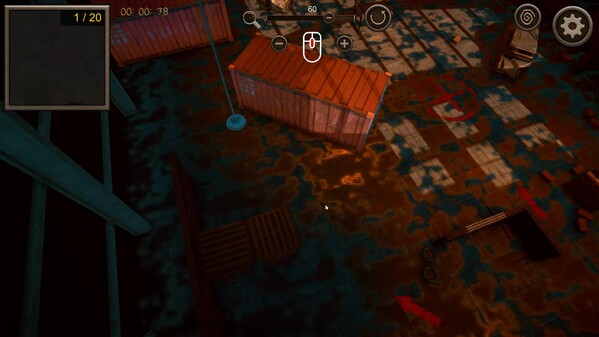
The core gameplay loop is as straightforward as it gets. Players are shown a target object and must visually scan the storehouse environment to locate it. Once found and clicked, the game immediately assigns the next item. This continues until all required objects have been discovered, at which point the session ends. There are no timers, penalties, hints, or difficulty modifiers, making the experience entirely dependent on the player’s patience and observational skills. Because the scene remains static throughout, the challenge comes solely from distinguishing target objects from the surrounding clutter rather than from evolving mechanics or interactive puzzles.
Visually, Hidden Storehouse Top-Down 3D adopts a barebones 3D presentation. The environment resembles a frozen diorama filled with shelves, crates, props, and decorative elements meant to obscure the hidden items. However, the models and textures are simple, and there is little sense of atmosphere or artistry beyond functional placement. There are no animations or environmental changes, which can make the scene feel lifeless and purely utilitarian. While the top-down 3D perspective does allow for overlapping objects and depth-based concealment, it rarely feels used in a way that meaningfully enhances the puzzle beyond basic visual clutter.
The game’s pacing is entirely self-directed. A single playthrough can be completed quickly, often in just a few minutes, depending on how easily the objects are spotted. Because the list of items can change between sessions, there is some degree of replayability, but the unchanged environment limits how fresh repeated attempts can feel. Once players become familiar with the layout of the storehouse, subsequent runs tend to rely more on memory than on observation, which reduces the sense of challenge over time.
One of the most notable aspects of Hidden Storehouse Top-Down 3D is how closely it adheres to a template seen across multiple similar releases by the same developer and publisher. This gives the impression of a standardized product line rather than a bespoke puzzle experience. While this consistency may appeal to players who already enjoy these ultra-casual hidden object games, it also invites criticism for its lack of innovation, originality, or expansion upon the formula. There are no additional modes, scoring systems, progression mechanics, or narrative hooks to add long-term engagement.
Overall, Hidden Storehouse Top-Down 3D is best described as a very lightweight hidden object game designed for brief, low-effort play sessions. Its strength lies in its accessibility—anyone can understand how to play within seconds—but that same simplicity also defines its limitations. Players looking for rich environments, clever puzzle design, or meaningful progression will likely find the experience shallow and repetitive. For those who enjoy extremely casual visual searches and are content with a stripped-down approach, it delivers exactly what it promises, but little more.
Rating: 5/10