Hexcells Plus, developed and published by Matthew Brown, is a logic puzzle game that refines a deceptively simple idea into something remarkably precise and satisfying. It builds on the foundation of the original Hexcells by expanding its puzzle design and introducing more intricate logical relationships, yet it never loses sight of what makes the experience compelling: clarity, fairness, and the quiet pleasure of deduction. It is a game that does not rely on spectacle or variety, but instead earns its impact through careful design and consistency.
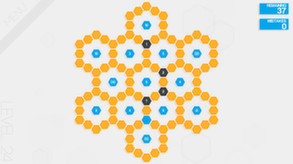
The gameplay revolves around a hexagonal grid where players must determine which cells should be filled and which should remain empty, guided by numerical clues. While the concept shares similarities with classic logic puzzles, the hex-based layout introduces subtle but important differences that reshape how information is interpreted. Clues apply not only to adjacent tiles but also to lines and patterns across the grid, requiring players to think in broader, more interconnected ways. As puzzles grow more complex, they begin to layer these rules together, demanding a level of attention and reasoning that feels both challenging and fair.
One of the defining qualities of Hexcells Plus is its commitment to pure logic. Every puzzle is constructed so that it can be solved without guessing, which creates a strong sense of trust between the player and the game. When progress stalls, it is not because the puzzle is unclear, but because the solution has not yet been fully understood. This design philosophy encourages players to slow down, reassess the information available, and find the next logical step. The satisfaction comes not from trial and error, but from the moment when a pattern clicks into place and the solution becomes clear.
The pacing supports this approach by removing any sense of urgency. There are no time constraints, no penalties for taking longer to solve a puzzle, and no external pressures that might disrupt the flow of thought. This creates an experience that feels calm and focused, allowing players to engage with each puzzle at their own pace. The gradual increase in difficulty is handled with care, introducing new concepts in a way that feels natural rather than overwhelming. Each new layer of complexity builds on what came before, reinforcing understanding while expanding the range of possible solutions.
Visually, the game embraces a minimalist style that prioritizes readability. The clean interface and distinct color palette make it easy to interpret information at a glance, which is essential for a game built around observation and deduction. The presentation is understated but effective, avoiding unnecessary detail that might distract from the puzzles themselves. The subtle audio design complements this, providing gentle feedback that enhances the experience without drawing attention away from the task at hand.
Despite its strengths, the game’s focused design also defines its limitations. It offers little in the way of variety beyond its core mechanic, and once the puzzles have been completed, there is limited reason to revisit them. The solutions are fixed, and the satisfaction of discovery cannot be replicated once the answers are known. Additionally, the absence of narrative or alternative modes means that the experience is entirely centered on its puzzles, which may not appeal to players seeking a broader or more varied gameplay experience.
However, these limitations are also a reflection of the game’s intent. Hexcells Plus does not attempt to be anything other than a carefully crafted logic puzzle experience, and it excels within that scope. Its strength lies in how well it executes its core idea, delivering puzzles that feel thoughtful, fair, and consistently engaging. For players who appreciate this type of design, the lack of additional features is unlikely to detract from the overall experience.
Ultimately, Hexcells Plus stands as a refined example of minimalist game design, demonstrating how a single concept can be elevated through careful iteration and attention to detail. It offers a series of challenges that reward patience, observation, and logical thinking, creating an experience that is both intellectually stimulating and quietly relaxing.
In the end, Hexcells Plus is a standout puzzle game that prioritizes quality over quantity, delivering a focused and deeply satisfying experience for those who enjoy pure logic challenges. It may not offer long-term replayability, but its carefully designed puzzles ensure that the time spent with it is consistently rewarding.
Rating: 9/10