
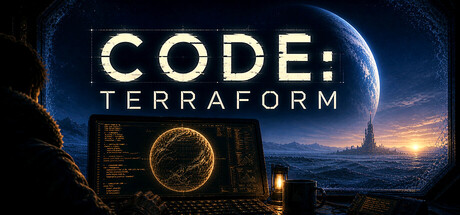
A deep automation and programming game on a frozen alien planet. Write real code to drive rovers, run power grids, fabricate parts, and fly drone fleets across the world. Your scripts run while you plan your next move. The more you terraform, the more the planet responds.
Modeled estimate, not a reported figure. How we estimate →
Charts
Each storefront's own chart, in its own country — the closest public signal to sales where none is published. A country missing from a list is one we don't collect there, not one where the game doesn't chart.
No United States chart position — it charts only in the markets below.
Same day: best UK #67, worst DE #88 · 3 markets collected
About
FREE DEMO IS AVAILABLE: Download and play the game now.
You've been sent to a frozen alien world. Your ship is silent. Sensors offline.
The only way to bring this place to life is to write code.
Code: Terraform is an automation/programming game where every action happens through scripts you write. Not visual programming. Not drag and drop. Real code, in a language modeled after Python, with a full editor, console, and documentation built into the game.
You don't click to mine. You write the mining script. You don't manage a power grid by hand. You script the policy that runs it. Solar trackers follow the sun because your code reads the clock. Drone fleets fly because your code dispatches them. The more systems you script, the more the planet responds.
Bring your base online one script at a time. Calibrate sensors. Activate solar power. Read raw instrument data and turn it into meaning. Every system is a component you interact with through code.
Your solar tracker follows the sun. Your rover surveys distant sites and drills the ones worth mining. Your smelter refines what comes back. They all run at the same time, your code working while you plan your next move.
Earth sends contracts. Data processing challenges with real rewards. Parse signals, filter datasets, compute solutions. The harder the contract, the bigger the payout.
Earn credits. Buy machines. Deploy modular rovers and Pioneers, swap nav and sonar and drill modules to suit the job. Smelt ore into ingots. Fabricate parts: pipe segments, machine frames, circuit panels, turbine rotors, cargo pods, thruster assemblies, battery packs. Ship orders to Earth's contractors for credits, recipe unlocks, and tech upgrades. Scale from a single solar panel to a planet spanning industry.
Drill water from underground reserves. Tap oil wells. Cap geothermal vents for steam. Pipe each medium across the planet, balance backpressure, and feed tier three machines that demand continuous flow to run at full output. Bridge crossing pipes with overpasses. Wire power subnets with line segments. The infrastructure layer is tile by tile, and yours to design.
Mark I machines bring you to a thin atmosphere. Mark II push you to breathable air. Mark III demand fluid input but unlock the climb to terraformed. Earn upgrade packs through orders, apply them to deployed machines, watch your output curve bend.
Plan pipes, power lines, and outposts in a tile based blueprint editor. Send a Pioneer with a Constructor module to execute the plan. Lay infrastructure piece by piece, exact tile by exact tile, the same way a real engineering crew would.
Assemble drones from chassis, thrusters, and modular pods. Plant outposts in the richest territory and operate them remotely. Write flight scripts that haul ore home, ferry supplies out, recover stranded fleets. Charging stations and refueling pads keep the fleet airborne. Recovery bays airlift the ones that don't make it back. Distance becomes a function of battery and fuel, not track. Share a route once as a library script and every drone uses it.
Full code editor with syntax highlighting, autocomplete, signature help, type aware completions, rename refactoring, and inline docs that jump on Cmd+click. Multiple scripts running concurrently. Library scripts for shared code: import a function once, use it everywhere. Breakpoints, log points, conditional breakpoints, three step modes for real debugging. Dock the editor to code and watch the results side by side.
Sensor readings that don't match. Warm patches where nothing should be warm. Structures that weren't there yesterday. Mission control asking questions they shouldn't need to ask. The more you terraform, the more the planet responds. Not to your equipment. To you.
No cutscenes. No cinematics. Every story beat arrives through the systems you already use. Briefings, sensor data, encrypted transmissions, contract anomalies. The truth unfolds while you work. Pay attention to the details.
There are docs and hints. No tutorials. Figure it out, like a real engineer would.
Genres
Stats
All-time low is the lowest price we've recorded for this game since we started tracking it.
Languages: English**languages with full audio support
Add-ons
Each DLC is estimated with the same model as a game, then summed — a modeled figure, not reported DLC sales.
Engagement
Reviews
Themes across 201 recent reviews and how positive each mention is. A keyword signal, not full sentiment analysis.
Reviews
Demo looked promising. Bought the game. Then I ran into this: > This is a proximity scanner, discrete sectors, just around base. For wider planetary exploration (coordinates, distant mining sites), that's the rover with its sonar module. Two different tools, two different scales. That's screamingly Claude. Sorry, if you didn't think this game was worth writing, I don't see why I should think it's worth playing. (I see that there are a number of complaints about AI-generated art and music. I don't approve much of those either. But the *fundamental core* of this game is writing programs to script various thingies, and if that's all Claudeslop then there isn't anything here at all.)
This game fails on many aspects: design, simulation, and lore. Let's start with design. In this game, you don't build features by writing code; instead, you solve unrelated, contrived puzzles, and the game unlocks features for you. It doesn't feel like overcoming difficulties to adapt; it feels like being asked to hop through hoops and then getting rewarded with a treat. It works in many game genres, but when the premise of the game is to build something through code, what you build should be the thing that delivers value. Imagine playing Besiege, but all it takes to beat levels is to make a given shape with your vehicle, and when it is done, a magical meteor comes crashing down on the structure you were meant to destroy. Not fun at all. Then, the simulation. It sounds like a beginner's idea of what programming is. For the language itself, early Python had a huge issue of not having any typing, and modern Python managed to solve that with a pretty robust typing system and tooling. This game throws that out of the window, in many ways. For instance, '4.0' will automatically be cast to an int, which would be a huge flaw in any serious setting, but my favorite will always be this other example: when a function's signature tells you that its return type is 'Transmitter' (for instance), but then the doc tells you that in some cases it returns None. When parts of the api looks like that, you just know that the rest is a complete circus. Then, there's that strong feeling that the designers never had to use programming frameworks for serious work. You will frequently encounter cases where you call a function, and this function will read the whole script and manipulate it to validate it. If you have the slightest rigor or experience, the simple thought should make you throw up. When the game wants to check the behavior of some code the player has written, it should do so by using a very basic control inversion pattern, for instance by asking the player to provide a function that solves the problem. Finally, the lore. The world-building is extremely clumsy. Dialogs are extremely cringe, and only serve to remind you of the game's pitch in the most vague language possible: mission givers do not know how to express their needs, so you are just left guessing, and often times the ui is what will let you guess your goal. Curiously, this part about the client not knowing what they want would be accurate if the main protagonist could follow up with precise questions that would enable him to understand the features he is supposed to deliver. But no, instead of that, all we have from the main protagonist are some 'snarky' (understand: lame as possible) comments. Friendly reminder to anyone writing dialog: a joke has a setup and a payoff. If you can only be bothered to write a payoff, then it won't land. Also, some built-in functions are literally named 'activate_sensors', 'activate_power ', and 'boot'; those are run on the base's main computer, which doesn't make any sense, and reveals that no thought at all went into imagining how the base as a whole could be functional in real life. In conclusion, the game is exactly what you think a vibe coding AI bro would commit: it losely resembles something, but completely fails to accurately portray it, and fails to give you any sense of accomplishment. Maybe because the AI can only do so much? Maybe because vibe coding bros don't know what accomplishment is, because they never had any? Maybe both? A detail is something that is supposed to be so good that the consumer does not consciously perceive it, not something that the producer can forget. We don't live by averages.
Media

Related
Related
Price dynamics, follower growth, revenue and sales trajectories with interactive tooltips
This and every other Pro feature is free until October 20, 2026. A free account is all it takes.
Hours played at review time, across 202 reviews with recorded playtime.
positive critical· bar length = how often the theme comes up
I really just did not like the amount of ai in this game. I like the concept, and I would definitely repurchase it if the ai was removed in future updates, but I just cannot stand the ai music, art, and voice acting.
The text is so loaded with LLM-isms it makes me want to tear out my eyes. I really don't care if there's 500+ pages of docs or whatever, if the dev can't be bothered to write it, I can't be bothered to read it. Note there's no mention of AI usage for any text (which happens to be a pretty large part of a puzzle coding game) in the "AI Generated Content Disclosure" section on the steam page either
AI slop. It is infinitely valuable to just spend a few hundred bucks on an artist to design a few things for your game.
As is, leans towards wouldn't recommend. That being said, it's early access and I can see this opinion going either way in the future. The UI is gorgeous and the puzzles easy to grasp, but the AI slop is undeniably present and has gotten worse since the demo. I don't mean the graphics. It's a programming game, AI sprites to illustrate is fine by me. But the functions and documentations have obviously been written by an AI, and this *hurts* because they all come with 3 lines of useful description followed by a litany of exceptions or edge cases that will probably never happen and will never need to be handled (with a half-smart design). After the first few hours of going through components handwritten, a very enjoyable ride, it becomes reminiscent of pre-internet era and dredging through C++ tomes to understand how the hell things are supposed to be used. Then there's the pacing. I just don't like it. It doesn't lean strongly enough on the simulation side to be immersive so it's just a massive wasting-my-time feeling. -- Rovers moving slowly, means every slight test or modification demands 30s of waiting around for the slightest change .Which might be fine ("get it right the first time") except it's mostly about testing your understanding of the documentation. -- Unlocks being time-gated is just silly. I can see an argument for puzzle unlocking harder ones, but time-gating? I want to play the game on my own time, if I finish a puzzle I expect the next one to present itself, if not have them all available from the get-go. I'm not letting the game idle for the sake of playing it later.
Linux users should avoid. It seemed like a solid game and I was extremely excited to play, but from what I can tell, the developer has removed the ability to play without a compatibility layer a couple days after launch. It also also designed in a way that does not let you easily use more modern versions of Proton. (Uses runtime 4.0) Audio does not work when using Linux even with the devs experimental builds that were put out to fix that. It seems there are also performance issues later on with Linux specifically. Seems like a solid game built with under an extremely poor(for this use case) Windows specific framework. It does also have all the AI issues you can read about in other negative reviews and is likely the cause for using the terrible use case framework I mentioned.
Shameful AI music is on by default - replace it with human made, then I'll be happy to play it.
Documentation screams of AI generated content and a lack of human review. Very disappointing as the concept is pretty fun and interesting. E.g. Opened the scanner python code for the first time and I see a warning about the scanner vs the rover with the sonar module that ends with "two different tools. two different scopes." This is hardly the only example of the kinda wording that screams AI. There is a few spots I noticed where the docs have complete disconnects and tell me things I don't need to know right now - writing code for the first oxygen generator, reading the info section, there is a whole section about how items move: but you don't move items in the code to make v1 of the oxygen generator work. And even below the little "how items move" graphic is a subtitle that mentions that fluids move differently with "the FluidAPI described above" - but there is no fluid API described above!!! The games AI disclosures on the steam page list voice acting, music, graphics and game capsules/main menu art as being AI generated - its bad enough to dodge paying artists for their work across those parts of this game, but lying by omission that the docs are AI generated really sucks. Uncool.
I know the AI use disclaimer has everybody's hackles up, and for good reason in a world innundated by slop, so let me break down how the AI has been used here and to what effect. This is the only example I know of in the gaming industry where AI content is used appropriately: to fill small and otherwise inconsequential details. The most notable AI contributions here is the voice acting, the music, and the menu layouts of the UI, all of which are accounted for in the disclaimer. Voice acting is rare in the game, functioning to fill in some of the lore aspects that are going on in the background on good ol' planet Earth. Again, pretty inconsequential to the gameplay on a whole. The menu layout definately is a pretty cut and dry default template. You won't find any glitzy UI here, but that's pretty typical for a game in the programming genre, where the spartan visuals contribute to the industrial software vibes. Using an AI to help organize and clean up an already minimalist style menu doesn't take away human content, since there was little there to begin with. A possible remedy for those who are particularly complainitive might be to add an unlockable feature where the user has the opportunity to code to customize the menu layouts (ex. coloiur schemes, font, maybe moving modules to custom categories). One of the most popular uses of coding today is to tailor UI to make it both functional and visually appealing, no? As for the music, it's definately a generic generated house mix. I'm not going to give points for the sound track here. Listen to it or not, it's your decision. The mute button can be found in the lower right corner, in case you're having trouble locating it. Now for the meat of the game: the coding aspects. No AI contribution here as far as I can see. The helpful manual in the DOCS too darn thorough and comprehensive to be written by an LLM. The optional coding puzzles are likewise too coherent to be designed by an AI slop generator. That takes a considerable amount of human effort, which ought to be recognized appropriately. In short, I recommend this game because of good quality content where it matters. TLDR; The heart of the game is all the coding and instruction aspects, which are human made and well made too. All AI generated content can be found in menu organization or else aeesthetic elements that are off to the side and do not affect gameplay. This game is the only example I know of that uses gen AI without using slop. Worth a buy.
Selling now
See how fast this game is selling right now — estimated copies and revenue per day from recent review growth.
Active players
Estimated daily and monthly active players (DAU/MAU) modeled from peak concurrency.
Players by region
Where this game's players are, estimated from review languages.
Players also reviewed
The games this title's players most often review too — audience affinity.
Related
| Game | Estimated lifetime revenue | Reviews | Review score | Price |
|---|---|---|---|---|
| $4.2M | 4.1K | 77% | $20.79 | |
| $1.6M | 1.6K | 87% | $29.99 | |
| $1.3M | 1.7K | 75% | $19.99 | |
| $346.2K | 666 | 84% | $10.49 | |
| $109.3K | 112 | 88% | $24.99 | |
| $95.5K | 232 | 69% | $12.99 |
Related
| Game | Estimated lifetime revenue | Reviews | Review score | Price |
|---|---|---|---|---|
| $169.5K | 1.3K | 92% | $4.99 | |
| $169.4K | 2.3K | 95% | $2.99 | |
| $169.5K | 979 | 91% | $9.99 | |
| $169.5K | 1.9K | 64% | $4.99 | |
| $169.4K | 330 | 77% | $19.99 | |
| $169.6K | 500 | 88% | $14.99 |