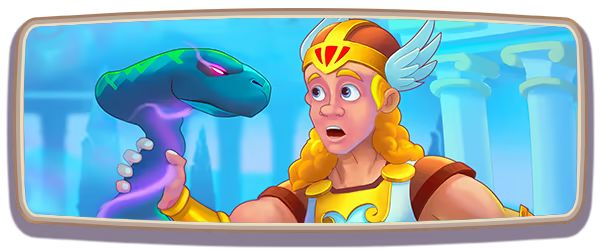
An ancient rivalry resurfaces. Megaera, a vengeful being with a dark past, found solace in her ominous lair, surrounded by suffering and horror. Fuelled by resentment and a thirst for power, she set her sights on Aphrodite, the embodiment of beauty.
Modeled estimate, not a reported figure. How we estimate →
Media

About


Stats
All-time low is the lowest price we've recorded for this game since we started tracking it.
Languages: English, German, Russian
Reviews
nee!
Ist ganz nett gemacht. Man macht hier einen Ausflug in die griechische Mythologie, baut Altare, bittet Götter und Helden um Hilfe und schickt Bösewichte zurück in den Hades. Es gibt in diesem Spiel ein paar Zusatzaufgaben, die man lösen kann oder auch nicht. Z.b. zusätzliche Holzkisten suchen, die irgendwo auf der Karte versteckt sind und einem ein paar zusätzliche Ressourcen schenken. Auch gibt es violett-schwarze Energiegebilde (juchu, und im echten Leben Kontaktlinsen die ultraviolettes Licht sichtbar machen) die spontan auftauchen und die man sammeln kann (sofern man sie bemerkt), um damit schon mal ein paar Hindernisse auf dem Weg zu beseitigen. Man füttert Katzen und beruhigt Hunde, spendet Opfergaben, setzt sich mit Aphrodite, Achilles usw. auseinander und baut nebenbei gewisse Gebäude, heilt Bewohner und vertreibt Geister und Diebe. Die Gebäude können abgerissen und neu gebaut werden - je nachdem, was man am meisten/schnellsten benötigt.
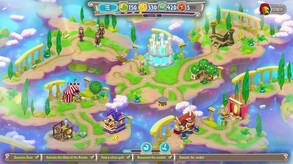
Hermes: The Fury of Megaera, developed by Game Mixer and published by Alawar Casual, is a structured time management strategy game that leans into Greek mythology to frame its familiar mechanics. The story follows Hermes as he sets out to reverse a catastrophe caused by the vengeful Megaera, who has turned Aphrodite to stone and thrown the world into disarray. While the narrative itself is simple and mostly serves as connective tissue between levels, it provides enough thematic flavor to give the game a sense of direction and identity without overshadowing the core gameplay. The foundation of the experience is built on classic time management principles. Each level places players in a contained environment where they must gather resources, clear obstacles, repair structures, and complete objectives within a limited timeframe. Workers are assigned tasks that consume both time and materials, turning every decision into a small strategic calculation. The mechanics are intuitive and easy to understand, making the game accessible from the outset, but efficiency quickly becomes the defining challenge. Planning the correct sequence of actions—deciding when to collect resources, when to build, and when to unlock new paths—is essential to success. As the game progresses, it gradually introduces new elements that expand the complexity of its systems. Additional resource types, more intricate production chains, and varied objectives begin to appear, requiring players to adapt their strategies. Environmental hazards and enemy encounters add further complications, forcing players to balance resource management with situational awareness. While these additions help maintain engagement, they build upon the same core loop rather than fundamentally changing it, ensuring that the experience remains consistent throughout. One of the strengths of the game lies in its pacing and difficulty scaling. Early levels are forgiving and serve as an introduction to the mechanics, allowing players to become comfortable with the systems before facing more demanding challenges. As the game advances, time limits become tighter and objectives more complex, particularly for those aiming to achieve the highest ratings. This creates a satisfying progression where players gradually refine their approach and improve their efficiency through repeated attempts. The inclusion of multiple difficulty settings further enhances accessibility, allowing players to choose between a more relaxed experience or a stricter, optimization-focused challenge. Visually, the game adopts a bright and stylized approach that complements its mythological setting. Environments are filled with recognizable elements such as temples, ruins, and natural landscapes, all rendered in a colorful, cartoon-like style. The emphasis on clarity ensures that resources and objectives are easy to identify, which is crucial during fast-paced moments. While the graphics are not particularly advanced, they are polished and cohesive, contributing to an overall presentation that feels consistent and approachable. The narrative is delivered through brief dialogue sequences between levels, providing context and introducing characters without interrupting the flow of gameplay. The tone remains light and accessible, with mythological elements used more for atmosphere than for deep storytelling. Hermes and other figures serve their roles effectively, but the story remains secondary to the gameplay, functioning primarily as a framework for the progression of levels. Despite its solid execution, the game does not significantly depart from the established formula of the genre. Players familiar with other time management titles, especially those from the same publisher, will recognize many of the mechanics and design patterns. While the gradual introduction of new features helps maintain interest, the repetition of similar tasks across numerous levels can become noticeable over time. This familiarity can be both a strength and a limitation, depending on the player’s expectations. Replayability is largely driven by the pursuit of efficiency. Players are encouraged to revisit levels to achieve better completion times or higher ratings, creating a loop of refinement and mastery. This can be rewarding for those who enjoy optimizing their strategies, but it may not appeal as strongly to players looking for new content or gameplay variations beyond the main campaign. The game offers a substantial amount of levels, but its longevity depends on the player’s willingness to engage with its repetitive structure. In the end, Hermes: The Fury of Megaera is a dependable and well-crafted time management game that delivers a consistent experience without attempting to innovate beyond its core formula. It combines accessible mechanics, steady progression, and a charming presentation into a cohesive package that works particularly well in short sessions. While it may not stand out for originality, it succeeds in refining a proven style of gameplay and providing an enjoyable experience for fans of the genre. Rating: 7/10
Related
Related
Trends
Modeled estimate over time, reconstructed from Steam's monthly review histogram.
Momentum
Pace estimated from the game's recent review growth (our daily snapshots) at its own sales-per-review ratio — a momentum signal, not booked sales.
Related
| Bubumbu | $1.8K | 117 | 97% | $0.49 |
| Floating Farmer - Logic Puzzle | $1.8K | 74 | 88% | $1.99 |
| Space Hotel | $1.8K | 58 | 38% | $1.99 |
| BuildMoreCubes | $1.7K | 143 | 72% | $0.49 |
| Zombie Solitaire 2 Chapter 2 | $1.8K | 74 | 88% | $1.07 |
| DOSMan: Space Aliens in Space! | $1.7K | 82 | 84% | $1.04 |