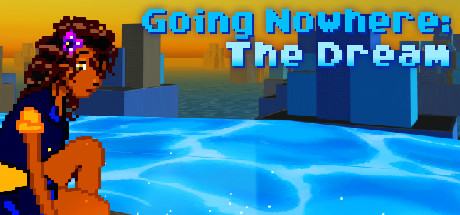
Going Nowhere: The Dream, developed and published by Nowhere Town, is a quietly ambitious indie experience that blends first-person parkour, abstract exploration, and dreamlike storytelling into a compact but emotionally resonant journey. Rather than guiding players through a conventional objective-driven structure, the game invites them to wander, experiment, and interpret its world on their own terms. From the outset, it establishes a mood of dislocation and introspection, presenting environments that feel familiar yet subtly wrong, as though reality itself has been bent by memory and longing.
You play as Loren, a young woman whose life is unsettled by the sudden reappearance of Violet, a friend who once disappeared under unclear circumstances. This simple narrative hook acts less as a traditional plot engine and more as an emotional anchor. The story unfolds indirectly through environmental cues, fragmented dialogue, and the logic of dreams rather than explicit exposition. Urban spaces transform into surreal playgrounds, where scale, gravity, and continuity are unreliable, mirroring the uncertainty of Loren’s internal state. The result is a narrative that feels intimate and personal, encouraging players to reflect on themes of loss, connection, and the blurred boundaries between memory and imagination.
Movement is the game’s central mechanic and primary source of engagement. Going Nowhere: The Dream emphasizes parkour-inspired traversal, asking players to navigate rooftops, ledges, and abstract structures using momentum, timing, and spatial awareness. There is no combat to distract from this focus; instead, progress depends entirely on understanding the physical language of the environment. Jumping gaps, finding unconventional routes, and chaining movement together becomes a form of problem-solving in itself. The controls favor deliberate motion over speed, making each successful traversal feel earned rather than automated.
Exploration is encouraged not just as a means of reaching the next objective, but as a philosophy that defines the experience. The game is filled with hidden paths, secret areas, and mechanics that are never directly explained. Players are rewarded for questioning assumptions, revisiting spaces from new angles, and even intentionally breaking the perceived boundaries of the world. Some of the most intriguing content—alternate outcomes, deeper narrative implications, and achievements—can only be found by pushing against the edges of the game’s logic. This approach gives the experience a sense of mystery that persists well beyond a straightforward playthrough.
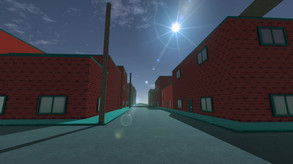
Visually, the game adopts a restrained 3D aesthetic that prioritizes atmosphere over technical polish. Environments often resemble stripped-down urban landscapes, but their arrangement and behavior feel dreamlike, as if assembled from half-remembered places. The first-person perspective enhances immersion, making movement and discovery feel immediate and personal. Rather than overwhelming the player with detail, the visuals leave room for interpretation, allowing the imagination to fill in emotional gaps. Subtle lighting changes and spatial distortions reinforce the sense that the world is governed by dream logic rather than physical law.
Sound design plays a similarly understated role. Music and ambient audio are used sparingly, often fading into the background or giving way to silence. This restraint amplifies the feeling of isolation and introspection, drawing attention to the act of movement and exploration itself. When sound does emerge, it tends to reinforce mood rather than direct action, supporting the game’s contemplative tone rather than dictating emotional responses.
The game’s brevity is both a strength and a limitation. A straightforward run can be completed relatively quickly, but the true depth of the experience lies in uncovering its secrets and interpreting its narrative layers. Players who treat it as a one-and-done adventure may find it slight, while those willing to experiment and explore thoroughly will uncover a more nuanced experience. Technical roughness and occasional control quirks are present, reflecting its indie origins, but they rarely overshadow the core design intent.
Ultimately, Going Nowhere: The Dream is a game that values curiosity over clarity and atmosphere over spectacle. It does not aim to entertain through constant action or explicit storytelling, instead trusting players to engage with its systems and themes at their own pace. For those who appreciate experimental indie titles, first-person exploration, and narratives that unfold through implication rather than instruction, it offers a distinctive and memorable journey. While it may not appeal to players seeking structure or polish, it succeeds as a thoughtful exploration of movement, memory, and the strange logic of dreams.
Rating: 6/10