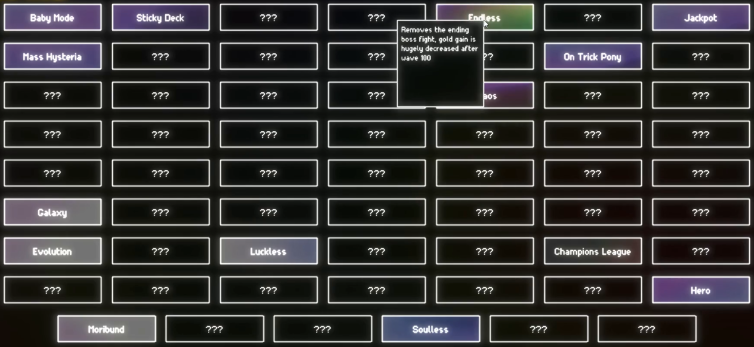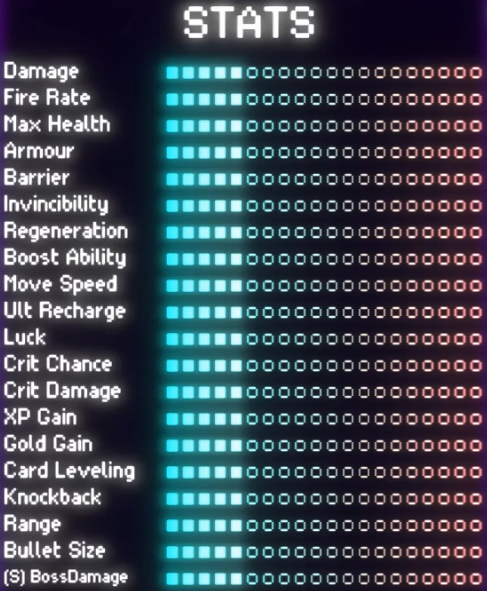
In this game, you are the bullet hell. Face off against 100 waves of enemies and bosses by collecting a deck of attack cards that activate in real-time to unleash destruction upon everything in sight. There's an insane amount of customizability leading to an infinitely replayable experience.
Modeled estimate, not a reported figure. How we estimate →
Media

About


Stats
All-time low is the lowest price we've recorded for this game since we started tracking it.
Languages: English
Engagement
Hours played at review time, across 40 reviews with recorded playtime.
Reviews
Themes across 40 recent reviews and how positive each mention is. A keyword signal, not full sentiment analysis.
positive critical· bar length = how often the theme comes up
Reviews
This game expects you to replay it a thousand times. But, I managed to complete the entire base campaign in one go, just over one hour, and... [i]There's no other draw. No real story, even though it tries to have bits of one.[/i] I don't see anything deeper waiting for me except more arcade bullet hell. If it didn't have the vestiges of a story, I would've accepted that, but I can't. The final boss waiting for you is... [i]jarring,[/i] to say the least, compared to the entire rest of the game, as it kinda ditches the core gameplay loop you spend the entire rest of the game honing in on. The core gameplay loop, though?- Pretty fun... Just, not my type of fun. If you want an arcade game with roguelike elements, then this is alright - and it [i]is[/i] worth its price. [i]Just understand it's kinda cheap, and that battlefield legibility will lower over time just due to base design choices.[/i]
great game
yeah its fun
g
really underrated game
Whoo boy, who is the target audience for this game? If you're heavy into hard bullet hell games and enjoy incremental games and roguelikes, the center of those three circles is who will really get this game. I'm not very skilled at bullet hell games, so this is confusingly frustrating for me. I think the wave requirements is probably my main complaint. If I was *just* bad at it, but could keep progressing, then I'd probably enjoy this a lot more, but you have to "git gud" to be able to unlock further cards and modifiers, and here's the stark cold reality: Some players will never be able to "git gud". I know that angers a lot of folks, but it's just true. As it is, I'm sitting on a ton of Gold that I can't spend, because I'm gated by the wave requirements.
Battle Of The Shades/10
very fun
Fabric of Reality is an energetic and ambitious indie roguelite that mixes bullet-hell chaos, deck-building experimentation, and wave-based survival into a single fast-paced experience. Developed and published by *Jester*, the game immediately sets itself apart with its premise: instead of merely navigating elaborate bullet patterns, you *create* them. Each run places you in a top-down arena where you must survive 100 escalating waves of enemies while building a loadout of attack cards and modifiers that shape the way you unleash destruction. That concept gives Fabric of Reality a strong identity from the outset, presenting itself as a hybrid of arcade intensity and strategic customization. At its core, the gameplay revolves around the constant dance between mobility and firepower. You steer a small ship or character around circular arenas, firing off patterns generated by the attack cards you collect. These cards form the backbone of your offensive capabilities, ranging from simple projectile shots to wide cones, spirals, bouncing bullets, knockback blasts, and more experimental patterns that can turn the screen into a kaleidoscope of color. As you progress, modifiers layer additional complexity—adding poison effects, increased size, piercing, ricochets, or multishot properties that transform even basic attacks into devastating combinations. The thrill of Fabric of Reality often comes from watching a run evolve from modest beginnings into a full sensory explosion as your build reaches maturity. The game’s replayability is anchored in its breadth of content. With a large pool of enemies, attack cards, characters, and modifiers, each run presents a different opportunity to experiment. The tech tree adds long-term structure, offering unlocks and perks that gradually expand the kinds of builds you can attempt. Even if individual waves sometimes follow familiar patterns, the constant randomness of card drops ensures that no two runs feel exactly the same. For those who enjoy discovering synergies, chasing rare cards, and refining builds through repeated attempts, the game delivers a satisfying cycle of failure, experimentation, and eventual triumph. Visually, Fabric of Reality leans heavily into the neon-saturated, particle-dense style common in modern bullet-hell titles, but amplifies it to a degree that can feel overwhelming. When the game hits its stride, the screen fills with swirling patterns, shimmering blasts, and dense projectile fields coming from both you and your enemies. This contributes to the frenetic energy that defines the game’s best moments, but it can also create readability issues. Amid the visual spectacle, it becomes challenging at times to distinguish enemy shots from your own dense barrages, making some deaths feel more like accidents than learning experiences. While that may be part of the intended chaotic charm, it also highlights the thin line between exhilarating challenge and sensory overload. The game’s controls and general feel show both strengths and limitations. Movement is quick and responsive, allowing players to weave through enemy attacks with satisfying agility. But certain actions—particularly leveling up, selecting cards mid-run, or interacting with menus—can feel slightly clunky. Controller support exists but isn’t always seamless, and some players may find mouse-and-keyboard navigation more intuitive. These small friction points don’t undermine the overall experience, but they do reinforce the impression of an ambitious indie project with occasional rough edges. Structurally, the game’s progression is straightforward: waves escalate, bosses appear at predictable intervals, and your success hinges on surviving long enough for your build to stabilize. While the variety of cards and modifiers adds depth, the arena itself remains largely unchanged throughout runs, and the core loop—dodge, shoot, collect, repeat—leans heavily on its early momentum. As a result, Fabric of Reality shines brightest in short, high-energy sessions. Extended play reveals a degree of repetition, especially once you’ve grown accustomed to enemy types and wave patterns. The game thrives on intensity rather than diversity, making it more appealing to players who enjoy arcadey challenge than those seeking evolving environments or narrative progression. Still, despite its limitations, Fabric of Reality’s identity as a chaotic roguelite experiment is compelling. It offers the immediate gratification of explosive combat, the addictive unpredictability of randomized builds, and the long-term draw of unlockable upgrades. The ability to craft outrageous projectile patterns gives it a creative edge, letting players lean into the role of architect of destruction. It may not achieve the precision of the most polished twin-stick shooters nor the depth of more complex deck builders, but it balances arcade fun with strategic tinkering in a way that feels both accessible and engaging. Ultimately, Fabric of Reality is a vibrant and chaotic bullet-hell roguelite that excels at delivering fast-paced action and creative build possibilities. It is best suited for players who enjoy experimentation, don’t mind sensory overload, and appreciate games that favor intensity over finesse. While its repetition, visual clutter, and occasional mechanical roughness hold it back from greatness, it remains a memorable indie experience that rewards curiosity, resilience, and a love of wild, screen-filling spectacle. Rating: 8/10
Amazing!
Related
Related
Trends
Modeled estimate over time, reconstructed from Steam's monthly review histogram.
Momentum
Pace estimated from the game's recent review growth (our daily snapshots) at its own sales-per-review ratio — a momentum signal, not booked sales.
Audience
Estimated from the language of this game's reviews — a proxy for where players are, not official Steam demographics.
Related
| Beach Invasion 1915-Gallipoli | $18.1K | 68 | 69% | $6.99 |
| Blackout Z: Slaughterhouse Edition | $18.1K | 1.9K | 83% | $0.49 |
| Arena Hero | $18.1K | 69 | 77% | $9.99 |
| Kunugi's Life is a Mess! | $18.1K | 64 | 88% | $10.99 |
| Fermi's Path | $18.1K | 53 | 68% | $8.99 |
| Automata Empire | $18.1K | 53 | 70% | $8.99 |
Related
| Garry's Mod | $228.7M | 1.3M | 97% | $9.99 |
| Human Fall Flat | $109.3M | 225.6K | 95% | $19.99 |
| DAVE THE DIVER | $67.1M | 158.8K | 97% | $19.99 |
| House Flipper | $65.8M | 110.8K | 94% | $24.99 |
| Slime Rancher | $65.5M | 137.8K | 98% | $19.99 |
| People Playground | $62.2M | 315.4K | 98% | $9.99 |