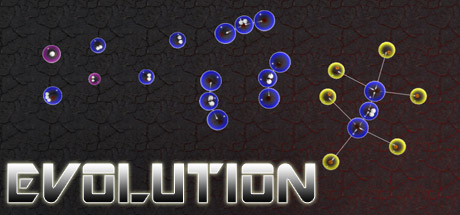
Evolution is a real time simulation of the evolutionary process. Creatures have DNA that defines their structure, traits, how they see the world around them, and how they react to it. Each creature is unique, most die quickly, some die a little slower, and others survive (some just like rocks, they usually die too).
Revenue comes from in-game items and microtransactions, which our price-based model doesn't estimate. Copies below reflect the player base, not paid sales.
Media

About
Genres
Stats
Languages: English
Engagement
Reviews
Themes across 40 recent reviews and how positive each mention is. A keyword signal, not full sentiment analysis.
Reviews
since its free to play I would say that its "OK" but on my first time playing I had no idea what to do so I logged out and watched a video about it and I got really exited so I logged back in and it wouldnt load so recomendation [watch a video on how to play it before playing it]
.
[h1] [/h1]
Related
Related
Trends
Concurrent players on Steam, sampled daily since tracking started.
Hours played at review time, across 40 reviews with recorded playtime.
positive critical· bar length = how often the theme comes up
Когда космический гость с Солнца посещает Землю, начинается локальный апокалипсис. В одном городе выживает лишь мальчик Пол. Его исследуют и обнаруживают слияние личности Пола и пришельца с раскаленной звезды. Чтобы спасти планету и людей, Пол принимает трудное, но единственно возможное решение…
the community for this games dead lets revive it
-
I found my username and others in an html page hidden on his site literally a dat file with my username and my username is very unique as in I am the only one with "borblezorb41" here is the html page http://www.grubbymonster.com/e3/players/
Cool science simulation. But... its not a game. Luckily I love simulations but if you don't then you'll probably hate this game as controlling a cell is like 2 minds in a single body.
Evolution is a free-to-play evolutionary simulation game developed by Alex Williams and published by Grubby Monster Games. Instead of focusing on combat, story-driven quests, or traditional strategy mechanics, the game places its attention on the fascinating process of natural selection. Players are given the opportunity to observe and influence living ecosystems where creatures evolve according to genetic rules, adapt to environmental challenges, and compete for survival. The result is a unique experience that feels closer to a scientific sandbox than a conventional video game, offering an intriguing look at how complex life can emerge from simple systems. The foundation of the game lies in its DNA-based simulation. Every creature within the world possesses genetic information that determines its appearance, behavior, senses, movement, and overall survivability. These creatures are not simply programmed to follow predetermined patterns. Instead, their actions are influenced by evolving traits that are passed down through generations. As species reproduce, mutate, and compete with one another, entirely new forms of life can emerge. This system creates a living world where unexpected developments become one of the most enjoyable aspects of the experience. What makes Evolution particularly interesting is the way it allows players to witness the consequences of environmental pressures. Food availability, competition, predation, and other survival factors constantly influence which creatures thrive and which disappear. Species that are successful in one situation may struggle when conditions change, forcing future generations to adapt or face extinction. Watching these evolutionary cycles unfold creates a surprisingly engaging gameplay loop because every ecosystem gradually develops its own story through the interactions of its inhabitants. Unlike many management simulations that require constant micromanagement, Evolution often encourages observation. Players influence conditions and monitor outcomes rather than directly controlling every creature. This design choice gives the game a distinctive identity. Much of the enjoyment comes from studying behavior patterns, identifying successful adaptations, and watching entire populations evolve over time. Players become more like researchers observing an experiment than traditional commanders issuing direct orders. The progression system revolves around strengthening species and helping them survive increasingly difficult challenges. As creatures evolve and ecosystems are conquered, new opportunities emerge for further experimentation. The game rewards players who carefully analyze environmental conditions and understand how different genetic traits interact with one another. Successful species can continue growing stronger, but survival is never guaranteed. New challenges frequently arise, forcing constant adaptation and preventing ecosystems from becoming completely stable. One of the most compelling features is the way creatures from different environments interact. The game introduces outside competition through species that have evolved elsewhere, ensuring that players are constantly exposed to new evolutionary strategies. This system adds variety and creates fresh obstacles that must be overcome. Dominant species can suddenly find themselves challenged by unfamiliar rivals with completely different adaptations, leading to interesting and often unpredictable outcomes. The visual presentation is functional and focused on communicating information clearly. Creature designs evolve alongside their genetic changes, allowing players to observe visible differences as species adapt over time. While the graphics are relatively simple, they serve the simulation well by making evolutionary developments easy to identify. The emphasis remains firmly on the underlying systems rather than visual spectacle, which feels appropriate given the game's scientific focus. The strongest aspect of Evolution is undoubtedly its emergent gameplay. No two simulations develop in exactly the same way. One session may produce highly aggressive predators that dominate the environment, while another may result in specialized scavengers or defensive species becoming the dominant lifeform. These unpredictable outcomes create a sense of discovery that keeps experimentation enjoyable. The game consistently rewards curiosity and encourages players to explore different approaches to ecosystem management. However, the game's strengths can also become weaknesses depending on player expectations. Because much of the experience revolves around observation, the pace can feel slow at times. Players looking for constant action or direct control may find themselves waiting for interesting developments rather than actively creating them. The satisfaction comes from understanding the systems and watching them interact, which is a very different type of engagement compared to most mainstream games. The learning curve can also be somewhat intimidating. Many of the simulation's deeper mechanics are not immediately obvious, and new players may need time to understand how various genetic traits influence survival. The interface occasionally struggles to communicate complex information efficiently, which can make experimentation more difficult than necessary. Patience is often required before the game's most interesting systems begin to reveal their depth. Despite these issues, Evolution succeeds in delivering something genuinely distinctive. Few games attempt to simulate natural selection in such a direct and system-driven manner. Its emphasis on emergent behavior, adaptation, and genetic diversity creates a fascinating sandbox where every session can produce different results. The game may not appeal to players seeking fast-paced excitement, but it offers a rewarding experience for those interested in simulation design, biology-inspired mechanics, and experimental gameplay concepts. Ultimately, Evolution stands as an ambitious indie project that embraces its niche wholeheartedly. Its DNA-driven creatures, evolving ecosystems, and constantly shifting environmental challenges create an experience that feels both educational and entertaining. While the presentation is modest and the pacing may not suit everyone, the underlying simulation provides enough depth and unpredictability to remain engaging over long periods. For players who enjoy observing complex systems and watching virtual life evolve organically, Evolution offers a unique and memorable journey through the mechanics of survival and adaptation. Rating: 5/10
♥♥♥♥
Momentum
Pace estimated from the game's recent review growth (our daily snapshots) at its own sales-per-review ratio — a momentum signal, not booked sales.
Audience
Estimated from the language of this game's reviews — a proxy for where players are, not official Steam demographics.
Related
| House Flipper | $65.8M | 110.8K | 94% | $24.99 |
| Soulmask | $22.2M | 22K | 77% | $29.99 |
| BMX Streets | $4M | 4.2K | 81% | $24.99 |
| Occupy Mars: The Game | $3.4M | 3.1K | 70% | $29.99 |
| Emberward | $2.7M | 3.7K | 97% | $19.99 |
| Drunken Wrestlers 2 | $1.9M | 18.7K | 87% | $3.99 |