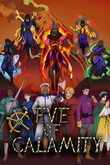
Prevent a world-ending Calamity your way! A player-driven old-school RPG inspired by both the Japanese and western classics of the 80s and 90s.
Modeled estimate, not a reported figure. How we estimate →
Media

About
Two decades ago, your adoptive father prevented the end of the world, but the deeds of his adventuring party were pushed to the side and forgotten. Now, that which threatened us is stirring once again, and it's your turn to combat it. Travel freely in the empire of Asterna and the islands surrounding it, seek power and allies, and prevent the next coming of a world-ending Calamity.

Build your characters by mastering and switching between over 20 classes, learn more than 150 active and passive skills, use several hundred items and pieces of equipment.
Find, recruit, and get to know more than 15 companions to form your party.
Freedom to do what you want as you prepare for the final battle: no mandatory quests, no specific order of story events you must see, no hand-holding. Pick a side in a civil war, fight in an arena, hunt monsters, make money by trading - whatever gets you what you need is a valid way to play.
Turn-based combat at your own pace; no need to hurry to make decisions, no long waits as animations play or you transfer to and from combat.
Graphics, gameplay, and music reminiscent of early 90's role-playing games.

New post-game story and dungeons.
New quests and bounties.
6 new Ascended Classes with their own skills.
More than 70 new pieces of equipment to further tweak your character builds.
Genres
Stats
All-time low is the lowest price we've recorded for this game since we started tracking it.
Languages: English, Japanese
Engagement
Reviews
Themes across 40 recent reviews and how positive each mention is. A keyword signal, not full sentiment analysis.
Reviews
Visuals are as seen in the store page's screenshots. Audio is okay. As for the writing... it's not good. But that might be fine; mediocre writing can be excusable as long as the open world design is good. But how do I say this? Exploration does not feel rewarding. Of course this is partially because of the aforementioned mediocre writing making it harder for me to care. Town walker NPCs recycle generic throwaway lines; what purpose do they even serve, other than to randomly step around and into 1-tile wide hallways where they'll annoyingly idle to block your path? The other thing that makes exploration feel unrewarding to me is the random loot in chests, which is a symptom of a bigger problem: loot not being placed deliberately by the designer tells me that the world is not crafted intentionally. I mentioned random loot. Let me also describe my experiences with random encounters and in-combat RNG. At the end of the intro sequence, you are not exactly railroaded but heavily steered towards clearing out what is supposed to be (this is an open world game so you can ♥♥♥♥ off and do whatever instead) the first dungeon: a goblin cave. Inside this dungeon, you can get the 1 Wolf random encounter, which is a walk in the park and can be beaten by just spamming basic attacks, or the 3 Wolves random encounter, which can wreck your ♥♥♥♥ and force you to dip out of the cave and rest. You can get the 1 Goblin random encounter, which is again a walk in the park, or you can get the 1 Goblin Shaman random encounter, which can wreck your ♥♥♥♥ probably harder than the 3 Wolves since it can mass slow your entire party. After running into multiple consecutive hard random encounters in my first incursion into the goblin den, I decided that maybe it would be easier to come back after recruiting a 4th party member. (At this point, you most likely only have 3 party members including your MC.) To this end, I walked around the world map and quickly came across a village where the townsfolk are about to lynch an outsider and you can help rescue (and recruit) them. The village guards started the fight by using their most powerful skills and knocked out my 2 squishies early (targeting them even though my Weapon Master was wearing an aggro-increasing hat) before they could contribute much of anything to the fight, and my frontline had to carry the rest of the fight, barely scraping a win. Since I wanted more EXP for the members that were KO'd, I decided to reload and try the fight again. This time, I got luckier and only 1 squishy got KO'd instantly, and so I had a much easier fight. This was the only notable event in the village. An empty set piece, containing 1 single event and a couple of random treasure chests and foraging patches. But anyhow, I got what I wanted out of that detour. With my full party, I confidently walked back inside the goblin cave, where this time I ended up only seeing the easy random encounters. And at the end, the goblin boss encounter felt easier than the Goblin Shaman random encounter. What an anti-climax. Maybe the real boss was the Shaman all along. Perhaps there is some potential for strategic depth in the combat, but I didn't experience much of that in what I played, where the only real questions I had to ask in my decision-making were "is this fight going to last long enough to justify buffing up" and "is any party member low enough on health to justify spending a turn on in-combat healing". Now obviously, I have less than 2 hours (Steam refund window) of play time. Maybe it does get better. I did catch some glimpses of cool systems (like the potion crafting system, or having class changes and prestige classes along with 10 move slots to cook your own builds) but unfortunately I was not able to experience those systems deeply in my first 2 hours. The only potion recipe I had was for a lesser healing potion (heals 100 HP and can be sold for 25 gold at the general store), which is made from a healing herb (which you can randomly pick from foraging patches and can be sold for 17 gold at the general store). Instead of using these potions to heal my party, I used the basic healing spell Comfort (which costs 10 MP and heals based off Magic stat). I learned this healing spell through a skill book purchased in a shop. Skill books are apparently reusable, so I taught the skill to literally everybody in my party regardless of actual class (because why not, I still haven't filled up all 10 move slots yet anyway). Even for a low Magic stat Berserker, casting Comfort (out of combat, of course --- I'm unlikely to be wasting my DPS's action economy on in-combat healing) is competitive with the lesser healing potion, which makes me wonder why the lesser healing potion even exists if I can instead just buy the cheap MP cost spell's reusable skill book with my starting resources. I picked up this game because I just wanted to play an RPG Maker game with decent combat and lots of good side content, but the overall flaws and the lack of attention to detail that I saw in my first 2 hours (the most important 2 hours where any dev ought to be focusing their efforts on polishing to make a strong first impression and to hook a player past the point of no refund) lead me to believe that this is not that game I was seeking.
Related
Related
Trends
Modeled estimate over time, reconstructed from Steam's monthly review histogram.
Hours played at review time, across 40 reviews with recorded playtime.
positive critical· bar length = how often the theme comes up
What i have played of this game is great would highly recommend
Eve of Calamity is easily among the best RPG Maker games I've played, standing on its own merits as a worthwhile investment of the 12-ish hours it should take to complete a first playthrough. Though the graphical style is an acquired taste, and in places borrows from RPG Maker MV's default asset pool, this does not noticeably detract from the experience; if anything, the simple (and occasionally ugly) portraits lend a charm to the characters that few games are able to replicate. The writing serves its purpose, which is to communicate information to the player that propels the story forward. Recruitable characters have basic but distinct and established personalities, opening the player to choose from their favorites to bring along into battle. Outside of the opening crawl, world-building is dished out in small doses, rewarding players who choose to explore with a deeper understanding of how the world came to be, what the Calamity is, and why it threatens to return. The player character follows a straightforward but satisfying character arc, beginning the game as a desperate novice and ending it as a hero worthy of the title. The soundtrack has a grungy, unfocused tone that, while not everyone's cup of tea, lends itself well to a world steadily descending into chaos as once-allied regions squabble amongst themselves and a cult dedicated to the Calamity works steadily towards its return. The default RPG Maker sound effects contribute little to the overall feeling, but aren't terribly distracting once you get used to them. The real winning quality of Eve of Calamity, though, is the gameplay. After a short tutorial segment following the game's opening, you are given your first and only real goal: to defeat the Beast of Calamity. From that point on, everything you do is at your own direction, and leads towards that ultimate end. You can visit towns and dungeons, recruit allies, take on quests, and explore the three major nations at your own pace and in whatever order you see fit. Battles are quick and have a satisfying difficulty curve, wasting no time on unnecessary fluff and forcing you to genuinely struggle in the early game, especially before you fill out your party. Once you get into the swing of things, though, you gain the satisfaction of effortlessly cutting down hordes of enemies on your way to the next boss fight. The mechanics are straightforward and easy to understand, and it feels sufficiently rewarding to reach a new class level milestone, unlock a new skill, and figure out how it fits into your battle strategy. As mentioned above, a first playthrough will generally run somewhere in around the 12-hour mark. That's about as long as it takes to visit each town, level up a couple of classes on each of your characters, take care of enough quests to get geared up, and head into the final area to take on the endgame. Even if you try to do everything, it is unlikely you will take more than about 16 hours to complete a run; however, because many of the game's item and character locations are semi-randomized, and there are achievements to earn from reaching the end either very quickly or very slowly, it's easy to justify multiple playthroughs. All in all, Eve of Calamity is a solid game that I would recommend to anyone who enjoys old-school RPGs that value your time.
good game
Eve of Calamity, developed and published by Klothscape, is a retro-inspired role-playing game that embraces the design philosophies of classic Japanese and Western RPGs while offering a modern sense of player freedom. Set in the vast empire of Asterna and its surrounding islands, the game centers on the looming return of a catastrophic threat once held at bay by a previous generation of heroes. You step into a world shaped by past sacrifice, political instability, and growing unrest, tasked not only with preparing for an impending apocalypse but also with carving out your own path in a land that does not revolve solely around a linear main quest. One of the defining characteristics of Eve of Calamity is its open-ended structure. From early in the game, players are free to explore the empire largely at their own pace. Rather than funneling you through a tightly scripted progression, the game allows you to take on quests in varying orders, pursue side activities, or even wander into dangerous territory long before you are fully prepared. This nonlinearity creates a sense of genuine exploration, where decisions about where to travel and which conflicts to engage with meaningfully shape your experience. Political tensions, civil unrest, monster infestations, and personal character stories coexist in the world, allowing the narrative to unfold organically rather than through rigid sequencing. Character progression is deep and highly customizable. With over twenty distinct classes available, players can shape their protagonist and companions in numerous ways. Each class offers unique abilities, strengths, and growth paths, encouraging experimentation with party composition and combat strategies. The game also features a wide array of active and passive skills that can dramatically alter how battles are approached. Equipment variety is substantial, ranging from simple weapons and armor to rare items that enhance specific builds. Recruiting companions further enriches the experience, as each potential party member contributes not only combat utility but also narrative flavor and personality. Combat operates within a traditional turn-based system, emphasizing strategy and resource management. Battles move at a brisk pace, avoiding excessive animations or downtime between actions. Positioning, skill synergy, and careful use of abilities are key to overcoming tougher encounters. Enemy variety increases as you explore more dangerous regions, requiring adaptation and thoughtful preparation. While the mechanics remain rooted in classic RPG design, the streamlined pacing ensures that combat remains engaging rather than repetitive. Exploration is central to the game’s identity. The empire of Asterna is expansive, with multiple towns, wilderness areas, and islands offering distinct challenges and rewards. Hidden dungeons, optional bosses, and lore-rich side quests encourage curiosity. Because the game does not heavily restrict where you can travel, stumbling into high-level areas early is possible, adding an element of risk to exploration. This design choice enhances immersion but also demands attentiveness from players who must gauge their readiness before venturing too far. Visually, Eve of Calamity embraces detailed pixel art reminiscent of early 1990s RPGs. Character sprites are expressive, environments are varied, and the overworld design conveys a sense of scale despite its retro presentation. The art direction prioritizes clarity while maintaining charm, allowing players to appreciate both combat and exploration without visual clutter. The soundtrack complements this aesthetic with compositions that evoke classic fantasy themes, enhancing immersion without overwhelming the experience. The game’s openness may not appeal to everyone. Players accustomed to clearly marked objectives and guided progression might initially find the freedom overwhelming. Difficulty can fluctuate depending on the order in which quests are tackled, and the lack of heavy hand-holding requires active engagement. However, for those who appreciate player agency and self-directed growth, this structure becomes one of the game’s greatest strengths. Ultimately, Eve of Calamity stands as a confident homage to classic RPG traditions while offering a flexible and player-driven adventure. Its expansive class system, open-world exploration, and strategic combat create a layered experience that rewards curiosity and experimentation. Rather than redefining the genre, it refines and celebrates it, providing a nostalgic yet thoughtfully constructed journey through a world on the brink of disaster. For players seeking a retro-styled RPG with depth and freedom, Eve of Calamity delivers a substantial and engaging experience that honors its inspirations while forging its own identity. Rating: 7/10
The game looks a bit rough, but honestly is amazingly fun if you enjoy older style RPG's, but with more modern day QOL changes. Basically open world, highly customizable MC, and a pretty interesting plot!
Very nice little RPG to play through Good amount of classes to master and characters to recruit Branching paths as well; I never even saw my sibling my first run
Score: 2/5 I purchased EoC based on Humblemud's very positive video review. I will never take him seriously again. With significantly better writing and moderately better mechanical and narrative balance/choices, I would have stuck around to see how the developer(s) handled some of the better ideas/systems/narrative hooks. [b]The Good[/b] 1. Some variety/replayability thru randomized elements. Primarily based on the player's class/mechanical progression choices. Some combat encounters have unexpected twists like [spoiler]bandits bribing you in exchange for their life, or surprise potential party members events[/spoiler]. 2. Freedom of choice for exploration. I was not directly prevented from going almost anywhere by way of invisible barriers, or dumb physical roadblocks, but by mountains or large bodies of water or, less reasonably, absurd difficulty spikes from entering a higher-level zone. 3. Fast movement speed in towns/dungeons and on the world map. 4. Cool boss progression system [spoiler]based on play-time[/spoiler]. 5. I dislike strong meta-gaming in most single-player games, especially speed-running. However, like my appreciation/approval for meta-gaming in Morrowind, or speed-running in Neon White, EoC has good mechanical and narrative support for speed-running (but not the player knowledge meta-gaming required to do so), so I appreciate how it was handled here and want to give credit where credit is due. [b]The Bad[/b] 1. [b]Grinding/Repetition[/b], Balance, and Progression Mechanics a. Leveled zones have large gaps in difficulty, requiring meta-gaming and/or grinding. b. Differences between a character/NPC even comparing their early and mid-game effectiveness/performance is too strong/pronounced. Zero to hero crap (for viable builds/NPC party members). c. Multiple character builds heavily under-perform when approaching mid-game. d. Some choices/strategies for a run (economy/trading in my case) are unbelievably cheesy, but strongly reduce the grind/difficulty of a run (while still being boring and repetitive). Attempting to play the game without cheesing it was moderately boring and highly repetitive for most of my play-time. 2. [b]Writing[/b] Bland and poorly paced. Unbelievable characters blatantly telling the player the plot while placed/engaged in artificial situations. Humor doesn't land. Info dumping. Narrative choices are mostly disappointing, with many having only 1 branch that has a beneficial outcome and the others being uninteresting dead-ends with minor, non-mechanical role-playing benefits (I do not see how attempting to role-play or create your own story in EoC would be anything except disappointing for almost any player). 3. [b]Visuals/Art style[/b] Many parts of the game, especially the characters, are ugly or difficult to tell what you're looking at without the associated text box that has the character name/monster species/description. 4. Some of the music is grating (most is fine or even good).
Great game
Awesome old school experience, great for winding down after work. just enough difficulty to keep me save scumming
Momentum
Pace estimated from the game's recent review growth (our daily snapshots) at its own sales-per-review ratio — a momentum signal, not booked sales.
Audience
Estimated from the language of this game's reviews — a proxy for where players are, not official Steam demographics.
Related
| Fenimore Fillmore: The Westerner | $19K | 113 | 92% | $9.99 |
| Dragon Rage | $19K | 171 | 76% | $4.89 |
| Ghost Feed | $19K | 414 | 83% | $3.49 |
| The Last DeadEnd | $19K | 106 | 78% | $7.99 |
| Row Divers | $19K | 187 | 85% | $2.99 |
| Platform Builder | $19K | 80 | 81% | $14.99 |