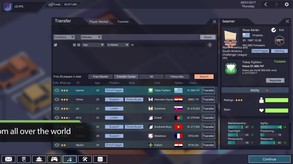
ESports Club is a sim game based on electronic sports industry, including most popular game types such as FPS and MOBA. What are you still waiting for? Start your esports career now!

Modeled estimate, not a reported figure. How we estimate →
Media

About

Genres
Stats
All-time low is the lowest price we've recorded for this game since we started tracking it.
Languages: English, Simplified Chinese, Russian
Engagement
Hours played at review time, across 40 reviews with recorded playtime.
Reviews
Themes across 40 recent reviews and how positive each mention is. A keyword signal, not full sentiment analysis.
positive critical· bar length = how often the theme comes up
Reviews
Задумка отличная, игра очень неплоха. Но рекомендовать к покупке я её не могу, т.к. игра заброшена автором, обновлений нет. Я думаю, выпускаешь игру в раннем доступе за деньги - будь добр её закончить, выполнив обещанное в манифесте раннего доступа.
本来挺好的,然后逆更新了,还圈完钱跑路了
比赛细节不够,CS比赛的时间太长,而MOBA我都点全自动了,为什么关键决策还要我自己来? 选手和俱乐部自定义选项过于少。 作为一款经营类游戏,经营部分足够复杂,但是最重要的趣味性不足。 天天在那抠钱抠数值,过了前期比赛全部点跳过,拿到世界总冠军又怎么样,我也没有觉得很开心。 最可恨的是制作组跑路不更新,害我拿不到大满贯的成就。
ESports Club is a management simulation that attempts to capture the operational side of competitive gaming by placing the player in charge of building and running an esports organization from the ground up. Developed and published by Hangzhou Xinlan Network Technology Co., Ltd., the game leans heavily into systems-driven gameplay, focusing on recruitment, training, financial management, and strategic planning rather than direct control of matches. It stands out immediately for its premise, as relatively few games attempt to simulate the inner workings of esports organizations, and even fewer do so with this level of structural ambition. The core loop revolves around assembling a team of players and guiding them through training, competitions, and long-term development. Each player is defined by a variety of attributes, including technical skill, role specialization, and mental condition, all of which influence their performance during matches. Managing these variables becomes a central challenge, as players can improve through training but also decline due to fatigue, poor morale, or aging. The game encourages a careful balance between short-term success and long-term sustainability, pushing players to think beyond immediate results and consider how their decisions will affect the team over time. This creates a satisfying sense of progression, particularly when a struggling roster gradually evolves into a competitive force. Beyond individual players, the game introduces a broader organizational layer that includes upgrading facilities, managing finances, and interacting with a network of clubs and competitions across different regions. The scale is one of the game’s most appealing aspects, with a large pool of teams and players that gives the impression of a living esports ecosystem. Participating in leagues and tournaments provides structure, while transfer markets and contracts add an economic dimension that reinforces the management theme. These systems work together to create a sense of running a real organization, even if some of them lack the depth or polish needed to fully realize that illusion. Matches themselves are simulated rather than directly controlled, with players setting strategies and tactics before watching the results unfold. This approach aligns with the game’s management focus, but it also creates a certain distance from the action. While there are attempts to reflect real competitive strategies—such as aggressive plays or coordinated team movements—the presentation is relatively minimal, and the outcomes can sometimes feel detached from the decisions that led to them. As a result, victories and losses may lack the emotional intensity that players might expect, making matches feel more like statistical outcomes than dramatic events. One of the more notable aspects of ESports Club is its pacing, which tends to be slow and methodical. Building a successful team requires time, patience, and careful resource management, particularly in the early stages when funds are limited and progress is incremental. For players who enjoy long-term planning and gradual improvement, this can be rewarding, as each advancement feels earned. However, the repetition inherent in training cycles, match simulations, and resource accumulation can become tiring, especially when the game does not introduce enough new elements to keep the experience fresh over extended play sessions. The game’s biggest weakness lies in its lack of polish and incomplete feel. While the underlying systems show clear potential, many aspects of the game appear underdeveloped or insufficiently refined. The interface, while functional, can be clunky and unintuitive, making it harder to navigate the game’s many systems efficiently. Visual presentation is basic, with minimal flair or stylistic identity, and match simulations lack the excitement that could elevate the overall experience. Perhaps most significantly, the game’s development appears to have slowed or stalled, leaving certain features feeling unfinished and limiting the sense of long-term growth the game initially promises. Despite these shortcomings, there is still something compelling about ESports Club for a specific type of player. Those who are deeply interested in the management side of esports—who enjoy tweaking rosters, optimizing training routines, and watching a team develop over time—may find the game engaging despite its flaws. The combination of strategic planning and incremental progression can be addictive, particularly when the systems align and produce meaningful results. However, for players seeking a more polished, dynamic, or immersive simulation, the game’s rough edges and lack of refinement may overshadow its strengths. In the end, ESports Club feels like a project with strong ideas that were never fully realized. It offers a unique perspective on esports and provides a framework for an engaging management experience, but it falls short in execution due to its limited polish, repetitive pacing, and incomplete features. It is a game that can be appreciated for what it attempts to do, even if it does not fully succeed in delivering on its potential. Rating: 6/10
Download the League of Legends MODs and try to win worlds. Enjoy
跑路
最开始还能看,后面就糊了,成了一坨
圈钱跑路的狗屎
偶然想起来这sb半成品游戏,果然跑路了,补个差评
好好好
Related
Related
Trends
Modeled estimate over time, reconstructed from Steam's monthly review histogram.
Momentum
Pace estimated from the game's recent review growth (our daily snapshots) at its own sales-per-review ratio — a momentum signal, not booked sales.
Audience
Estimated from the language of this game's reviews — a proxy for where players are, not official Steam demographics.
Related
| Crossing Souls | $442.8K | 1.4K | 78% | $14.99 |
| Best Served Cold | $442.9K | 690 | 88% | $17.99 |
| Zup! | $442.6K | 8.9K | 94% | $1.99 |
| Breachway | $443K | 1.5K | 76% | $9.99 |
| Atelier Ryza: Ever Darkness & the Secret Hideout DX | $443K | 310 | 79% | $39.99 |
| DLC Quest | $442.3K | 6.2K | 88% | $2.99 |