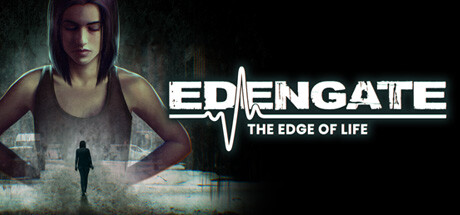
EDENGATE: The Edge of Life, developed and published by 505 Pulse, is a short, atmospheric narrative adventure that delves into themes of isolation, memory, and emotional trauma. It opens with a strikingly quiet introduction: the player awakens as Mia Lorenson, a scientist who finds herself alone in a desolate hospital with no recollection of what has happened. The sterile walls and empty corridors tell the story of an abandoned world, one that seems frozen in time. From the first moments, the game establishes an air of mystery and melancholy, urging players to uncover what led to this eerie emptiness. Rather than relying on action or complex mechanics, EDENGATE embraces a minimalist approach, focusing on slow-paced exploration, environmental storytelling, and introspective dialogue to convey its narrative. The result is a moody, contemplative experience that feels more like an emotional journey than a traditional video game.
Visually, the game succeeds in capturing the unsettling stillness of a world that has lost its inhabitants. The environments are detailed and grounded, with decaying medical equipment, scattered personal items, and dim lighting that enhances the sense of loneliness. Each location—from the quiet hospital halls to the fog-drenched city streets—feels meticulously crafted to evoke unease without resorting to cheap horror tricks. The use of light and shadow gives the spaces a dreamlike, almost surreal quality, reinforcing the idea that Mia is navigating both a physical and psychological landscape. The sound design is equally vital to this atmosphere; soft ambient tones, distant echoes, and the occasional haunting melody provide a constant undercurrent of tension. Mia’s voice acting gives her internal struggle a human touch, allowing her confusion and pain to resonate even when the world around her remains silent.
Gameplay in EDENGATE is simple and intentionally restrained. The experience revolves around exploring, examining clues, and interacting with environmental objects that trigger flashbacks or fragments of memory. There are a handful of light puzzles, but they are largely straightforward, serving more to punctuate the exploration than to challenge the player. This minimalist design choice helps keep the focus on storytelling and emotional immersion, but it can also leave the game feeling somewhat shallow for players seeking a greater sense of interactivity. The linear structure means that there are few surprises in terms of gameplay, and while the pacing is deliberate to reinforce the tone, it occasionally borders on sluggish. The lack of real mechanical variety makes it clear that EDENGATE’s strength lies not in its systems but in its atmosphere and emotional weight.
The narrative unfolds slowly through Mia’s recollections, and the fragments she uncovers begin to suggest the story of a world undone by a mysterious event connected to her past work as a scientist. As memories resurface, the player learns of guilt, loss, and a desperate search for redemption. The writing occasionally veers into ambiguity, leaning heavily on symbolism and emotional abstraction, which leaves interpretation open to the player’s imagination. Some moments are poignant and personal, while others feel underdeveloped, as if the game’s brevity prevents it from fully exploring the ideas it introduces. The final act takes a surreal turn that blurs the line between reality and dream, delivering a conclusion that is thematically resonant but narratively vague. It’s a story that raises more questions than it answers, and depending on one’s expectations, this can either feel poetic or unsatisfying.
Technically, EDENGATE runs smoothly and demonstrates solid craftsmanship for a smaller-scale project. The Unity engine is used effectively, providing polished lighting effects and crisp visuals that support the game’s emotional tone. The performance is stable across most systems, with minimal loading times and few bugs. However, because the game’s environments are small and highly linear, it doesn’t push any technical boundaries. What it lacks in complexity, it compensates for with atmosphere—every sound, reflection, and flicker of light feels deliberate. The developers clearly prioritized mood and tone over spectacle, and that restraint helps maintain the immersion throughout its short runtime.
The game’s greatest strength lies in its ability to evoke feeling. EDENGATE is at its best when it lets silence and subtle environmental details carry the weight of the story. It doesn’t rely on dialogue-heavy exposition or overt cutscenes to communicate emotion; instead, it allows players to piece together Mia’s state of mind through exploration and introspection. There are moments where the loneliness becomes almost tangible, where the ambient hum of machinery and the emptiness of a once-living world become oppressive. For players drawn to narrative experiences that prioritize atmosphere over action, this is where EDENGATE shines. However, for those seeking deeper mechanics, complex puzzles, or a more cohesive story arc, the game may feel underwhelming once the initial intrigue fades.
At roughly two hours long, EDENGATE: The Edge of Life feels more like an interactive short film than a full-length game. Its brevity prevents it from overstaying its welcome, but it also limits the development of its story and ideas. It leaves a strong emotional impression but stops short of being profound. Still, within its modest scope, it delivers an evocative experience that captures the quiet beauty of despair and the fragile hope of recovery. It stands as a reflection on isolation—perhaps influenced by real-world themes of solitude and loss—and offers a contemplative respite from the chaos of larger, more demanding games. EDENGATE may not redefine the narrative adventure genre, but it demonstrates that even small, subdued stories can leave a lasting emotional echo when told with care and sincerity.
Rating: 7/10