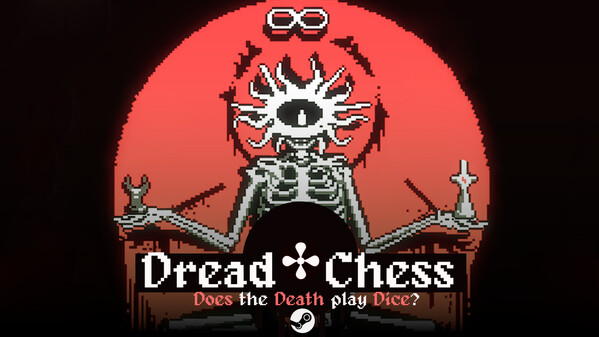
Dread Chess est un jeu original et étrange mêlant histoire narrative, puzzles et éléments de sandbox. Découvrez les mystères en parlant aux dieux en latin. Plongez dans une atmosphère de folie et atteignez l’une des nombreuses fins d’une partie injuste contre la Mort, qui ne peut être jouée qu’UNE SEULE FOIS...
Revenue comes from in-game items and microtransactions, which our price-based model doesn't estimate. The player count below is how many people own it, not what they spent.
About
✣ Dread Chess is an original and strange narrative story-puzzle game that you can play as a chess sandbox by setting asymmetric rules for the players, or explore it in search of different endings and achievments.
Key Features
Branching Narrative: Multiple endings based on your successes, failures, and the choices you make.
Asymmetric Rules Sandbox: Design unfair advantages or crippling handicaps—then see them in action.
Option to use Latin as main Language: "Mortales ludunt, dii rident"
Dark Atmosphere: Gothic pixel art, unsettling soundscapes, and a story that lingers.
Self-Playing Chess: Observe autonomous matches that reveal hidden truths and secret paths.
Spectator Mode: Sit back and watch the AI duel itself, or share the spectacle online.
Narrative Mode
Confront the God of Madness as it poses three life-or-death riddles—discover the answers by watching enchanted, self-playing chess matches unfold. Each choice echoes through a richly decorated, gothic pixel-art world, leading you toward one of several hauntingly endings.
Sandbox Mode
Unleash your creativity in a versatile sandbox environment. Customize asymmetric rule sets and go head-to-head against the AI—or a friend—in a variety of modes:
Card Mode: Choose from three thematic options (bad, average, good) for each move.
Tarot Cards: Global conditions that change the rules of the game.
Dice Mode: Roll the die to determine which chess piece you must move—luck may be on your side, or it may betray you.
Classic Mode: Pure, classic chess with direct control.
Discover Dread Chess and decide for yourself: can you outwit the God of Madness?
Genres
Stats
Languages: English, Russian, Simplified Chinese
Engagement
Reviews
Themes across 47 recent reviews and how positive each mention is. A keyword signal, not full sentiment analysis.
Reviews
На удивление мне хватило моего навыка игры в шахматы чтобы пройти данную игру. Ставлю лайк
Dread Chess is less about chess and more about fate, horror, and philosophical choices. The game mixes eerie pixel art, cryptic dialogue, tarot mechanics, and unfair “self-playing” chess into a strange but memorable experience. Its biggest strength is atmosphere. Everything feels cursed, mysterious, and intentionally unsettling. The hidden endings and obscure secrets make exploration rewarding, especially if you enjoy experimental indie horror. It can be confusing at times, and players looking for normal chess gameplay probably won’t enjoy it. But if you like surreal psychological games with dark themes, Dread Chess stands out as something genuinely unique. Overall rating: 8.5/10
Media

Related
Related
Price dynamics, follower growth, revenue and sales trajectories with interactive tooltips
This and every other Pro feature is free until October 20, 2026. A free account is all it takes.
Hours played at review time, across 47 reviews with recorded playtime.
positive critical· bar length = how often the theme comes up
Первый раз проиграл, второй раз тупанул. И все, больше шансов игра не дает. Очень понравилась. Таинственная и карающая. Любителям шахмат и окультизма - советую!
Dread Chess takes one of the oldest and most recognizable strategy games and deliberately twists its rules, atmosphere, and purpose into something much stranger. Rather than presenting itself as another straightforward digital chess application, it combines chess with narrative adventure, puzzles, dark fantasy, and experimental rule variations. The result is an unconventional experience where understanding the board remains useful, but winning ordinary matches is not necessarily the primary objective. Developed by NullTale and published by NullTale Scape, the game is clearly aimed at players who enjoy familiar systems being transformed into something unpredictable and occasionally unsettling. Its narrative component provides much of its personality. The player becomes involved with the God of Madness and faces three dangerous riddles whose answers are connected to events taking place around enchanted chessboards. Matches can unfold automatically, turning observation into part of the puzzle-solving process. Instead of constantly commanding pieces, players may need to watch how a game develops, recognize unusual events, and determine whether those events reveal information relevant to the larger mystery. It is an intriguing inversion of conventional chess because the board becomes both a strategic arena and a storytelling device. The story also offers multiple outcomes, giving decisions and discoveries greater importance than they would have in a purely linear presentation. This encourages replaying sections or approaching situations differently to see how events can change. The supernatural themes give the experience a deliberately mysterious tone, while the option to use Latin adds another unusual stylistic element. It is certainly not an accessibility feature for most players, but it complements the ritualistic and archaic character the game is trying to establish. Together with its themes of madness and uncertainty, these choices make the narrative feel distinct from the sterile presentation commonly associated with computerized chess. Outside the story, the sandbox systems reveal how far the game is willing to depart from traditional rules. Players can create deliberately unbalanced matches by granting one side advantages or disadvantages. Chess normally depends heavily on both competitors beginning with equivalent resources, so removing that symmetry creates unusual tactical situations. Instead of asking only which player has superior chess knowledge, these scenarios ask whether an apparently unfair position can be exploited, survived, or overcome. Matches can be played against computer-controlled opposition or another player, making the sandbox a useful environment for experimentation. Additional modes introduce even more unpredictability. Card-based mechanics can influence a match through different effects, while Tarot Cards can establish special conditions that change the behavior or circumstances of a game. Dice Mode goes further by restricting which category of chess piece can be moved according to a roll. Such randomness would be undesirable in a serious chess simulator because it can invalidate carefully constructed plans, but here that disruption is intentional. Players are repeatedly forced to adapt when their preferred move is unavailable or when the rules suddenly interfere with conventional strategy. Classic Mode is important because it provides a more recognizable alternative for anyone who wants direct chess play without constantly embracing the stranger modifiers. Spectator functionality also allows computer-controlled matches to unfold without direct participation. Watching autonomous games might initially seem like a minor extra, yet it fits naturally with the narrative's emphasis on observing enchanted boards for clues. Dread Chess consequently treats watching, interpreting, experimenting, and actively playing as different ways of interacting with the same underlying system. The gothic pixel-art presentation supports this unconventional direction effectively. Chess pieces and boards are surrounded by imagery that gives familiar matches a darker identity, while the audio contributes to the ominous atmosphere. The game does not depend on graphical complexity to create its personality. Instead, its visual style works because it complements the supernatural themes and allows the chess interface, narrative scenes, and puzzle elements to coexist without feeling completely disconnected. Its greatest strength is also likely to be its most divisive characteristic. Players searching for a rigorous chess simulation may find random restrictions, asymmetric advantages, supernatural storytelling, and unconventional modifiers frustrating. Chess enthusiasts accustomed to carefully calculating several moves ahead may particularly dislike mechanics capable of disrupting those plans. On the opposite side, players primarily interested in visual novels or narrative adventures will still need some willingness to engage with chess-related concepts. The game therefore occupies a narrow but interesting middle ground between strategy game and experimental narrative experience. Replay value comes from more than repeatedly facing ordinary opponents. Multiple endings, achievements, different match conditions, AI battles, local multiplayer possibilities, sandbox configurations, and unusual chess variants provide reasons to revisit its systems. The strongest incentive is curiosity. Changing conditions can produce dramatically different matches, while alternative narrative decisions encourage players to investigate outcomes they missed previously. The overall package feels less like a definitive chess platform and more like a collection of strange ideas constructed around the chessboard. Steam Deck compatibility should be approached conservatively. There is no official Steam Deck Verified or Playable rating indicated for the game, so it should be considered unverified rather than guaranteed to function perfectly on Valve's handheld. Its relatively modest 2D presentation appears suitable for portable hardware in principle, but factors such as Proton compatibility, input behavior, interface scaling, and text readability can still affect the experience. Steam Deck users should therefore expect that manual adjustments or compatibility experimentation may be necessary. Dread Chess ultimately stands out because it is willing to undermine the qualities that normally define chess. Predictability gives way to randomness, balanced starting conditions can become deliberately unfair, direct participation can become observation, and an ordinary match can become part of a supernatural riddle. Not every experiment will appeal equally to every player, but the ideas work together around a coherent theme of distorted logic and uncertainty. Anyone seeking serious tournament-style chess will find better alternatives elsewhere, but players attracted to eccentric indie projects, dark mysteries, strategic experimentation, and unconventional board-game mechanics may discover a surprisingly memorable experience. Rating: 7/10
Dread Chess — бесплатная нарративная головоломка‑песочница с элементами хоррора и визуальной новеллы. Игра переосмысливает шахматы: игрок сражается с самой Смертью и Богом Безумия, а исход партии влияет на судьбу души. Доступна на PC (Steam), поддерживает русский язык и латынь, включает достижения Steam. В игре — несколько концовок, готический сеттинг и необычные режимы. Плюсы: бесплатная модель распространения; нестандартный подход к шахматам: асимметричные правила и разрушительные ограничения; несколько игровых режимов: классические шахматы, карты Таро (добавляют непредсказуемость), кубики (ход зависит от броска), мини‑шахматы (доска 4 × 4); возможность наблюдать за игрой ИИ против ИИ; готическая атмосфера и мрачный сюжет с элементами хоррора; нелинейность и несколько концовок — зависят от побед, поражений и решений игрока; загадки Бога Безумия как часть нарратива; поддержка русского языка и латыни для погружения в атмосферу; достижения Steam; сочетание жанров: шахматы, визуальная новелла, головоломка и хоррор. Минусы: высокая сложность из‑за нестандартных правил и асимметрии партий; мрачная тематика и хоррор‑элементы могут не подойти чувствительным игрокам; мини‑шахматы на доске 4 × 4 могут показаться слишком упрощёнными любителям классических шахмат; некоторые механики (карты, кубики) снижают роль стратегии в пользу случайности; ограниченный визуальный контент — акцент на нарративе и геймплее; одиночный режим без кооперативного или соревновательного мультиплеера между реальными игроками; возможны трудности с освоением правил в нестандартных режимах без подробного обучения. Итог Dread Chess подойдёт любителям нестандартных шахматных игр, хорроров, визуальных новелл и головоломок с глубоким сюжетом. Игра впечатляет готической атмосферой, разнообразием режимов и нарративом с последствиями решений, но из‑за мрачной тематики, случайных элементов в геймплее и асимметричных условий может не заинтересовать тех, кто ищет классические шахматы, казуальный геймплей или многопользовательские состязания. Хороший выбор для тех, кто готов к экспериментам и погружению в тёмную историю с философским подтекстом.
„Dread Chess“ ist ein Spiel, das vor allem durch seine außergewöhnliche Schach-Mechanik auffällt. Statt klassischem Schach mit nüchterner Oberfläche bekommt man hier einen einzigartiges Erlebnisss geboten, der düster, stilisiert und fast schon künstlerisch wirkt. Besonders hervorzuheben ist die poetische Aufmachung des Spiels. Vieles wird nicht direkt erklärt, sondern bleibt bewusst vage und bietet viel Interpretationsspielraum. Dadurch entsteht eine besondere Atmosphäre, die das Spiel mehr wie ein interaktives Kunstwerk als wie eine reine Schachsimulation wirken lässt. Auch die Art des Storytellings ist einzigartig. Die Geschichte entfaltet sich durch die Schachmechanik selbst, was dem Spiel eine interessante Tiefe verleiht und das klassische Brettspiel in einen völlig neuen Kontext setzt. Negativ fällt jedoch auf, dass es kein wirkliches Tutorial gibt. Viele Mechaniken und Besonderheiten muss man sich selbst erschließen, was zwar zum mysteriösen Stil passt, aber stellenweise auch frustrierend sein kann. Zusätzlich gibt es kleinere Übersetzungsfehler, die manche Rätsel unnötig komplizierter machen können. Mir persönlich hat das Spiel gefallen, gerade wegen seines besonderen Stils und der ungewöhnlichen Umsetzung. Gleichzeitig ist mir aber bewusst, dass es sehr speziell ist und vermutlich vielen Spielern nicht zusagen wird. Insgesamt ist „Dread Chess“ ein künstlerisch starkes, poetisches und ungewöhnliches Erlebnis, das nicht für jeden gemacht ist, aber genau darin auch seinen Reiz findet. Müsst ihr Wissen!
剧情很有意思,剧情引导十分狗屎,全成就10h里面有9h是在莫名其妙的地方卡关,攻略只有毛子的且毛子写的攻略不全,若有可能我会在其他平台发布一篇简短的中文攻略,也有可能不会
не люблю шахматы
Это ахуеть как крута, давно искала такие игрульки, классбббббб
Delilik Tanrısı ve yalnızca bir kez oynanabilen kendi kendini oynayan (belki de görünmeyen varlıklar oynuyordur) bir satranç hakkında felsefi hikayedir..
Selling now
See how fast this game is selling right now — estimated copies and revenue per day from recent review growth.
Players by region
Where this game's players are, estimated from review languages.
Related
| Game | Estimated lifetime revenue | Reviews | Review score | Price |
|---|---|---|---|---|
| $0 | 0 | 56% | Free | |
| $20.3K | 172 | 90% | $9.99 | |
| $15.3K | 97 | 78% | $9.99 | |
| $4.2K | 42 | 93% | $7.99 | |
| $1.2K | 34 | 79% | $2.99 | |
| $983 | 33 | 88% | $2.55 |