You are Bixby, an agent within the bureaucratic metropolis known as the Ministry Of Order. As Lounge District's go-to detective, take a stroll through a retro-future so analog it'll make your head spin.
Modeled estimate, not a reported figure. How we estimate →
Media

About
Stats
All-time low is the lowest price we've recorded for this game since we started tracking it.
Languages: English**languages with full audio support
Engagement
Hours played at review time, across 41 reviews with recorded playtime.
Reviews
Themes across 41 recent reviews and how positive each mention is. A keyword signal, not full sentiment analysis.
positive critical· bar length = how often the theme comes up
Reviews
I do not understand negativity in other reviews. This is very low budget title and developer never promise anything big. For what it is, it is good. Anyone who demands more is just being unreasonable.
This trailer caught my eye for what seemed like fun narrative and a beautiful environment. What I got was a beautiful oversized level and aimless wandering with no clues on how to find where I should be going or even a way to record objectives.
I regret paying for this. It sounded interesting and I was willing to give it a chance despite mixed reviews, but after having played it for just ten minutes, it's far too bewildering to persist with. It's "Bewildering: The Game".
Выпала из кейса за 5 рублей))
Στα [-] • Ενα συνεχές καί χωρίς νόημα περπάτημα στούς πολύχρωμους δρόμους καί τά φαντασμαγορικά κτίρια μιάς μελλοντικής μεγαλούπολης, μέ πρόφαση κάποιες πρόχειρες, επιφανειακές καί βλακώδεις αστυνομικοφέρνουσες αποστολές. • Η αδυναμία πλήρους κατανόησης τών αποστολών πού σού ανατίθενται καθώς, όχι μόνον δέν υπάρχουν υπότιτλοι, αλλά καί η προφορά τών ηρώων κάνει τά λεγόμενά τους σέ μεγάλο βαθμό εντελώς ακατανόητα. Παρεμφερείς Τίτλοι CALIFORNIUM NORWOOD SUITE, THE http://adventures-index10.blogspot.gr/2015/08/door-to-door.html
Door To Door is an eccentric, atmosphere-driven adventure that prioritizes mood, worldbuilding, and curiosity over conventional structure or mechanical depth. Developed and published by CD Jones, the game feels less like a traditional detective story and more like a slow walk through a strange, bureaucratic dream. From the outset, it establishes a distinctive retro-futuristic identity, blending noir sensibilities, analog technology, and surreal humor into a setting that feels intentionally disorienting yet oddly inviting. Rather than pushing the player toward clear goals or dramatic payoffs, Door To Door asks them to exist in its world, absorb its details, and gradually piece together meaning through observation. You play as Bixby, a low-level agent working for the Ministry of Order in a department tellingly named “Correction Pending.” The setting, known as the Lounge District, is a dense urban sprawl soaked in neon lights, jazz-inflected ambience, and bureaucratic absurdity. The narrative framework is intentionally loose, structured around a series of case files that function more like prompts for exploration than tightly scripted missions. These cases send you wandering through streets, buildings, and offices, talking to strange inhabitants and uncovering fragments of information that hint at larger systems and quiet injustices operating beneath the city’s surface. Gameplay is deliberately understated. There are no complex puzzles, combat systems, or fail states in the traditional sense. Instead, interaction revolves around moving through the environment, speaking with characters, examining objects, and following subtle leads. Progress often comes from paying attention rather than solving overt challenges. An optional assistant character can guide you toward objectives if you feel lost, and a public transit system allows for fast travel once the city opens up. These features keep frustration low while preserving the game’s relaxed, exploratory pacing. What truly defines Door To Door is its atmosphere. The Lounge District feels like a living artifact of a future imagined in the past, filled with humming machinery, paper-heavy offices, and looping public announcements. The aesthetic recalls dystopian satire more than cyberpunk spectacle, emphasizing bureaucracy, routine, and quiet alienation rather than rebellion or high-stakes conflict. Environmental storytelling does much of the heavy lifting, with visual details and incidental dialogue suggesting stories that are never fully explained, encouraging players to draw their own conclusions. The narrative itself is fragmented and ambiguous. Instead of a clear central mystery with a dramatic resolution, the game presents a series of small, interconnected situations that gradually reveal the tone and logic of the world. This approach can be deeply immersive for players who enjoy interpretive storytelling, but it can also feel directionless to those who prefer strong narrative arcs or explicit goals. Door To Door rarely tells you what to think or how to feel, and it often ends threads without tidy conclusions, reinforcing its themes of bureaucratic stagnation and incomplete understanding. Visually, the game reflects its indie roots and technical limitations, but these constraints work in its favor. The art style is stylized rather than realistic, with bold shapes, muted colors, and a slightly rough presentation that complements the analog-future aesthetic. Animations and models are simple, yet they convey personality through posture, framing, and environmental context. Sound design plays a crucial role, with ambient music and background noise creating a constant sense of place. The jazz-inflected soundtrack, in particular, reinforces the game’s laid-back yet uneasy mood, making exploration feel contemplative rather than urgent. Pacing is slow and intentionally so. Door To Door is not a game designed for binge-style play or constant stimulation. Instead, it rewards patience and curiosity, allowing players to wander, linger, and engage with the environment at their own speed. This makes it well-suited for short, thoughtful play sessions, but it can also test the patience of players looking for momentum or escalating challenge. The lack of traditional gameplay hooks means engagement depends almost entirely on how much the player connects with the world and its tone. Reception to the game reflects this divide. Players who value atmosphere, originality, and unconventional storytelling often praise Door To Door for its distinctive identity and willingness to be strange. Others criticize it for its lack of structure, minimal mechanics, and moments where the experience feels more like a walking tour than a game. These reactions highlight that Door To Door is less concerned with mass appeal than with expressing a specific creative vision. Ultimately, Door To Door is best understood as an interactive mood piece rather than a conventional adventure game. It offers a quietly fascinating world filled with odd characters, subtle satire, and a strong sense of place, but it asks the player to meet it on its own terms. For those who enjoy slow-burn exploration, surreal settings, and narrative ambiguity, it provides a memorable and unusual journey. For players seeking tight gameplay systems, clear objectives, or dramatic storytelling, its charms may be harder to appreciate. Within its narrow scope, however, Door To Door succeeds as a distinctive indie experience that values atmosphere and curiosity above all else. Rating: 5/10
"Bread ties. There's 91 of them. Why so many, and where'd they come from? That was the question you might ask yourself. What kind of a madman would subject such cruelty on others? Why would he? Who was he? These are the kinds of shoulders I rub against. The nights I shutter to remember the next morning. They're always rainy too. Why? Who knows? Maybe it's just the whether, or maybe I just think it's raining and it actually isn't." "In fact, it's the middle of the day, lunch hour, and nothings happening just like right now. Yeah. It was a beautiful day in the lounge district; except it wasn't. Not at all in the slightest because there were 91 bread ties just laying around the edges of the floors and between the tiles. It was something I'd never seen before. Several of them like snowflakes fallen to the ground except all the same. Horrible. A memory so vivid Christmas was ruined. Everybody cried. They all held their loved ones. Except they didn't 'cause they hated each other. Unbelievably bitter. Thankfully, none of it happened." This is an example of one of the longer monologues you'll hear from the main character throughout the game. It's very much a 1920's Detective Noir themed game. Except that your running around what's basically a grand hotel from Las Vegas during the pandemic shutdown. The only things left in the building to interact with are the non-animated robots (because I assume they are conserving power). Basically, think of it this way. It's an Army of the Dead solo mission. Someone murdered somebody else. Everybody has fled, and you're the one who's been hired to solve the case. You'll be running around in circles trying to figure out not only what the hell is going on, but what you're suppose to be doing, and where you're suppose to be going. I think there are 10 or so cases you can try and solve, but once you've had the pleasure of finishing one, that's when you say to yourself, "I'm not going through that again."
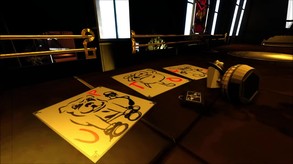
There are a slew of caveats for this game, but there's something about it which just grabs me. It's essentially a walking simulator/exploration game. It's set in a world where agents in robot bodies run Ministries which control aspects of reality (e.g., Sound, Colour, Light). And administration agencies like the Ministry of Order police them. You are Bixby of the Dept. of Correction Pending; in exchange for your efforts to cut through the Ministry of Order's bureaucracy, you are not only the last agent in your department, but trapped in the Lounge District. The Lounge District is a labyrinth of glossy lobbies, bars, suites, malls, parks, and bus lots -- all abandoned by the Ministry of Order agents when you interfered. It's up to you (and your trusty radio operator Stiggs) to troubleshoot all the weird happenings that go on. The game is divided into 'cases', each with a description of the gameplay (e.g., navigation, security evasion) and a time estimate. You are directed from place to place by placard or clues, and the plot moves a step further with each stop. Lore is scattered through the district by radio, info booth, and talk show, but the case storytelling is entirely dialogue. Your time will be spent hovering through the Lounge District (at a good clip) getting lost while you zone out to the pretty great Vangelis-style soundtrack. The game is best approached as meditative and atmospheric. Because there IS a real atmosphere here. The Lounge District is a Neo Art Deco delight, with no two rooms alike and many shrouded in shadow or odd corners. The world-building is vague and the District is deserted, but in every room there's a reminder of the backstory (including portraits of the ex-Ministry of Order dictator), so paranoia builds. Later cases go a little farther afield, exploring new areas. As for the cases themselves, the most relative word is 'surreal' (they have names like, 'High Frequency Corn Syrup' and 'Dogs With Shoes.') There is an insistence on analogue, throwback touches, a la Bioshock. You get the feeling all business is conducted by pneumatic tube. Now for the caveats -- and there are several. Repetition is one; almost all the gameplay is navigation-based (although I guarantee you will NEVER learn your way around -- if getting lost is the point, then the game definitely delivers on that). Some people will find the emptiness of the world off-putting, although some crumbs of backstory explain why the District is abandoned. Some of the clues are unclear, so you will end up wandering around; this is especially difficult when you forget what exactly you're looking for, as the game has no quest information to refer back to. You can skip around the case list, but you cannot save mid-case. The biggest problem, though, is the dialogue -- especially unfortunately, as the plot is built on it. It's cleanly recorded but the actors are often muffled, so you have to crank up the sound to hear. More, it's very dense, and employs a lot of in-house future slang. You MUST pay strict attention. To their credit, the dev responded to comments on this and attempted to install subtitles, but the engine wouldn't allow it. The dev also came back quickly on bug reports. The whole game is clearly a labour of love by a single developer. The graphics, the programming, the music, the writing -- all one person. And that really shines through, as the game is undoubtedly a cohesive whole, and infused with the enthusiasm of creation. If you loved Myst's atmosphere but didn't like the puzzles preventing you from wandering around, or if you love dark ambient music and want a surreal way to jam along with it, give it a go!
Very fun game
Необычный концепт. Играем каким-то убощиком-роботом-пылесосом (а он ещё и умеет прыгать), с которым (а он видимо техника разумная) по связи беседует время от времени кое-кто дающий указания. Наша цель это поиски, поиски чего-то о чём говорит этот кто-то. Буквально мы перемещаемся по огромной локации дизайн которой навороченно ретро-футуристичен, комнаты огромны и "давят" своим гигантизмом, просторны, не похожи на друг друга, заблудиться в принципе легко. И вот мы "ходим" (у робота нету ног) в поисках красной стрелки символизирующей то что мы нашли, подходим к этому месту "где что-то интересное", связываемся с "тем кем-то там", он снова даёт "задание" и мы снова в поисках места с красной стрелкой - это весь геймплей от начала до конца. И если когда ты впервые обследуешь "этот мир" это ещё интересно (над дизайном мира постарались - он необычный как в иных играх), а потом обойдя "все локации", ты просто ходишь в поисках, по местам уже знакомым тебе и это уже не так интересно и минусом к этому ещё отсутствие записи прогресса, то есть ты должен завершить "дело" найдя все "улики-места", и не рассматривается возможность что тебе надоело или ты устал - выйдешь, изволь начать с начала. Всего в игре 10 "дел", локация одна размеров огромная, и в общем-то геймплейно интересен этот "псевдо-детектив" лишь как концепт, а по факту скучно да и нудно. Такой вот по факту симулятор ходьбы (но робот не ходит, хз как он перемещается, под ним какая-то анимация, видимо левитирования), значит симулятор ползания. Возможно вся эта детективная муть "в голове" персонажа им воображена, ведь по факту он робот-пылесос и моет пол под собой :) По дизайну же навевает биошок (автор говорит что вдохновлялся фильмом "Бразилия" - но я такой не знаю, глянул трейлер и считаю что не похоже), над ним в этой игре и постарались. хз как оценить игру, пусть будет положительно. ведь плюсы я нашёл в игре, хоть они и не в геймплее.
Related
Related
Trends
Modeled estimate over time, reconstructed from Steam's monthly review histogram.
Momentum
Pace estimated from the game's recent review growth (our daily snapshots) at its own sales-per-review ratio — a momentum signal, not booked sales.
Audience
Estimated from the language of this game's reviews — a proxy for where players are, not official Steam demographics.
Related
| Euro Truck Simulator 2 | $421.6M | 932.3K | 97% | $19.99 |
| American Truck Simulator | $103.7M | 194.2K | 97% | $19.99 |
| Human Fall Flat | $92.8M | 173.7K | 95% | $19.99 |
| DAVE THE DIVER | $67.1M | 158.8K | 97% | $19.99 |
| House Flipper | $65.8M | 110.8K | 94% | $24.99 |
| Slime Rancher | $65.5M | 137.8K | 98% | $19.99 |
Related
| Unbreakable Vr Runner | $4.2K | 56 | 98% | $3.99 |
| Welcome to Bummertown | $4.2K | 92 | 82% | $2.99 |
| Samosbor | $4.2K | 266 | 66% | $0.99 |
| This Is Not Your House | $4.2K | 273 | 86% | $0.99 |
| Aviator - Bush Pilot | $4.2K | 82 | 23% | $1.49 |
| Hijacker Jack : ARCADE FMV | $4.2K | 83 | 66% | $1.99 |