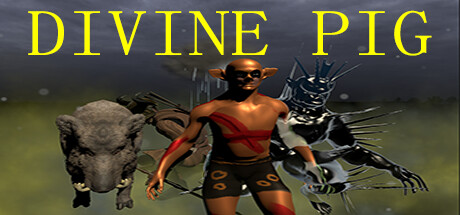
Divine Pig developed and published by liugao is an offbeat indie action RPG that builds its identity around a quirky transformation premise and a straightforward, combat-driven progression system. Instead of placing players in the role of a conventional hero, it begins with a twist—a once-powerful warrior reduced to a pig after a crushing defeat. This unusual starting point gives the game a distinct personality, framing the entire experience as a climb back toward strength, dignity, and ultimately redemption.
The narrative itself is simple and mostly serves as a backdrop, but the central idea of reclaiming lost power carries the experience forward. Progression is tied not only to numerical upgrades but also to the symbolic journey of overcoming weakness. While the story doesn’t delve deeply into character development or world-building, it provides enough context to make each stage feel like a step toward something greater. The lack of heavy exposition keeps the pacing tight, though it also means the emotional impact remains fairly limited.
Gameplay revolves around a series of structured levels where players engage in fast-paced combat against waves of enemies. The mechanics lean toward a hack-and-slash style, emphasizing direct confrontation, quick reactions, and positioning. As players advance, they unlock abilities and enhancements that slightly expand their combat options, introducing some variation into encounters. However, the overall system remains relatively simple, focusing more on consistency than complexity. This makes the game easy to pick up, but it also means that experienced players may find the mechanics lacking in depth over time.
The level-based design contributes to a steady and accessible rhythm. Each stage is compact, allowing for quick sessions that fit well into short bursts of play. This structure keeps momentum high, as there is little downtime between encounters or objectives. At the same time, the reliance on a consistent gameplay loop—fight, progress, upgrade—can lead to repetition during longer sessions. The game introduces new challenges primarily through increased difficulty rather than through significant mechanical changes, which can make later stages feel more like extensions of earlier ones rather than distinct evolutions.
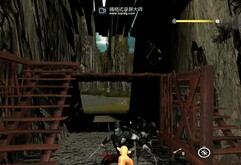
Visually, Divine Pig presents a stylized 3D world that reflects its mythological themes. Environments vary enough to suggest progression through different areas, and the overall tone leans into a slightly surreal, fantasy-infused aesthetic. However, the presentation is uneven, with some areas appearing more detailed than others. Character animations and combat feedback are functional but not particularly refined, occasionally making movement feel less fluid than it could be. The visual design supports the game’s concept, but it doesn’t elevate it beyond a modest indie standard.
One aspect that stands out is the game’s ambition relative to its scale. Despite being a smaller project, it attempts to deliver a full action RPG loop with progression, abilities, and multiple stages. While it doesn’t fully realize all of its ideas, there is a sense that it is aiming beyond its limitations. This ambition is both a strength and a weakness, as it gives the game personality but also highlights the areas where execution falls short.
The simplicity of the overall design can be both appealing and limiting. On one hand, it creates an experience that is easy to understand and accessible to a wide range of players. On the other, it restricts the potential for deeper engagement, as the systems do not evolve significantly over time. Players looking for intricate combat mechanics or a rich narrative may find the experience lacking, while those who prefer straightforward progression may appreciate its focused approach.
In the end, Divine Pig is a game that stands out more for its concept than for its depth. It offers a clear and consistent gameplay loop supported by a quirky premise, delivering moments of enjoyment without overcomplicating its structure. While it doesn’t fully capitalize on its potential, it remains a competent and occasionally charming indie title that fits well into short, casual play sessions.
Rating: 7/10