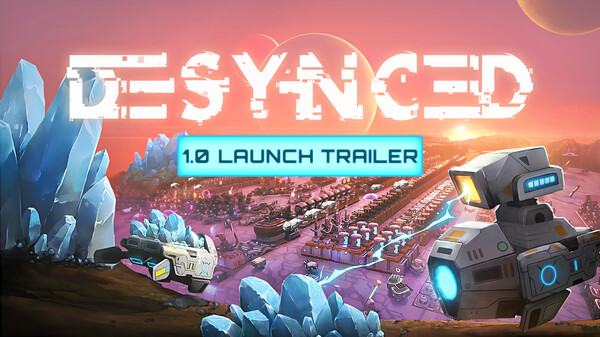
Desynced is a sci-fi strategy game with fully customizable units and behaviors. Gather, build, research, and explore the unknown. Alone or with friends, unveil the mystery of an AI on the edge of self-awareness and uncover the hidden truth in this blend of strategy, automation, and exploration.
Modeled estimate, not a reported figure. How we estimate →
Prices
Each in the currency that store quoted — not converted: the gap between two rows is the publisher's pricing, not an exchange rate.
Every market we collect.
Discounts
Every price cut of more than 20% we have observed, in each market that quoted one, with this game's chart position on either side of it. These are episodes, not a model: a sale is one event, and one event cannot tell you what the next one will do.
Reviews, worldwide (the counter carries no country): 0.29/day in the week to Sep 11 → 1.17/day in the week after.
About
When your ship becomes damaged, you must send drones to the surface of an unknown planet to build the facilities necessary for repairs. Guided by ELAIN, your onboard AI, you will build, automate, survive, and thrive. But is there more to learn from this mysterious world?
Desynced is an automation game without belts. Drones connected to your logistics network will automatically fill orders to move material around your base. Set up mining operations and factories, expand your logistics network to cover more area, manage power generation and storage, and more. When you need a more custom solution, tailor the behavior of your facilities and bots using customizable parameters, or dive into drag-and-drop scripting for maximum control.

Intricate Resource Management: Master the art of resource management, production chains, and automation to ensure the survival and prosperity of your base. Every decision counts as you strive to maintain a delicate balance in this hostile world.

Fully Customizable Units: Desynced uses drones instead of belts. Equip them with tools fit for their purpose, or program advanced behaviors using a drag and drop editor. Tailor units to your playstyle and adapt to the challenges that await.

In-Depth Technology Tree: Dive into a deep research system that will expand your technological prowess. Unlock new possibilities, develop advanced units and structures, and gain an edge over your foes as you unravel the secrets of this captivating world.

🔧 Make it your own with modding Support and Steam Workshop Integration
👥 Join forces with friends or challenge them in multiplayer
Updates
Build ids and update times come straight from Steam's PICS — the same source SteamDB reads. Patch history grows as we record new builds.
Engagement
Reviews
Themes across 104 recent reviews and how positive each mention is. A keyword signal, not full sentiment analysis.
Reviews
I really want to like this game, the concept is all there to make a great game. The implementation however leaves a lot to be desired, the documentation is FAR too sparse for the complexity of the scripting. Even as a professional automation engineer I find this a headache to get into and overly complicated for what they are trying to do. Some things are just very counter-intuitive without proper documentation or tutorial. After 1.0 I came back to give it a good shot after making a decent base in pre-release but after spending all day just setting up some basic logic and fighting with the system every step of the way I decided to just uninstall. If I am going to spend this much time learning basic conepts I would be better off starting a new actual project or learning a new software language. You will spend a TON of time just learning the basics so if you are looking for a new software language to learn and already know them all, then this may be for you, otherwise I suggest spending the time with a real language that will pay off.
Media

Related
Related
Price dynamics, follower growth, revenue and sales trajectories with interactive tooltips
This and every other Pro feature is free until October 20, 2026. A free account is all it takes.
Reviews, worldwide (the counter carries no country): 0.43/day in the week to Jul 22 → 1.38/day in the week after.
For scale, across Steam · Top Sellers · Brazil over the last 30 days: the 25 chart moves that followed a price cut of more than 20% went a median of 10 places towards #1, and the 2,413 moves with no price cut behind them went 2 away. One store, one chart, one country — it is the only place we have enough observations to say even that.
Prices outside the United States have been collected since 6 August 2026 and chart positions since 19 July 2026, so a cut older than that has no market to compare and a market that joined later has no history yet. Nothing here is converted between currencies.
Genres
Stats
All-time low is the lowest price we've recorded for this game since we started tracking it.
Languages: English, French, German, Spanish - Spain, Russian, Simplified Chinese, Japanese, Korean, Traditional Chinese
Hours played at review time, across 105 reviews with recorded playtime.
positive critical· bar length = how often the theme comes up
In very early access the programming seemed to be easier and make sense but as the game got closer to release and in the current state I can't even get a simple program to locate nearby resources due to how every aspect of their programming logic being ambiguous, unintuitive, and having so many nitpicky details you have no access to blocking the ability for any simple logic. This seems very much in part to bad translations for the logic descriptions from some other language to English. I am sure the programming is highly powerful for those with extensive coding experience and the desire to dig through whatever documentation can be found for the backend workings of the logic, but for an average gamer it is highly infuriating and very difficult to get anything working. The game itself is playable without programming, but there are far better resource management games. The whole appeal was logic automation and in the current state that is not really an option without taking out student loans to get a degree in coding.
There are little things and big things that keep me from liking this game. Overall it feels like the idea came first and then they decided to bolt a game onto it without a good understanding of what makes a game feel good. The quality of life features that one would expect are just not there, and greatly hamper the experience. I love the idea of combining combat and RTS elements with an automation game, but for one, the bot controls are just not great. The move command is right click, but the game constantly drops that because right click is also drag to move the camera. Rebinding it to another key makes it very clear that the dropped input is the game misinterpreting your action, but even with a rebound action it's a delay every time you use it and a delay before your bots respond. If it were an intentional design choice that you had to play safely to work around a signal delay (since it's a remote bot), it would be one thing, but it is entirely poor game responsiveness over action and delay. I can even see how it could be a great tool for pushing players to interact with the behavior system since the bots could respond themselves, but there are woes there too. I have worked in game development for 15 years at this point, and was part of a project that was building a toolchain with visual scripting up from scratch. The idea of using visual scripting in an automation game is a really exciting one, but it's just very, very clunky. The system dramatically lacks quality of life, and the features it does have are just the last thing a player would expect. Let me give you an example: the Divide node presents you with "From" input, "Num" input, and "Result" output. Is it From / Num or Num divided From the From register? The help text says "Divides the value in Num from the value in From and stores the floored integer result". So it's From / Num, but it doesn't give you a decimal/floating point/fractional number, and integer. So the most obvious uses of division, finding the current percentage of max (health, battery, etc), requires an extra step of multiplying by 100 beforehand so you can check 0-100. Oh, and each register has a "Data" and "Number", so a Value you can store is like "Iron Ingot : 25", so the Divide node should actually read "Divides the Number of From by the Number in num, and writes that into the Number of "Result"". Want to set a Value? Gotta Set Data and Set Number as separate operations (unless you discover the unhelpfully differently named "Combine Register" node, which ONLY lets you set both rather than have optional inputs. Want to get clever and create a building Behavior that sets the product of each of its Production components? Well, you can use the helpful "Loop Producers", but you can't easily set the product. You have to find Set to Component, which sets one of the component registers based on the slot, but you don't know which register a looped Producer result is in to set it (it sets Number to their production time??). Oh, and both 0 and 1 are register 1, because why not. So what do you do? Output it to a parameter, exit the script, and drag the result to all your production components. You know, intuive-like. You can work with the "store" register and get a lot of functionality out of that, but the primary defining feature is just frustrating to use. It feels like the game is fighting me at every turn, but also not challenging me. You get turrets and walls very early, but enemies don't actually attack your base. They don't patrol, they just hang out near spawn locations. So the "turrets" are actually just weapons you can equip to your bots. You eventually do have to explore to progress, but again, you can just whittle away the enemy and their spawns until they're dead, and they won't repopulate, so that area's safe forever. So not much to engage with there. Speaking of progressing, research is your tech progression, and there are no ways to scale up the speed at which it works until you get overclocking like 15 hours in. Having multiple research buildings doesn't do anything. Your production unlocks are nice, and do serve to move things forward, but really the biggest upgrade was from transporter modules, which let a building move items from nearby buildings. That's right, your bots have to move everything until then, and even after you get that and start building massive blocks with item chains, realize you can tell your buildings to only move things by transporters (the bots will try to help, occupy themselves, and slow things down otherwise), and get things up and running, it's never really for anything. Like I said, you're hard-capped on research rate, so scaling up just fill your surplus faster. Some of the unlocks are great, like new bots, buildings, and the like, but a lot of them are like "ok now you have virus turrets and virus cubes to make", and only give you another bot-automated build to construct. The production chains aren't puzzles, they're just "build this, and the bots will sort it out" or "put a storage here that maybe you can set a bot to fill (or not)" and that's it. Again, I think there are interesting things here if the scripting becomes friendly and straightforward, or the factory expanding had meaningful payoff, or the combat was engaging at all.
I spent a fair amount of time trying to figure out what this game is trying to be, and my conclusion is that it's several "rule-of-cool" ideas in a trench coat. The experience that I had playing it was a let-down. There's so much potential for good gameplay, but a lack of cohesion leaves me always wanting. Most of this comes from the way that the behavior system is integrated with the main gameplay. The main faction you can play, the robots, all come with integrated behavior controllers. This lets you design behaviors for them from the very beginning of the game. Even the runner, a unit with no enhancements and a single inventory slot, can be programmed. This is really exciting! But then, when you try to do much of anything with it, you find out that the systems that the runners use outside the behavior system are difficult to inspect within it. Orders can be given to the logistic network, but you can't read them or figure out which order the runner is fulfilling. Nor can you change the network settings, besides turning it wholesale on and off. The information asymmetry is strange for a programming game--programs fundamentally just move data from point A to point B. From here, things only get worse. Say you have a unit with a factory component equipped, and you'd like to produce a unit. If you're using the UI, you can select a blueprint. If you're using code, you can use the produce unit instruction. So far so good, but then the problems pile up. * If you don't have enough room for all of the blueprint's components, then production blocks, even if those components are needed at different stages of construction. (e.g. constructing the chassis versus adding components to the chassis.) * If you do have enough room for all of the components, then you'll get a unit produced! You'll also have to wait on the component to finish, since the produce command doesn't block. And if you want to know which unit was produced, then you'll need to basically guess. Now, that could be an interesting balance problem. Complex units require buildings with lots of inventory, so you can invest more in a building for more inventory! Except that inventory modules are gated further down the tech tree, and require materials more advanced than the units you're constructing. You could spend time unlocking them and expanding the factory with new materials, but then you'll run into the problem that enemy difficulty is gated on the number of techs you unlock. Have no fear, though! You don't need to do *any* of that. Instead, you'll just use the integrated behavior controller. Create a blueprint that sets the behavior to a construction routine that orders the parts you need using the unit's built-in logistics network. Now the unit can build itself! And this would be clever, but it turns out that behavior controllers subverting mechanics is basically the theme of the game. * There's a signal register on every unit, and a specialized component to read it. But the behavior controller can already read it. You don't need a signal reader. You can actually use the behavior controller to make a very, very powerful signal reader. * There's a radio receiver component, and a specialized component to send a signal. But the behavior controller can already read it, and it can write a faction register, which broadcasts on a radio channel. You don't need a radio transmitter or receiver. * There's a radar component, but it's also a command, so you barely need it. * Unit construction is made more difficult, but you can sidestep inventory requirements using behaviors. I'm 60+ hours in, and most of that time I spent figuring out how each of the instructions function. And I'd still be having a grand old time of doing that, if the game didn't have such cool ideas that it seemed to undermine at every turn. One thing I can say about this game is that the devs do care about it. They're currently working on the behavior system, making many new things possible and giving the behavior system an overhaul in the discoverability department. As I said above, this game is full of potential. At this moment, however, it's not got much else going for it.
In short: It's a crap game. The game takes everything you take for granted in other games, like "peon moves from gold mine to HQ", and makes you manually configure the behaviour of every single unit. It starts off simple, but the complexity increases, no tutorial is given, and overall it just feels like you're being punished for playing this game instead of anything else. In any other game, you want to make circuit boards? Its smelter -> make plates -> make circuits (+ a chest for crystals). In this game its hours of researching how to make it work, if it's even possible. You might even make it all work, but will you have fun? I doubt it.
There's some interesting elements, like the extent to which you can customize units and buildings. But my overall impression--having purchased the whole game--is that it feels more like an early demo. Boring map. Barely tacked-on story. Clunky controls--especially for automation--made worse by less-than-stellar tutorials/documentation. I could put in the effort to progress further, but I have zero motivation to do so. While I'm sure some people like the game, I do not. I regret wasting time/money on it, and my general recommendation is to avoid it. I actually find it to be enough of a let-down that I'll probably avoid any other titles released by the developers/publishers. Oh, and IMO $30 is wildly overpriced (because, again, it feels like a demo). IIRC, I got it for ~$20 and that's still pretty steep for the disappointing experience I had. Lastly, my impression of the game is from ~1.0, so any significant updates beyond that might, possibly, result in a better, more polished game. Or not. But I've no intention of wasting time on a 2nd chance, and that's coming from someone who often revisits older games in their library.
不推荐购买!!!!! 这游戏是我第一款忍不住要评价一下的游戏。首先是价格,在同类型工厂自动化游戏中并不算便宜,中上的价格。其次科技树的长度不够长,内容有点少。玩法的话和异星工场,幸福工厂这种第一人称不一样,是RTS类似红警。这些都是还行的地方。 这个游戏的任务和任务提示就是一陀,没见过这么差的任务指引,很多任务都是做一半然后发现就做不下去了,下一步该干嘛没一点提示。还有游戏中一些建筑,简绍就那么7,8个字,干嘛用的也没提示。很多东西都要琢磨半天才知道怎么用。 玩这游戏60个小时,有20个小时都不知道在干嘛,任务做一半没了下一步该干嘛得找半天。这个科技树解锁不了,怎么解锁又查半天。浪费很多没有意义的时间,很多地方加几句提示的话,整个游戏流程就会顺畅很多,但就没有,这游戏还冷门,攻略也没几个查也查不到。玩到后面通关了也没啥剧情提示啥的,没看攻略都不知道通关了。 总之玩下来就玩的很便秘,一半时间都不知道在干嘛,没目标,剧情又是谜语人这一块那一块的。远远不如同类型其他游戏,推荐去玩幸福工厂,戴森球,别买这个!!!!!!
I really wanted to enjoy this game, but my experience was overwhelmingly frustrating. I couldn't even make it past the tutorial. The tutorial instructions are poorly written and use terminology as if the player already understands the game's mechanics, making it incredibly difficult for new players to learn. I spent nearly two hours trying to get through the tutorial before finally giving up. It's possible I encountered a bug, but regardless of the cause, the experience was so frustrating that I doubt I'll ever launch the game again. Overall, the game feels unfinished and rushed to release. Basic interactions are inconsistent—I often had to click on bots or buildings multiple times before the game recognized my selection. The logistics system, which appears to be a core gameplay mechanic, is unnecessarily complicated and never felt intuitive. Even after spending considerable time with it, I still didn't fully understand how it was supposed to work. To make matters worse, bots frequently perform actions I never instructed them to do, such as moving resources into storage buildings I hadn't assigned. Instead of feeling like I was managing an automated system, it felt like I was constantly fighting against unpredictable behavior. In the end, the game feels chaotic, lacks clear direction, and does a poor job of teaching players how its systems are intended to work. Unless the tutorial and core mechanics receive significant improvements, I can't recommend it.
I know the reviews on this game aren't great, but I'm not sure what they are missing. I love playing this game. You don't need conveyers, and you don't need a million bots to move things around. You have internal transport attachments that can move things around without you any oversight. This game is tons of fun to figure out how to play it, and you can customize it to your hearts content. You just have to take a second to learn how the game works.
Честно, оно своих денег не стоит, и нечего это сравнивать с Факторкой — у них нет ничего общего, не считая стоимости.
Selling now
See how fast this game is selling right now — estimated copies and revenue per day from recent review growth.
Active players
Estimated daily and monthly active players (DAU/MAU) modeled from peak concurrency.
Players by region
Where this game's players are, estimated from review languages.
Players also reviewed
The games this title's players most often review too — audience affinity.
Related
| Game | Estimated lifetime revenue | Reviews | Review score | Price |
|---|---|---|---|---|
| $3.8M | 3.3K | 65% | $29.99 | |
| $594.5K | 849 | 85% | $18.99 | |
| $4.2M | 4.1K | 77% | $20.79 | |
| $1.9M | 2.7K | 86% | $19.99 | |
| $21.9K | 38 | 74% | $19.99 | |
| $3K | 7 | 29% | $11.99 |
Related
| Game | Estimated lifetime revenue | Reviews | Review score | Price |
|---|---|---|---|---|
| $1.9M | 23.3K | 89% | $3.74 | |
| $1.9M | 4.8K | 93% | $19.99 | |
| $1.9M | 5.2K | 78% | $14.99 | |
| $1.9M | 7.6K | 94% | $9.99 | |
| $1.9M | 2.1K | 57% | $39.99 | |
| $1.9M | 4.2K | 85% | $14.99 |