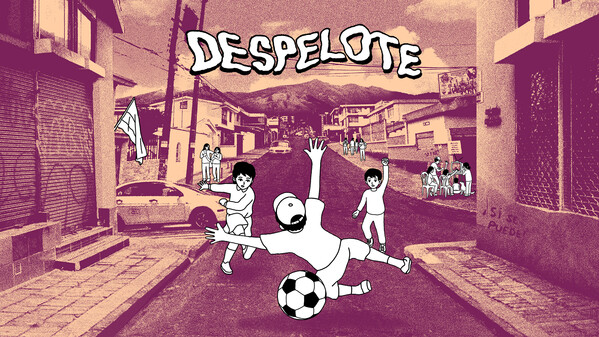
A slice-of-life adventure about childhood and the magical grip soccer held over the people of Quito, Ecuador in 2001.
Modeled estimate, not a reported figure. How we estimate →
Media

About
despelote is a soccer game about people. Get immersed in the streets and parks of Quito through the eyes and ears of eight year old Julián. Dribble, pass and shoot your soccer ball around town, and see what happens when you kick it someone's way. Feel the city change as Ecuador comes closer than ever to qualifying for the World Cup.
A bittersweet and sometimes dreamy semi-autobiographical tale of youth.
Explore a dense town space at your leisure, full of activities, interactions, and mischief to get up to.
A physics-based soccer ball that feels good to kick around in a first-person perspective.
A vibrant world full of characters that have funny, and genuine conversations.
Photos and audio recorded on location in Ecuador are used to create a strong sense of place.
Genres
Stats
All-time low is the lowest price we've recorded for this game since we started tracking it.
Engagement
Reviews
Themes across 52 recent reviews and how positive each mention is. A keyword signal, not full sentiment analysis.
Reviews
The late legendary film critic Roger Ebert said that, "Video games can never be art." Well he had not experienced games like Despelote which is not only art, but art at its highest level. What a beautiful narrative, that has the sensitivity of great films like Cinema Paradiso. If you wish to experience something special and have 2 hours to spare, just don't miss this one. Despelote is something you will remember for the rest of your life.
Not the longest game but very atmospheric. I didn't know what to expect from it and that's the best way to experience it tbh. This game got me invested in the Ecuadorian national team and now I have 4 national teams capable of hurting me at the world cup.
Related
Related
Trends
Modeled estimate over time, reconstructed from Steam's monthly review histogram.
Languages: English, Spanish - Latin America*, French, German, Portuguese - Brazil, Simplified Chinese, Spanish - Spain*languages with full audio support
Hours played at review time, across 52 reviews with recorded playtime.
positive critical· bar length = how often the theme comes up
First of all, I'm Peruvian, but I feel as though I've lived my life so disconnected from who I truly am, and this game was able to scratch an itch I've never been able to get rid of while being stuck in this place in my country with no one like me. This is an excellent game. Si se puede <3
足球并不独属于最后赢家 这个内置的足球游戏是真难玩
I love games that show me a perspective, place, or experience, that I've never experienced, or never even knew about. I will think about moments in despelote for a long time. It's a beautiful game.
Yeah, I don't understand the hype on this one. Story was meh, visuals were interesting for sure. I just didn't jive with this at all. It was short, it was buggy. I had times when all of the models in the game literally turned to mud, and it lost it's visual filter. This happened multiple times, and it stayed like that till the next cutscene or day. I just was thoroughly not impressed, I got it on deep sale, but still was not worth the money. Didn't even run well, which considering it has almost overwhelmingly positive reviews, floored me.
Everyone is taller than you. Inanimate objects obtain movement when you touch them. Posters wink at you or sparkle or embiggen the number one, projecting the dream of Ecuador’s football team winning the 2002 World Cup, of being number one. A dream of placing Ecuador onto the world stage where it has been given courtesy acknowledgements but largely ignored, just as you, the child Julián, are. How cute is it that Julián is dressed up so fancy for a relative’s wedding? How cute is it that Ecuador thinks they have a shot against the heavy hitters of Argentina, Brazil, and Germany? Save for the teacher, all adults are welcoming and gracious to the child Julián in their brief interactions. Their conversations are focused on other adults, not a child. Teenagers are the only hostile individuals who push you down if you steal their ball or snitch on their shoplifting. Even as a teen himself at a party, Julián is uneasy and uncertain of his acceptance by others as they all converse around him and not with him. The final section, in which Julián passes the football with two friends as an older teen, is warm and relaxed. It bears the conversational pacing and nonchalant subjects that previously surrounded him only ever as an observer and is now something he partakes in. Just as casually, the point of view is transferred to the ball as it gets bounced around time and space as familiar faces all pass it between one another. Football is a powerful and unifying force that transcends space and time. When focusing on the television screen Julián’s peripheral vision fades away as his focus is consumed, usually by archived recordings of the contemporary matches: Ecuador versus Peru, Argentina, Colombia, and Bolivia. The entire country participates in this viewing out of national pride. One that can take any form, whether it is speedwalking due to race walker Jefferson Perez taking Olympic gold in 1996 or taking “to the streets to show their love” for Colombian coach “Bolillo” Gomez after he was shot in the leg. On television someone proclaims, “This is sport: a jersey. And it has nothing to do with violence. Even less with politics.” And yet Ecuador’s political history unfolds itself in lock step with its progression towards the World Cup. Accounts of the economic crisis and “dollarization” are followed immediately by Ecuador’s upcoming match against the mighty Argentina. Newspapers headline football and sidebar economic developments. Ecuador’s history is viewed through the eyes of a child who shares the country’s passion for football but can only recite the facts of the greater events around him retrospectively with no real opinion of his own. More recitation than recollection. Football and politics are two sides of the same coin. Anxiety over political instability is soothed through football. Success in football validates their fight to regain stability. Football goes hand in hand with every action and event. It is in the school rooms just outside the window, it is on the minds of the children as they listen to their teacher drone on about mountains, it is at their feet as they pass to each other and trade off playing goalie. Every qualifying match is the locus of each chapter as you wander about a park in Quito, Ecuador. Interludes between chapters consist of mostly playing football. At first I believed these interludes to be dreams, but they reveal themselves to be flashes forward in Julián’s life: as he attends a soccer club, gets drunk at a party, is confronted by his mother for lying about where he would be. This last situation has a sly transition. While playing Tino Tini’s Soccer as a child his friends berate his sister until she runs away crying and Julián is subsequently lectured by his mother. As his focus is constricted on the television you do not notice you are now an older Julián playing the same game until his mother reenters the frame of focus bearing streaks of white hair. Another great transition comes shortly afterwards, as you continue to play the Tino Tini game. The match ends and the little blobs of players make their way off the field and into the city outside until your player walks into the house and jolts you awake at the screen. These playful and invisible transitions are accomplished as time flows according to no set measurement or speed. Chapters are hard cut transitions forward in time, but contain memories, daydreams, and the accelerated speed of childhood fun all flowing intermingled. Unrestricted by time or space, the greatest deceit is in plain view. The world through Julián’s eyes is monochromatic, introduced first by the black and white in-game videogame of Tino Tini’s Soccer ‘99, and bleeds into Julián’s real world surroundings. Detailed photogrammetry scans are downscaled, filtered through a pointillism screen, and reduced to a single color. Motion bearing objects and people are rendered as hand drawn figures of black and white with thick outlines. Hard details living hand in hand with substantial swaths of images being out focus match the fluidity of memory and dreams. During interludes I filed the odd shaped landscapes covered in wrong angled trees and buildings as “dream logic.” At the very end the veil is lifted in a powerful way: this landscape is not a result of illogical dreams but instead a 3D render of Google map data of the park and city as it exists now. Our narrator addresses this fact directly to us and continues to comment on the development of the game, revealing a second deception: that Julián is older than the developer was during the timeframe depicted. Despelote is more recreation than recollection, not only of the external but also the internal, as developer Julián Cordero was four, not eight, during this time and does not remember as much as he wishes. He never visited that park in Quinto until after it had been heavily remodeled as a result of the first World Cup qualification. Does this deception invalidate the potent recreation? Do we need our autofiction to hew closer to truth than imagination? Not at all! Accepting his Nobel Prize in Literature in 2017, Japanese author Kazuo Ishiguro included in his speech this fundamental truth that reverberates throughout all of Despelote: “But in the end, stories are about one person saying to another: This is the way it feels to me. Can you understand what I’m saying? Does it also feel this way to you?”
It looks nice and that's all, not really a game, or a story. I don't know what people find appealing.
Is this what it feels like to love your country
Despelote es un juego realista y no por gráficos ni gameplay, sino por los sentimientos que logra transmitir, quizás no logre recordar acontecimientos importantes que afectaron a mi pais en 2009 pero si recuerdo la clasificación de Chile al mundial y sobre todo recuerdo a Chile en ese mundial, la ganas únicas de querer jugar a la pelota, de jugar 1000 veces con Chile en el pes modeado. Esto es algo que el juego logra transmitir con su apartado artístico que satura el mundo excepto las cosas importantes para un niño, a pesar de esto deja ver la realidad a través de diálogos que uno escucha, de las noticias que se muestran y del ambiente general, mismas cosas que uno ignoraba de niño pero que siempre estuvieron ahí. No es ni por asomo mi juego favorito ni el mejor del genero, pero las sensaciones que deja las dejan muy pocos juegos y es por es que vale la pena echarle un ojo.
Audience
Estimated from the language of this game's reviews — a proxy for where players are, not official Steam demographics.
Related
| Esports Life Tycoon | $376.7K | 714 | 61% | $19.99 |
| The Pathless | $376.7K | 2.1K | 91% | $9.99 |
| Rain on Your Parade | $377.1K | 953 | 95% | $14.99 |
| SEASON: A letter to the future | $376.3K | 2.1K | 93% | $12.49 |
| Steel Armor: Blaze of War | $376.2K | 352 | 84% | $29.99 |
| Planetary Life | $377.5K | 881 | 94% | $11.99 |