Demented is a small-scale but ambitious psychological horror title developed by VisualTech48 and published by Volens Nolens Games that focuses less on traditional jump scares and more on sustained mental pressure, systemic dread, and the slow erosion of the player’s sense of control. You play as Bennet Helms, a man who awakens in an unfamiliar, hostile environment with fragmented memories and an overwhelming sense that both the world and his own mind are unstable. Rather than guiding the player through a clearly structured narrative, the game drops you into this broken reality and asks you to survive long enough to piece together meaning from scattered clues, distorted spaces, and unsettling mechanics.
The core gameplay loop revolves around exploration, survival, and managing overlapping systems that constantly work against the player. Demented places heavy emphasis on a sanity mechanic that steadily deteriorates as time passes, creating a persistent feeling of urgency. As sanity drops, the game becomes increasingly hostile: hallucinations intensify, vision narrows, environmental distortions become more aggressive, and hostile creatures appear more frequently. This creates a layered tension where danger is not limited to enemies alone, but also to the player’s internal state. Unlike many horror games where fear is externalized, Demented makes the player’s own mind one of the most significant threats, forcing constant decisions about risk, pacing, and resource use.
One of the more unsettling design choices is how the game allows morally and psychologically disturbing actions to be used as survival tools. In desperate moments, self-harm can be employed to temporarily restore sanity, trading long-term survival for short-term mental stability. This mechanic is intentionally uncomfortable and reinforces the game’s central theme of desperation and psychological decay. Health, sanity, and environmental hazards such as radiation all intertwine, meaning that solving one problem often worsens another. These systems are not always finely balanced, but their roughness adds to the sense of instability, making the player feel as though they are constantly improvising in a world that refuses to behave logically.
The environment itself feels alive in an unnerving way, largely due to the presence of the WCD, a mysterious force that seems to act as the “brain” of the world. The WCD influences how spaces shift, how enemies appear, and how reality itself warps as the game progresses. Familiar areas may become corrupted, layouts can subtly change, and safe spaces can lose their reliability without warning. This unpredictability reinforces the psychological horror angle, as players are never entirely sure whether what they are seeing is real, temporary, or a symptom of their declining sanity. The result is a game world that feels hostile not just because of what inhabits it, but because it actively resists being understood.
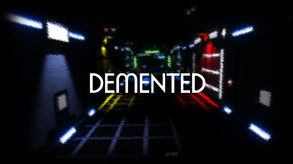
Visually, Demented is modest and clearly constrained by its indie budget, but it uses lighting, fog, and environmental effects effectively to establish atmosphere. The environments are often sparse, relying on darkness, flickering lights, and limited visibility to create tension rather than detailed textures or complex geometry. Sound design plays an equally important role, with distant noises, sudden audio distortions, and ambient hums contributing to a constant sense of unease. Silence is used just as effectively as sound, often making exploration feel oppressive and lonely, as if something unseen is always watching from just beyond the player’s field of vision.
Combat and encounters with enemies are intentionally uncomfortable and often encourage avoidance rather than confrontation. Resources are limited, enemies are dangerous, and direct engagement rarely feels empowering. This reinforces the survival horror tone and pushes players toward cautious movement, observation, and strategic retreat. When things go wrong, they tend to spiral quickly, creating moments of genuine panic where managing sanity, health, and positioning all at once becomes overwhelming. These moments are where Demented is at its strongest, successfully translating psychological pressure into mechanical stress.
Reception to the game tends to reflect its niche appeal. Players who enjoy experimental indie horror and unconventional mechanics often appreciate its ambition and unsettling systems, while others may find it rough, unpolished, or frustrating due to its limited guidance and sometimes unforgiving balance. The pacing can feel uneven, and the lack of clear narrative direction may alienate players who prefer more story-driven horror experiences. However, for those willing to engage with its systems and embrace uncertainty, the game offers a distinct experience that stands apart from more formulaic horror titles.
Overall, Demented is an imperfect but intriguing psychological horror game that prioritizes atmosphere, mental deterioration, and systemic tension over spectacle. It is a game that thrives on discomfort, ambiguity, and the slow collapse of certainty, asking players not just to survive external threats but to manage their own unraveling perception of reality. While its presentation and mechanics may feel rough around the edges, its commitment to psychological horror gives it a unique identity that will resonate with players who value mood, experimentation, and sustained unease over polish and jump scares.
Rating: 6/10