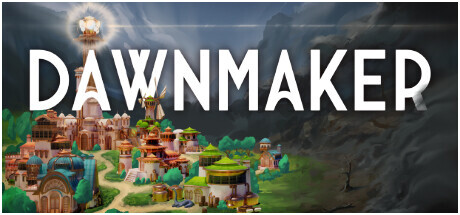
Dawnmaker is a turn-based city building and deckbuilding game, made by 2 strategy fans. It feels like playing a solo board game. Build luminous cities, optimize your deck and create powerful combinations between buildings and cards to bring life back to a dead world. Play the demo now!
Modeled estimate, not a reported figure. How we estimate →
Media

About
Dawnmaker is a solo strategy game combining elements of city building and deck building to create a board game-like experience. In a world covered by a toxic Smog, only you can rekindle the ancient lighthouses and bring light and life back. Construct buildings, gain new cards, generate resources and improve your central lighthouse to unlock new building space.

Optimize your deck — Gain increasingly powerful cards as you improve your city. Your cards and buildings interact in various ways: choose them wisely to create the most powerful combinations!
Build efficient cities — Make the best of your limited space by optimally positioning your buildings. Improve your lighthouse to repel the Smog and expand your city.
Manage your resources — Grow farms, build industries, develop science and inspire your people to create the rarest of resources: Eclairium!

Reclaim the lost continent — The continent of Heksiga has been covered by a toxic Smog. Repair and improve magical lighthouses to repel that Smog and reclaim the land, region by region.
Recover lost technologies — Explore vestiges of the old Empire and rediscover technologies that were lost to the Smog.

Hi, we're Adrian and Alexis! We founded Arpentor Studio, a cooperative company, to create deep strategy games. Dawnmaker is our first commercial game. If you want to get involved, give us feedback on the game or help our small studio spread the word about Dawnmaker, please join our discord!
Genres
Stats
All-time low is the lowest price we've recorded for this game since we started tracking it.
Languages: English*, French, Japanese*languages with full audio support
Engagement
Hours played at review time, across 42 reviews with recorded playtime.
Reviews
Themes across 42 recent reviews and how positive each mention is. A keyword signal, not full sentiment analysis.
positive critical· bar length = how often the theme comes up
Reviews
This is a great game, and I really wish I could recommend it, but it lacks any sort of nuance and depth. It's a ton of fun for the first few hours, but the gameplay gets stale pretty quickly. There isn't enough variance -- between levels, between characters, between runs. In this game, I can pick the strategy I'm going to use for the rest of the run before I play my first card, and from there it's just execution with barely any significant decisions. The really good deckbuilders (e.g. Slay the Spire) force you to make lots of choices which have meaningful impact on the rest of the run. Dawnmaker doesn't do that. Here are some things I'd like to see. If some of these are added, or really any other fun mechanics that break up the monotony, I'd be a lot more interested in playing this game some more and a lot more likely to recommend it. 1. Variance between levels. This is far and away the biggest problem. Every stage is a big flat plain with mostly buildable tiles and a scattering of buildings (ruins, lighthouses, etc). Give me some variety. Give me a map where half the terrain is lakes or mountains and I have to prioritize when and where my buildings interact. Give me a big lake with some isolated islands. Give me a tiny map where I don't have enough room for everything and I need to destroy my low-tier buildings to make space in the lategame. If you're feeling really crazy, give me a map where some of the tiles change position every time I shuffle my deck. The way things currently stand, synergy bonuses between adjacent buildings are by far the strongest mechanic and badly in need of balance. Also, change the way the cards work in certain levels. Maybe make one resource more valuable sometimes. For example, give me a lush farming environment where agricultural production from farms and harvests is increased but there's a penalty to industry and activated buildings. How about a map where all building costs are doubled? How about a map where all [rock] costs are changed to [book] and vice versa? Some of these ideas might be terrible, and all of them would require some testing and balancing, but right now every level is too similar. And on a related note... 2. Variance between characters. For starters, give us more unique cards and some unique buildings for each character. There's some slight variation right now in the starting deck and building set, but it's not enough to matter significantly. You don't even need to design a lot of new buildings -- just take some of them out of the general pool and restrict their availability to one specific character. 3. Limit some broken combos. It's super satisfying the first time you get a big pile of distilleries and barns and restaurants and libraries and [that one building that gives you +1 action and +1 lightning for 4 books], but once you have it the rest of the game is just a bunch of mindless clicking. And when that's how every game goes, it's just not very interesting anymore. If each character only had access to a subset of the most powerful buildings, we'd have to figure out some different ways to win. Oh, and give us one character whose superpower is that she has access to all the buildings to keep all the ridiculous combos in the game, but balance her with a downside (or make her the easy / intro character). 4. Make lighthouses more impactful and/or necessary. More often than not, the best strategy is to completely ignore most of the lighthouses until the very last turn because the benefits they offer are not worth the cost. Maybe change the main hub upgrade so that e.g. from level 3+ the upgrade also requires at least 1 more repaired lighthouse. 5. Fix Exporter. In its current state, it's straight up broken. Either get rid of it entirely or nerf it so that it can't give so much money. Give it a cap where it stops working after generating 10 coins, or steadily increase the cost of using it. Right now, you can get a gamebreaking amount of coins from it, and the process of doing so is not even especially fun. Ok, that's it for now. I would absolutely love to come back and update this review to a positive one someday, so I hope this criticism is taken in the spirit in which it was intended. Cheers.
An interesting take on the episodic city-builder. Challenging but not impossible. Occasionally frustrating. Definitely worth the money.
Les points positifs: - Chouettes visuels - Partie à durée raisonnable - Mécaniques à découvrir, apprivoiser et maîtriser sympa - Les trois personnages qui forcent à explorer des mécaniques différentes tout en augmentant la difficulté est une très bonne idée. - Une démo disponible pour se faire une bonne idée du jeu! - Un prix raisonnable par rapport au contenu proposé. Les points négatifs: - Pas/Peu de musique - Peu de diversité dans les stratégies ce qui affecte l'expérience tout entière. - A partir du moment où les mécaniques sont maîtrisés le jeu ne propose plus vraiment de challenge ou de rejouabilité.
Dawnmaker is an intriguing strategy title that merges city-building principles with deckbuilding mechanics in a way that feels both familiar and refreshingly distinct. Developed by Arpentor Studio and published by Acram Digital, the game places players in the role of a caretaker tasked with restoring civilization across the mist-covered lands of Heksiga. The world has been consumed by a dangerous Smog, leaving only ancient lighthouses as bastions of hope. From its opening moments, Dawnmaker establishes a compelling premise centered on rebuilding, discovery, and survival, inviting players into a slower and more contemplative experience than many modern strategy games. The game's foundation lies in its turn-based design, where every action carries significance. Players build settlements around their lighthouse by drawing and utilizing cards that represent structures, resources, and technological advancements. This fusion of mechanics creates a satisfying rhythm, as each turn presents opportunities to refine a strategy or adapt to changing circumstances. Managing resources becomes a balancing act that never feels overly punishing, while the gradual expansion of one's settlement offers a constant sense of accomplishment. Dawnmaker succeeds by ensuring that even seemingly minor decisions can have lasting consequences later in a playthrough. A standout element is the limited space surrounding the player's settlement. Instead of encouraging endless expansion, Dawnmaker turns city planning into a puzzle. Buildings interact with one another in meaningful ways, rewarding careful placement and thoughtful combinations. Farms, workshops, and specialized structures all contribute to an interconnected economy, while upgrades to the central lighthouse slowly reclaim land from the surrounding Smog. This progression system is particularly effective because it ties gameplay advancement directly to the game's narrative themes of restoration and hope. Every newly illuminated tile feels earned, reinforcing the satisfaction of transforming a hostile landscape into a thriving community. The setting itself deserves recognition for its understated storytelling. Heksiga is presented as a world scarred by catastrophe, with traces of its former glory scattered across the map. Dawnmaker avoids excessive exposition, instead allowing players to piece together the history of the continent through exploration and progression. The atmosphere carries a quiet sense of melancholy, but it is balanced by the optimism inherent in rebuilding what was lost. This subtle approach to storytelling complements the gameplay well and gives the world a stronger identity than many indie strategy titles. Visually, the game embraces a clean and approachable art style that emphasizes clarity over spectacle. The interface is easy to navigate, and important information is presented in a manner that keeps players focused on strategic choices. Animations are simple but effective, lending weight to actions without slowing down the pace of play. Combined with a relaxing soundtrack, Dawnmaker creates a calm and inviting environment that encourages extended sessions. Its presentation may not be lavish, but it consistently supports the gameplay experience. Despite its strengths, Dawnmaker is not without limitations. Players looking for a sprawling city simulator with massive populations and extensive customization options may find its scope relatively modest. The methodical pace, while appealing to strategy enthusiasts, may also feel repetitive to those who prefer more dynamic or action-oriented experiences. Additionally, veteran deckbuilding fans may wish for a broader selection of cards and more varied late-game challenges to further diversify individual runs. Even with these minor shortcomings, Dawnmaker demonstrates a clear understanding of what it wants to be. It does not attempt to compete with larger strategy franchises through scale or visual excess. Instead, it focuses on delivering a tightly designed experience built around meaningful decisions and rewarding progression. The marriage of digital board game sensibilities with city-building mechanics results in a game that feels remarkably cohesive and memorable. For players who appreciate thoughtful strategy games that value planning over speed, Dawnmaker is an easy recommendation. Its blend of deck management, settlement building, and atmospheric world restoration creates a uniquely satisfying experience that stands apart from many of its contemporaries. Arpentor Studio has delivered an impressive title that showcases creativity and confidence in its design philosophy, while Acram Digital continues to support distinctive projects within the strategy genre. Rating: 8/10
Very engaging puzzler. I wouldn't call this a city builder- you do not manage population, jobs, housing, etc. You place buildings via an rng progressive card system into tiles with strategic positioning to increase value. The challenge is good, and the variety of cards, buildings, maps imply large amount of replayability. This is one that has caught in the 'one more turn' mentality. Turns are very quick.
Хорошая игра для своего жанра. Пока не понимаешь что к чему и не знаешь зданий интересно эту игру исследовать. Но в итоге мало вариативности для 3! прохождений на разных(нет) персонажах. НО! Слишком дорого за такое количество контента. По скидке в процентов в 60-70 можно взять.
Fun but currently too repetitive. some really broken combos you try to go for every game.
Um euro game competente, mas esquecível. Para quem é familiar com jogos de tabuleiro, várias mecânicas típicas do gênero vão soar imediatamente familiares: tile placement, deck building, engine building, entre outras. O gameplay de Dawnmaker reproduz a experiência clássica de um euro game — talvez até demais para o seu próprio bem. Dawnmaker é claramente um jogo construído em torno de suas mecânicas. A parte temática funciona apenas como flavour para sustentar o que realmente importa: as engrenagens do sistema. E é justamente nessas mecânicas que mora o grande valor do jogo. Elas são muito bem executadas. A sensação de progressão ao melhorar seu baralho após cada partida, o momento “ahá!” ao conseguir efetuar combos enormes e gerar recursos quase infinitos em um único turno — tudo isso é bastante satisfatório. Em alguns momentos, a variância pode parecer um pouco punitiva e fazer você sentir que, mesmo jogando bem, perdeu porque o prédio que gerava o recurso essencial simplesmente não apareceu nas últimas rodadas. Mas esses casos são raros. O jogo constantemente oferece ferramentas para você controlar a sorte, e, quando consegue domá-la, a recompensa é gratificante. Essa vontade de “domar” o jogo a cada nova run, otimizar combos e torcer para um pouco mais de sorte é o que faz você querer repetir uma partida atrás da outra. No entanto, Dawnmaker carrega consigo dois problemas que o impedem de alcançar a excelência. O primeiro, mais simples, é a falta de variedade. Apesar de oferecer três personagens jogáveis com baralhos iniciais distintos — o que, em tese, incentivaria diferentes abordagens —, a sensação de repetição surge após poucas horas. As variações de cartas não trazem mudanças significativas na jogabilidade e, na prática, cada personagem parece ter um “combo ideal” para vencer. Logo nas primeiras partidas, a ideia de explorar novas estratégias vai sendo deixada de lado. Você acaba perseguindo apenas a abordagem que sabe ser a mais eficiente. No caso da personagem inicial, por exemplo, combos de ativações: prédios que podem ser ativados a custos baixos colocados ao lado de prédios que geram recursos ao serem ativados indiretamente. Existem outras mecânicas de escalonamento, como o harvest das colheitas, mas a superioridade da primeira abordagem é tão intuitiva que raramente faz sentido investir na segunda. Dawnmaker se apresenta como um jogo de múltiplos caminhos para a vitória, mas, na prática, se resume a otimizar até acertar o caminho evidentemente mais forte. Ainda assim, esse ponto me incomodou menos do que o seguinte: a temática. Dawnmaker se vende como um jogo de construção de cidades, mas nunca me senti, de fato, construindo uma cidade. Ao entrar no flow do jogo, você só pensa nos números — quanto de recurso A e B consegue gerar, quantos turnos precisa para executar cada ação. O tema se dissocia das mecânicas, e a experiência se reduz a uma gestão genérica de números. Temas em jogos não são apenas recursos cosméticos; eles ajudam na imersão e também tornam o gameplay mais intuitivo. Em um jogo de batalhas táticas, por exemplo, basta olhar para uma unidade de arco e flecha ou de espada e escudo para inferir, intuitivamente, suas características, sem precisar ler descrições. Em Dawnmaker, o tema pouco apoia a jogabilidade. Por isso, rapidamente é deixado de lado e o jogo vira apenas uma engrenagem matemática. No fim, Dawnmaker me prendeu por algumas boas horas, e me diverti enquanto aprimorava meu baralho e encaixava combos satisfatórios. Mas é um jogo que provavelmente cairá no esquecimento. Um jogo bem feito, mas jamais memorável.
A very fun deck-builder. Works really nicely and definitely scratched the strategy itch.
很棒的 deck builder ,关键是平衡调的不错,一直都有挑战又不至于太难。 一定要把三个难度都试试,风格差异很大。这里的难不是容错性低,而是在不同的游戏风格下,需要更复杂的卡牌配合。
Related
Related
Trends
Modeled estimate over time, reconstructed from Steam's monthly review histogram.
Audience
Estimated from the language of this game's reviews — a proxy for where players are, not official Steam demographics.
Related
| Reach for the Sun | $64.9K | 343 | 70% | $4.99 |
| FPV Freerider | $64.9K | 344 | 89% | $5.99 |
| Duck Life 8: Adventure | $64.9K | 442 | 88% | $6.99 |
| Football Club Simulator - FCS #21 | $64.9K | 183 | 67% | $9.95 |
| Blossom Tales II: The Minotaur Prince | $64.9K | 222 | 91% | $14.99 |
| Transports | $64.9K | 107 | 66% | $17.99 |
Related
| Clash of Clans | $2.6B | 61.4M | 90% | Free |
| Plants vs. Zombies™ | $1.9B | 5.7M | 75% | Free |
| Clash Royale | $1.9B | 41.6M | 89% | Free |
| Lords Mobile: Kingdom Wars | $1.9B | 9.2M | 90% | Free |
| Stick War: Legacy | $1B | 3.2M | 96% | Free |
| Evony: The King's Return | $644M | 826.6K | 80% | Free |