Build, cable, and automate. Assemble racks, servers, and switches, connect enough capacity for each app, earn money from processed data, and unlock gear and bigger customers with XP and reputation. Follow colored data packets as your center comes to life.
Modeled estimate, not a reported figure. How we estimate →
Discounts
Every price cut of more than 20% we have observed, in each market that quoted one, with this game's chart position on either side of it. These are episodes, not a model: a sale is one event, and one event cannot tell you what the next one will do.
Reviews, worldwide (the counter carries no country): 2.29/day in the week to Sep 1 → 2.14/day in the week after.
For scale, across Steam · Top Sellers · Brazil over the last 30 days: the 26 chart moves that followed a price cut of more than 20% went a median of 7 places towards #1, and the 2,402 moves with no price cut behind them went 2 away. One store, one chart, one country — it is the only place we have enough observations to say even that.
Prices outside the United States have been collected since 6 August 2026 and chart positions since 19 July 2026, so a cut older than that has no market to compare and a market that joined later has no history yet. Nothing here is converted between currencies.
About

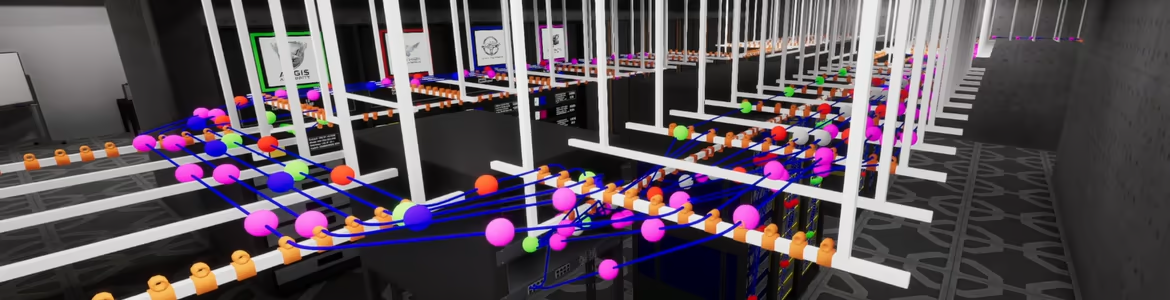
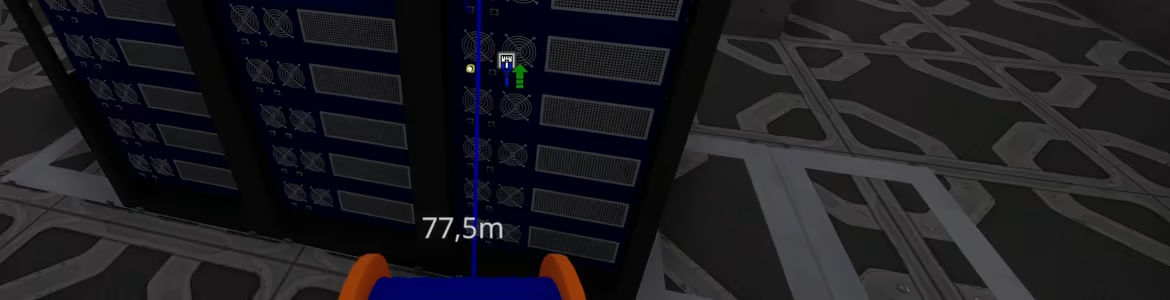
Build, cable, and grow a living data center from the ground up. Start with bare floors, buy racks, servers, and switches, then physically place and stack your hardware the way you want. Run Ethernet between ports to shape your network by hand and watch data spring to life: every customer’s traffic appears as colored packet-balls rolling along your cables, revealing bottlenecks, idle links, and beautifully tuned throughput at a glance.

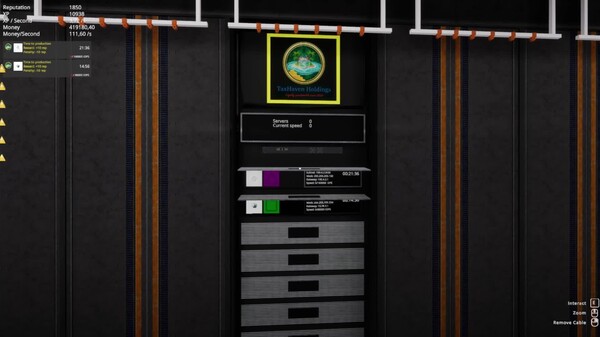
Customers arrive with app requirements and capacity targets. It’s your job to connect enough servers to each customer app, balance load across racks and switches, and keep the data flowing. As you successfully process customer data you earn money to expand, XP to unlock more capable devices, and reputation to attract bigger, more demanding clients. Hardware ages, too—servers and switches have end-of-life and can break—so design for uptime: keep services reachable even if devices on the path die, swap out failing gear, and build redundancy with servers that can use multiple network connections.
Tinker for perfect layouts or move fast to hit deadlines; either way, this is a tactile builder where every cable matters and every improvement is visible. No complex command lines—just the satisfying click of ports, the hum of stacked servers, and a vibrant river of packets proving your design works, even under failure.
Key features
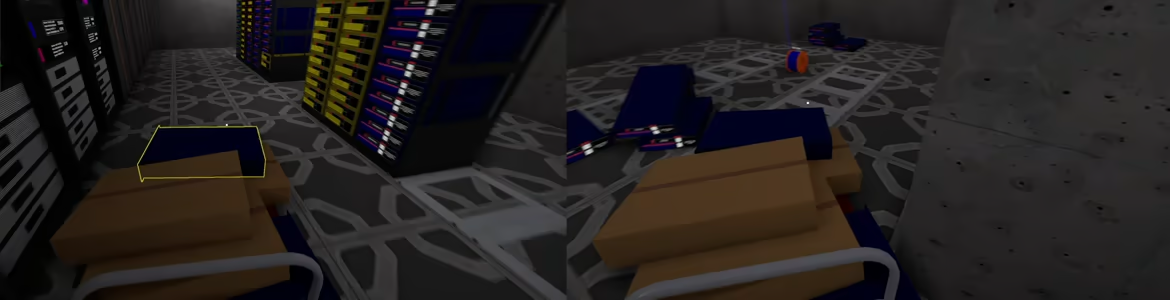
Hands-on data center building: buy racks, servers, and switches; stack hardware and route Ethernet by hand.
Visual networking: see packets as colored balls per customer, making flow, congestion, and capacity instantly readable.
Customer-driven goals: connect enough servers to each app to meet requirements and keep contracts running.
Progression that rewards good design: process data to earn money, gain XP to unlock new devices, and build reputation to attract new customers.
Reliability and maintenance: devices have lifespans and can fail—plan replacements, manage downtime risk, and keep services online.
Redundancy that matters: give servers redundant connections and create alternate paths so traffic stays reachable when a switch or link dies.
Evolve your layout: upgrade hardware, recable to remove bottlenecks, and scale your floor from scrappy beginnings to a bustling operation.
Immediate feedback: every placement, failure, connection, and upgrade changes how packets move—optimize by watching the network breathe.
Build it your way, wire it your way, and grow from a single rack to a reputation that attracts the biggest clients—all powered by a network you can literally see working, surviving hiccups and hardware end-of-life along the way.
Add-ons
Each DLC is estimated with the same model as a game, then summed — a modeled figure, not reported DLC sales.
Engagement
Reviews
Themes across 146 recent reviews and how positive each mention is. A keyword signal, not full sentiment analysis.
Reviews
Ну не плохая игра не хватает детального перевода для удобства, храмоватенькая оптимизация. Рекомендую любителям МММ.
Hyggeligt og til tider afslappende spil.
Satisfactory type shi, but more boring. But relaxing and fun if u smart
Media

Related
Related
Price dynamics, follower growth, revenue and sales trajectories with interactive tooltips
This and every other Pro feature is free until October 20, 2026. A free account is all it takes.
Genres
Stats
All-time low is the lowest price we've recorded for this game since we started tracking it.
Languages: English, French, Italian, German, Spanish - Spain, Arabic, Czech, Dutch, Japanese, Korean, Portuguese - Brazil, Portuguese - Portugal +7 more
Hours played at review time, across 149 reviews with recorded playtime.
positive critical· bar length = how often the theme comes up
e muito legar e muito bom
if ya got adhd good luck (learned from personal experince)- cannot spell ethier
I tried the demo of this game and it was okay given the fact that you are very limited in what you could do. Well, I have played this for some time and have actually found this to be a lot of fun, it is good for working on problem solving, and also realizing that you can do things the quick and easy way or the looks good kind of way.
It is a fun game and I have sunk quite a bit of time into it. I have quite a bit of background also in the IT sector so the game was quite easy for me to grasp. What I enjoyed: [list] [*] It is a tycoon type game [*] Nice to play and listen to a podcast or something else on the side [*] After you get people that switch out the EOL equipment, you can just focus on building [/list] But frankly there are something that I just found hard to figure out even with my background. And some things which just degrade the game for me. [list] [*] Every time you connect a cable, a switch, a server or add an IP to the server the whole network is re-evaluated. At first you don't notice since there is not that much to check. But now that I have 120+ racks of servers the frame rate drops after every move. I have no idea for a fix for this but this needs to be addressed as the play area very big. I have used only 10th of the whole area. And I have a "NASA PC" [*] Configuring routes was hella confusing at first, because I asumed that the source and target were [i] static routes [/i]. Turns out they want you to think of it as dynamic routing, which I figured out after I saw that routers can be assigned an ASN, which is a term used closely with BGP. Thus the source is the network you want to share and the target is whom you want to share it with. Completely opposite to the [i] static routing [/i] logic. [*] Allowing or disallowing VLANs does virtually nothing good as it seems that disallowing a vlan still allows [i] VTP messages [/i] to go trought. It would be really nice it would not replicate VLANs to the switches where a certain VLAN is not allowed. [*] When doing routes from Network A -> Network B you would normally expect it to go throught the router in the real world. In this game [i] it just knows where to go throught the OSI L2 [/i] and just skips going throught the router. TBF it makes it easier, because you don't have to have super big uplink cluster on the router then, and allows your routers to be connected with just one 1Gbps link, because no traffic will actually never hit the routers. This however creates a different problem. When I wanted to have only two core-SWs for my DMZ, I couldn't, because malicious attacks would just completely jump from one VLAN to another with out going throught the firewall like I wanted. [*] Service request by the companies are boring/useless. They are either [i] I want servers in another subnet then I provide [/i] or [i] I want access to the internet [/i]. The problem is that the service request get automatically done when you do your network right. Aka create a subnet for your X, RISC, Mainframe and GPU servers as that allows you to build racks faster and set IPs for the servers when racking them and then just assign compnies later because you route them anyways with the router after that. [*] Havent had any uses for the firewall except for putting it in-front of the DMZ, there is currently no penaltiy when a customer can "access all other customer servers" so just keeping all your servers in the same subnet, or even seperating subnets based on the server types has no penalty what so ever. [*] Last confusing part about the whole thing is that there are quite a bit non-private IPv4 addresses for the consumers/clients, but then you also have DMZ??? Also would be nice if there was a certain range of VLANs that are just for your datacenter so you know that you won't overlap any VLANs with other customers. [/list] Despite all of my problems with the game, I have still enjoyed it overall. I do recommend checking the game out. It is especially enjoyable if you don't want to cheese the whole thing and just build a massive server park with redudency and proper topology.
nice simulator but the tutorials are not I had to go to yt to see how that works lmao but keep going
Data Center, developed and published by Waseku, takes a refreshingly original approach to the simulation genre by placing players in charge of designing, managing, and expanding a modern server facility from the ground up. Instead of running a traditional business or city, the game focuses on the digital infrastructure that powers countless online services. Beginning with an empty room and a modest budget, players gradually transform their space into a sophisticated network hub by installing racks, servers, switches, and other critical hardware. The concept may sound highly specialized, but the game presents its systems in an intuitive way that makes the experience enjoyable even for those with little knowledge of networking technology. It blends realistic management mechanics with satisfying visual feedback, making every expansion feel meaningful and rewarding. Construction and organization form the core of the gameplay. Every component must be physically placed, and network devices need to be connected using Ethernet cables to create a fully functioning system. Rather than hiding the technical aspects behind automated menus, Data Center encourages players to understand how their infrastructure works through direct interaction. One of its most distinctive features is the real-time visualization of data packets traveling across the network. Watching streams of information move between servers and switches not only gives life to the facility but also serves as a practical tool for identifying congestion and inefficient layouts. As the data center grows larger, maintaining a clean and efficient network becomes increasingly important, turning every design decision into an engaging logistical puzzle. Progression revolves around serving customers who require computing resources for various applications. Completing contracts generates revenue, increases reputation, and unlocks new equipment capable of supporting larger and more demanding operations. The steady flow of upgrades ensures that the experience remains engaging, as each new server or networking device opens additional possibilities for expansion. Rather than simply purchasing stronger hardware, players must carefully integrate every addition into their existing infrastructure while maintaining optimal performance. This gradual progression creates a satisfying rhythm where financial planning, technical improvements, and strategic expansion work together to reward thoughtful decision-making. The simulation becomes even more compelling through its emphasis on reliability and maintenance. Hardware does not last forever, and equipment failures become an inevitable part of operating a successful facility. Players are encouraged to prepare for these situations by implementing redundant network paths and backup systems that keep customer services running even when individual devices fail. These mechanics add a welcome layer of realism without becoming unnecessarily punishing. Instead of merely reacting to problems, players are constantly motivated to design stronger, more resilient systems capable of handling unexpected disruptions. This focus on preventative planning gives the management gameplay additional depth and distinguishes Data Center from many other tycoon-style simulations. Visually, the game favors functionality over flashy presentation, and this design philosophy works remarkably well. Server rooms gradually fill with equipment, cables, and animated data traffic, creating an environment that feels active despite its technical subject matter. The interface remains clean and easy to navigate even as operations become increasingly complex, allowing players to monitor network performance without feeling overwhelmed. Sound design also contributes to the atmosphere through the subtle hum of running equipment and mechanical effects that reinforce the feeling of managing a professional server facility. Although the graphics are not intended to showcase cutting-edge visual technology, they effectively communicate information while supporting the overall immersion. Data Center succeeds by transforming an industry that many people rarely think about into an engaging and surprisingly accessible management experience. It combines construction, resource management, problem-solving, and technical planning into a simulation that remains consistently rewarding as operations scale upward. The careful balance between realism and accessibility allows newcomers to learn naturally while still offering enough strategic complexity to satisfy players who enjoy optimization and efficiency. Waseku has created a niche simulation that feels both educational and entertaining, proving that even the unseen backbone of the internet can become the foundation for compelling gameplay. For fans of management simulations looking for something beyond the usual factories, cities, or retail businesses, Data Center offers a distinctive and highly satisfying experience. Rating: 8/10
Selling now
See how fast this game is selling right now — estimated copies and revenue per day from recent review growth.
Active players
Estimated daily and monthly active players (DAU/MAU) modeled from peak concurrency.
Players by region
Where this game's players are, estimated from review languages.
Players also reviewed
The games this title's players most often review too — audience affinity.
Related
| Game | Estimated lifetime revenue | Reviews | Review score | Price |
|---|---|---|---|---|
| $9.6K | 39 | 77% | $8.30 | |
| $2M | 3K | 86% | $19.99 | |
| $141K | 255 | 74% | $14.99 | |
| $136.4K | 188 | 80% | $16.99 | |
| $28.3K | 49 | 94% | $14.99 | |
| $16K | 78 | 44% | $5.99 |
Related
| Game | Estimated lifetime revenue | Reviews | Review score | Price |
|---|---|---|---|---|
| $323.7K | 2.6K | 70% | $9.99 | |
| $323.8K | 1.2K | 89% | $9.99 | |
| $323.7K | 1.4K | 88% | $9.99 | |
| $323.9K | 1K | 88% | $12.99 | |
| $323.9K | 1.5K | 79% | $9.99 | |
| $323.9K | 637 | 92% | $15.99 |