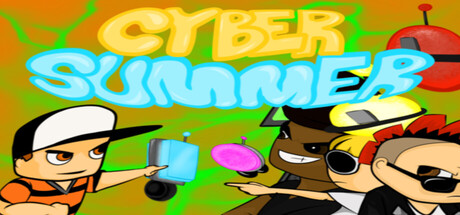
Role playing game set in the modern-day. Battle Robots with other kids in the city. Battle monsters in turn-based combat outside of real-time bot battles. Manage items, currency and trade with other kids to upgrade your robot. Trade/Collect Baseball cards, play a board game, and a shooter minigame.
Modeled estimate, not a reported figure. How we estimate →
Media

About
Name your character and choose their stats as well as their dress style. In this Bot Battler, you start the Summer with the newest fad toy. All the coolest kids have these new Cell Phone Robots that can battle each other. Take control of your robot in cyberspace as you battle other bots. Win battles and earn items you can use in turn-based battles. Trade items with other kids to pop on accessories for your robot. Use it as a phone to call other characters in the game. Unlock abilities based on your dress style. Collect Baseball cards. Use these cards in a Rock-Paper-Scissors style mini game where you can win more cards. Purchase packs of cards in game to earn new ones. Manage in game Currency and a Bank Account. Play an endless runner minigame called Bullets and Babes. Or slow things down with a simple dice rolling board game. Experience Summer's latest fad in whatever ways you like.
Stats
All-time low is the lowest price we've recorded for this game since we started tracking it.
Languages: English
Reviews
Cyber Summer is a small but imaginative role-playing experience that tries to recreate the feeling of a carefree, tech-driven childhood summer while blending it with elements of competitive robot battling. Instead of placing players in a fantasy realm, the game grounds itself in a modern setting where kids engage in digital competitions using customizable robotic companions accessed through their devices. This concept gives the game a distinct tone, combining everyday life with a layer of playful science fiction, and it immediately sets expectations for a more relaxed, exploratory experience rather than a high-stakes adventure. The gameplay is built around a mix of systems that attempt to simulate both competition and leisure. At its core are robot battles that take place in a virtual space, where players engage in combat using their customized units. These encounters alternate between real-time action and more deliberate, turn-based elements, creating a hybrid structure that aims to balance accessibility with strategy. Winning battles provides resources that can be used to improve your robot or personalize its appearance, tying progression to both performance and experimentation. While the combat system works well enough to support the overall loop, it remains relatively simple, and its mechanics do not expand significantly over time. Beyond combat, the game places a strong emphasis on variety, offering a range of side activities that attempt to capture the spirit of an unstructured summer. Players can trade items, collect cards, participate in small mini-games, and interact with various characters throughout the environment. These features give the world a sense of liveliness and encourage exploration, making it feel less like a linear progression and more like a sandbox of loosely connected activities. The idea of combining multiple small systems into a single experience is one of the game’s more interesting aspects, as it reflects the unpredictability and freedom of the setting it is trying to portray. However, the abundance of features also highlights one of the game’s main weaknesses. While there are many activities to engage with, most of them are quite shallow and do not evolve beyond their initial introduction. The mini-games are entertaining for a short time but lack the depth needed to remain engaging, and the broader systems often feel disconnected from one another. Instead of building toward a cohesive experience, the game can feel fragmented, as if it is presenting a collection of ideas rather than a fully integrated design. The presentation reinforces the game’s modest scope. Visually, it adopts a simple and colorful style that fits its lighthearted tone, but it does not push for detail or technical complexity. Character customization adds a small layer of personality, allowing players to express themselves through their appearance, which in turn influences certain gameplay elements. This connection between style and function is a creative touch, though it is not explored deeply enough to become a defining feature. The overall aesthetic is pleasant and approachable, even if it lacks a strong visual identity. Pacing is another area where the game struggles to find balance. Because it frequently shifts between different types of activities, it rarely settles into a consistent rhythm. Just as one system begins to feel engaging, the game often moves on to something else, which can disrupt immersion and make it harder to feel invested in any single aspect. This structure works well for short play sessions, where variety keeps things fresh, but it becomes less effective over longer periods, where the lack of focus becomes more apparent. In terms of long-term engagement, the game relies heavily on its initial charm and the novelty of its ideas. Once players have explored the various systems and become familiar with the mechanics, there is limited incentive to continue. Progression exists, but it does not offer enough meaningful rewards or evolving challenges to sustain interest. The experience is best approached as something to explore casually, rather than a game that encourages extended commitment. Ultimately, Cyber Summer is a creative and sincere project that succeeds in capturing a specific mood and sense of nostalgia, even if it falls short in execution. Its blend of robot battles, social interactions, and mini-games shows a clear ambition to create something varied and expressive, but the lack of depth and cohesion prevents it from reaching its full potential. It offers moments of charm and originality, particularly for players who enjoy experimental indie titles, but it remains a somewhat scattered experience that struggles to maintain momentum over time. Rating: 5/10
Related
Related
Trends
Concurrent players on Steam, sampled daily since tracking started.
Momentum
Pace estimated from the game's recent review growth (our daily snapshots) at its own sales-per-review ratio — a momentum signal, not booked sales.
Related
| Slay the Spire | $80.1M | 216.6K | 97% | $6.24 |
| The Scroll of Taiwu : Beyond The Dome | $62.3M | 69.8K | 66% | $29.99 |
| SPORE™ | $45.8M | 72.2K | 93% | $19.99 |
| Tabletop Simulator | $42.2M | 73.8K | 96% | $19.99 |
| OCTOPATH TRAVELER™ | $30.1M | 16.8K | 86% | $59.99 |
| Coral Island | $24.6M | 21.5K | 89% | $29.99 |
Related
| Glasses and Girls | $315.6 | 51 | 82% | $0.99 |
| Bongo Quest | $322 | 52 | 46% | $0.99 |
| Dances and Girls | $322 | 52 | 83% | $0.99 |
| Anime Sunset Ride | $334.4 | 54 | 67% | $0.49 |
| Cosmic Journey PC Live Wallpaper | $336.3 | 52 | 71% | $0.99 |
| Girls and Dragons | $340.5 | 55 | 76% | $0.99 |