Creo God Simulator is a game of city building, resource management, survival, and a ton of villager smiting. As the divinely chosen Creostrider, it's your job to build a society bit by bit, while convincing your new population to believe in you as their one true god.
Modeled estimate, not a reported figure. How we estimate →
Media
About
Creo God Simulator is a game of city-building, resource management, survival, and a ton of peasant smiting. As the divinely-selected Creostrider, it's your job to build a society bit by bit, while convincing your new population to believe in you as their one true god.
During your time as the Creostrider, you will discover new powers to use and more advanced buildings to place, but beware, as you progress, the randomized events that afflict your town will become more difficult, not to mention that a larger population presents a myriad of engaging challenges to overcome. Can you prove yourself as the new true God, or will you slowly fade from the memory of the people you led?
With God Powers come God Responsibilities
In Creo God Simulator, you are the Creostrider, a being chosen by the Gods to become like them. You are given incredible power to build great cities and smite the lowest peasant. Here are some of the features regarding your newly-found godhood:
Choose your Religion and Creostrider Name
A Willpower System: Each believer generates willpower, which you can use to cast mighty miracles and unlock powerful technologies
Faith/Fear System: Your actions affect your follower's opinions of you
Awesome God Powers: Meteors, lightning, rain, and more - the power's in your hands
Town villagers have the ability to convert each other without your influence or approval (just like in the real world!)
Build a Great Civilization
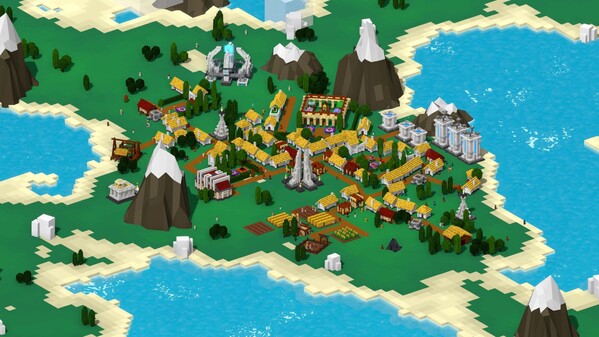
Creo's unique building system allows you to place buildings in any position you want. Do you want a new shopping center? Go for it! Or perhaps a ghetto surrounding your mines? What about tons of tightly packed homes that will definitely not be a fire hazard? The choice is yours!
Creo God Simulator has an extensive inspiration system/tech tree that you can use to unlock new and more powerful buildings, such as decorations, new workshops, and machines powered by ancient willpower technology.
With Creo's building and inspiration system, your imagination is the limit!
Free-form building placement
A large variety of building types and models
Various types of decorative items to personalize your town
Creo-specific architecture style
An ever-expanding inspiration system/tech tree
A New Gaming Experience with Every Playthrough
Creo God Simulator boasts an exciting main story and procedurally generated worlds, quests, and events! No two playthroughs will ever be the same. Things could be going smoothly for your town when suddenly, an earthquake erupts, and locust swarms descend upon your farms. Once those are dealt with, peace reigns once again, until an angry herd of cats decides that your town will be its new home—this is just one example of the countless stories that you can experience in Creo.
An exciting main storyline
A Procedurally-generated map
Various types of positive and negative procedural events
Cat herds
A regularly updated list of challenging new quests to accomplish
Discover the Ancient Past of Creo
The world of Creo is vast and ancient, with thousands of years of history, stories, and secrets. Those who came before you left numerous artifacts and willpower fragments which you can discover around the map.
These fragments and artifacts can then be collected in your museum to build full sets and for your review! There's plenty of lore to the world of Creo, and the unique archeology system in Creo God Simulator allows you to dive into this mysterious world.
An archaeology collection system which is available if you have a fully-staffed museum in your town
A wide number of ancient willpower fragments and other artifacts
A large collection of ancient writings, ranging from scientific reports, poems, romance shards, and more
Genres
Stats
All-time low is the lowest price we've recorded for this game since we started tracking it.
Languages: English, Spanish - Spain, Spanish - Latin America
Engagement
Hours played at review time, across 40 reviews with recorded playtime.
Reviews
Themes across 40 recent reviews and how positive each mention is. A keyword signal, not full sentiment analysis.
positive critical· bar length = how often the theme comes up
Reviews
The tutorial is either entirely nonsense or something about it does not translate to my mind correctly. If you want to be confused why your villagers aren't building things this is a great game, but otherwise play godus for free and painfully slowly for a similar experience.
From the moment you start, you're given the freedom to create, destroy, and influence your people in dynamic and unpredictable ways. The attention to detail, the strategic depth, and the sheer joy of watching your followers react to your divine interventions make every session feel fresh and exciting. Whether you want to be a benevolent deity, showering blessings upon your worshippers, or a vengeful force shaping the world through chaos, the possibilities are endless. Big game for god simulators!
great but, larger map, not having you lose the ability to build, give up button, and sandbox mode?
No cloud saves. While it's easy to play through and forget about doing it, when I was expecting to load saves from update a long time ago, they weren't transferred over or kept.
I loved black and white back in the day, so hopped into this hoping to scratch that age old itch... While it somewhat satisfied the itch, it also kind of missed the mark... Resource generation, population growth, faith generation via clicking a hard to spot icon above followers' heads, etc... all of it feels more like a mobile game... Some of the quests don't properly register either... I had one request I sell 70 stone... I had to empty the trading storage several times to fill it with exactly 70 in a single selling action to complete the quest, no amount of selling below that 70 outright counted(Sold 200 stone trying to trigger it before i decided to just empty the storage on my shop to complete it) I wont say it's a bad game, just... really needs something more to it so that it's not real life days to feel like you're making progress(I'm aware I didn't give it a full hour... I'm not refunding or anything, just observation and review right now...will expand later as i play more, but these were glaring issues imho...)
esta entretenido al principio
Nette Aufbausimulation für zwischendurch.
Un juego en el que eres dios, pero no puedes apagar un puto incendio. Cine. Le doy un 8-10 por que me parece que lo vale.
si
Creo God Simulator is an ambitious sandbox management game that combines city-building, survival mechanics, divine powers, and colony simulation into a surprisingly engaging god-game experience. Instead of simply placing buildings and managing resources from a distance, the game gives players direct influence over an evolving civilization as a supernatural ruler known as the Creostrider. Every decision shapes the fate of the settlement, whether through benevolent miracles, destructive punishments, or strategic intervention during disasters. The result is a management game that constantly balances creativity, chaos, and experimentation while encouraging players to guide an unpredictable civilization through survival and expansion. The core premise immediately captures attention because the game fully embraces the fantasy of becoming a flawed but powerful deity. Players are responsible not only for building settlements and managing resources, but also for maintaining the faith and loyalty of their population. Citizens worship the player’s actions, generating willpower that can then be spent on miracles, technological advancement, and direct interaction with the world itself. This system creates a satisfying relationship between population growth and divine influence because a thriving civilization directly increases the player’s supernatural capabilities. City-building forms the foundation of the gameplay and remains consistently entertaining throughout long play sessions. Players gradually expand settlements by constructing homes, farms, workshops, markets, mines, storage buildings, and decorative structures while attempting to keep citizens fed, productive, and emotionally stable. The free-form placement system allows towns to grow naturally rather than forcing strict grid-based organization, which gives each settlement its own visual personality. Some players may create highly organized cities while others embrace chaotic expansion, but both approaches feel valid within the game’s flexible sandbox design. One of the game’s strongest qualities is the integration of divine powers into traditional management systems. Players can summon rain to help crops grow, strike enemies with lightning, call down meteors, manipulate terrain, or directly influence citizens during moments of crisis. These abilities are not simply cosmetic gimmicks but meaningful gameplay tools capable of dramatically altering the direction of a settlement. Deciding when to help, punish, or interfere becomes a major part of the strategy because excessive destruction can damage public trust just as easily as miracles can inspire devotion. The faith and fear systems add another layer of complexity to the simulation. Villagers react dynamically to the player’s behavior, gradually forming opinions based on whether the Creostrider behaves like a merciful protector or a terrifying tyrant. A civilization ruled through fear may remain productive temporarily, but reckless use of destructive powers can eventually destabilize the population and create long-term problems. This balance between authority and responsibility helps the game feel more dynamic than standard colony simulators focused purely on economics and construction. Procedural generation also contributes heavily to the game’s replayability. Maps, disasters, quests, and random events change between playthroughs, ensuring that no two civilizations evolve in exactly the same way. One settlement might flourish peacefully for years before collapsing under famine and earthquakes, while another survives constant catastrophe through careful planning and divine intervention. Unexpected events constantly disrupt routine management, forcing players to adapt quickly and preventing the simulation from becoming too predictable. The progression systems are surprisingly deep for an indie management game. As settlements grow larger and more advanced, players unlock new technologies, stronger divine powers, decorative structures, and increasingly complex management tools. The technology progression feels rewarding because it steadily introduces new mechanics and possibilities without overwhelming players immediately. Expanding a civilization from a tiny village into a sprawling city powered by divine influence creates a satisfying long-term sense of growth. The archaeology and exploration systems also help make the world feel more alive. Players can uncover ancient artifacts, establish museums, and discover fragments of forgotten history scattered across the procedurally generated world. These discoveries provide additional lore and context while rewarding exploration beyond basic settlement expansion. The inclusion of these systems helps the game feel less mechanically sterile and gives the world a stronger sense of mystery and identity. Visually, Creo God Simulator adopts a colorful voxel-inspired art style that fits the sandbox nature of the game extremely well. Buildings, citizens, environments, and effects are simple but expressive, allowing large settlements to remain readable even during chaotic disasters and busy late-game scenarios. The stylized presentation also reinforces the game’s playful tone, where devastating catastrophes and divine punishment exist alongside humor and absurd procedural events. The soundtrack and sound design support the gameplay effectively. Relaxing ambient music accompanies peaceful city management while more intense sound effects emphasize disasters, divine powers, and emergencies. Construction sounds, weather effects, and citizen activity all contribute to the feeling of managing a living civilization rather than a static simulation. The overall atmosphere remains lighthearted even during moments of destruction and chaos. One of the most enjoyable aspects of the game is the unpredictable storytelling that naturally emerges from its systems. The combination of procedural events, population behavior, disasters, and player intervention constantly creates memorable situations unique to each playthrough. A city can suddenly descend into chaos because of starvation, monster attacks, or accidental divine destruction caused by an overenthusiastic miracle. These unscripted moments give the game personality and help every settlement feel like its own evolving story. However, Creo God Simulator is not without flaws. As an indie title with ambitious mechanics, the game occasionally struggles with polish and balance. The interface can become cluttered during larger settlements, and some management systems are not explained clearly enough for newer players. Certain mechanics feel more complicated than necessary, particularly when trying to optimize resource production and population behavior during later stages. Performance issues can also appear once cities become large and densely populated. Frame rate drops and occasional AI oddities become more noticeable during late-game scenarios where many systems are operating simultaneously. Villager behavior sometimes feels unpredictable in ways that appear unintentional rather than strategically interesting, especially during emergencies or disasters. Creo God Simulator may lack the polish of larger strategy games, but its ambitious systems, creative mechanics, and entertaining sandbox design make it one of the more distinctive indie god simulators available. Players willing to embrace its occasional rough edges will discover a surprisingly deep management experience filled with chaos, experimentation, and the constant temptation to solve every problem through divine intervention. Rating: 7/10
Related
Related
Trends
Concurrent players on Steam, sampled daily since tracking started.
Momentum
Pace estimated from the game's recent review growth (our daily snapshots) at its own sales-per-review ratio — a momentum signal, not booked sales.
Audience
Estimated from the language of this game's reviews — a proxy for where players are, not official Steam demographics.
Related
| Dust Raiders | $90.8K | 192 | 68% | $15.99 |
| DIMENSION REIGN - ROGUELIKE DECKBUILDER | $90.8K | 231 | 68% | $17.99 |
| A Long Way Down | $90.8K | 231 | 66% | $17.99 |
| Tetris® Forever | $90.8K | 356 | 74% | $34.99 |
| Life Eater | $90.8K | 373 | 83% | $7.49 |
| Truck Driver | $90.7K | 172 | 69% | $19.99 |
Related
| Factorio | $140.6M | 232.2K | 98% | $35.00 |
| House Flipper | $65.8M | 110.8K | 94% | $24.99 |
| Prison Architect | $63.1M | 73.6K | 89% | $29.99 |
| Dyson Sphere Program | $56M | 83K | 97% | $15.99 |
| The Scroll of Taiwu : Beyond The Dome | $51M | 56K | 66% | $29.99 |
| Tabletop Simulator | $42.2M | 73.8K | 96% | $19.99 |