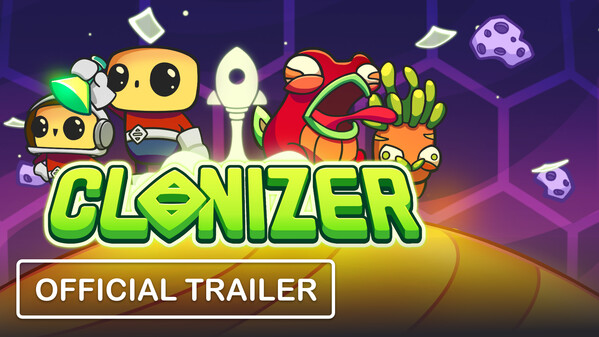
Clonizer combines Hex-based tactics and roguelike deckbuilding! Play cards, manage clones, explore unique charming planets and outsmart aliens. Craft a powerful deck through your expedition and Clonize the universe to become employee of the month of CLONPO!
Modeled estimate, not a reported figure. How we estimate →
Media
About
Genres
Stats
All-time low is the lowest price we've recorded for this game since we started tracking it.
Languages: English*, Turkish*, French*, German*, Spanish - Spain*, Japanese*, Korean*, Polish*, Portuguese - Brazil*, Portuguese - Portugal*, Russian*, Simplified Chinese* +2 more
Engagement
Hours played at review time, across 40 reviews with recorded playtime.
Reviews
Themes across 40 recent reviews and how positive each mention is. A keyword signal, not full sentiment analysis.
positive critical· bar length = how often the theme comes up
Reviews
It's alright, but unlocks are very slow and the one thing that makes me give this a thubms down is that has an inherent doom-timer that foces you to complete every match ASAP or you will just die and there is nothing you can do against it. Just takes away all the fun. It's also broken, in that in some missions you have to survive for 9 turns but it scales so fast you are basically doomed automatically. Not sure if that was playtested at all. Just an unfun game mechanism.
This is such a satisfying game that I love to keep in my rotation. The UI sounds, the sound effects, the music, the cute Clonees, the cute aliens, the funny dialogue and characters; heck it's even fun to just click buttons. I feel rewarded in everything that I do in this game. There are so many ways to play and to challenge yourself. I love the little things, like seeing the Goodies dangle in the same way dice on a rear car mirror shake. It's just a dopamine rush in every way.
Clonizer byla pro mě spíš jednohubka, která mi rozhodně neurazila, během svého času i zabavila, ale nedonutila mi si hru zahrát znovu. Věřím, že si hra najde své publikum, pokud máte rádi tento typ taktických her s kartičkami.
Clonizer, developed by Juicy Plume and published by Rogue Duck Interactive, is a refreshingly inventive blend of turn-based strategy, roguelike deckbuilding, and base-building mechanics, all wrapped in a quirky sci-fi aesthetic. It carves out its own niche within the crowded indie strategy genre by embracing a cheerful, cartoonish visual style and mixing lighthearted humor with genuinely thoughtful gameplay. At its core, Clonizer puts the player in command of a team of “Clonees,” bio-engineered beings deployed to colonize and conquer procedurally generated alien planets. Each mission challenges the player to navigate a hex-based world while managing resources, outsmarting enemy forces, and building up their territory using a card-driven system that evolves over the course of a run. The first thing that stands out in Clonizer is its playful presentation. The game avoids the grim tone typical of many sci-fi colonization titles and instead opts for a more whimsical, family-friendly approach. The Clonees are goofy and endearing, the environments are colorful and varied, and even the enemies carry a comedic flair that makes encounters amusing rather than intimidating. The UI is clean, intuitive, and functional, which allows players to focus on decision-making without being overwhelmed by complexity. Despite the light tone, the underlying mechanics are surprisingly rich. Players must explore planets tile by tile, capturing territory, harvesting resources, and carefully deploying Clonees to maximize efficiency. Every decision feels meaningful, and the consequences—positive or negative—often ripple through the rest of the mission. Central to Clonizer’s gameplay is its card-based system, which governs everything from combat actions to construction, upgrades, and special abilities. Cards are divided into several thematic “departments,” each with its own strategic flavor, encouraging players to experiment with different combinations to create synergistic builds. This system injects a satisfying layer of unpredictability and depth, as every new run offers different cards, upgrades, and blueprint opportunities. Over time, players unlock more departments and cards, expanding their strategic toolbox and increasing the game’s replay value. The deckbuilding mechanics are handled well, never overwhelming the player but always offering new ways to approach challenges. Clonizer walks the fine line between accessibility and depth, making it easy to pick up but difficult to master. The game’s procedural generation ensures that no two missions play out the same. Each planet features a unique layout, enemy placements, terrain modifiers, and random events that require players to stay adaptive. Exploration feels meaningful thanks to the strategic importance of tile control and the occasional unexpected encounter, like running into bizarre alien traders or uncovering mysterious anomalies. These dynamic elements help to keep the experience fresh, even after multiple runs. The roguelike structure also adds tension, as poor decisions or unlucky draws can quickly spiral into defeat. That said, the game avoids feeling punishing—players are encouraged to learn from failure and try new approaches with each run, especially as new departments and Clonee abilities are unlocked over time. While Clonizer excels in creativity and gameplay variety, it’s not without its flaws. The difficulty can feel inconsistent, especially in mid-to-late game missions where enemy strength spikes abruptly or the randomness of card draws can work against the player. Some card synergies feel less viable than others, and a few balance issues may lead to frustration if a player builds a strategy around mechanics that are underpowered. Additionally, while the humorous writing and quirky tone add charm, the narrative layer is thin. There’s little in the way of overarching story or character development, and most of the game’s progression is driven by mechanical goals rather than narrative ones. For players looking for a deep lore experience or emotional storytelling, Clonizer may feel a bit superficial. Despite these shortcomings, the overall package is impressive, especially considering the small size of the development team. Clonizer shows a clear attention to detail and a genuine enthusiasm for its own concept. The visuals are polished, the mechanics are engaging, and the user experience is smooth and satisfying. It's easy to appreciate how much love and creativity went into the project, and for its modest price, it delivers excellent value. The pacing is also a highlight—missions are contained enough to be played in short sessions, yet rich enough to demand strategic thinking and long-term planning. Players who enjoy short, repeatable challenges with evolving complexity will find Clonizer’s structure rewarding. In the end, Clonizer stands out as a smart, funny, and surprisingly deep strategy game that rewards experimentation and creative thinking. It’s an ideal pick for players who enjoy deckbuilding mechanics, turn-based tactics, and the procedural unpredictability of roguelikes. Though it may not cater to those who prefer tight narratives or meticulously balanced competitive play, it offers more than enough originality and gameplay variety to carve out a place among the best of recent indie strategy titles. For fans of games like Slay the Spire, Into the Breach, or For The King—especially those who appreciate a bit of humor in their strategy—Clonizer is a refreshing and worthwhile addition to the genre. Rating: 8/10

Сделано вроде и неплохо, но геймплей очень медленный, крайне мало нового контента после прохождения, из-за чего игра несмотря на жанр рогалика не особо реиграбельна. Я в неё достаточно с удовольствием поиграл, но в игре просто нет чего-то ради чего в неё хочется заходить пройти ее снова. Я получил нормально так удовольствия за эти 6 часовых ранов, но в последних 2 игра уже не предлагала мне ничего нового.
This is a pretty neutral review really, but I'm going to put it on the recommend side because I enjoyed it for a while and I can see there being a place for it, for the right kind of person or the right kind of time. For me it's not really that, because the very slow unlock progress and general lack of variety makes it a bit of a slog to play. If you were stuck only being able to afford one game for a month, like a kid in the eighties, then this would be a great pick because you easily *could* play it for a month and still be somewhat enjoying it. But in the modern landscape of having more games than you have time to play, I don't want to sink a month into a game that I'm only *somewhat* enjoying, when I could be playing 6 other games to completion instead, and fully enjoying them. A single run also takes a long time, and generally everything feels a bit slow - not the UI and animations, which are fine, but rather that most of the time your units can each only move one space per turn. On planets with heatwaves, where you have to move to a safe tile every few turns or die, this can be super annoying because you want to go 'west' but you have to spend an entire turn going 'east' because the safe tile to the west is two turns away, then another whole turn to get back to where you were, so it's three entire turns to take a single step in the direction you're trying to go. Only three-ish (may be more if you have zero-cost cards or energy boosting cards, but is often less because you can also have two-cost or three-cost cards) card-actions per turn also makes it feel like things are going slow. And then for the final battle you have to deal 50 damage to the boss, where most things do one or two damage, so again it tends to be a long slow slog. And then you win, and it unlocks like 1.5 levels of stuff, which is 2 new cards, that doesn't really change anything. There's different starter decks which are another different slog to unlock, and it seems they differ by two minor cards from the basic starter deck. There seems to be only two "main classes" which, to be fair, have a reasonable amount of difference between them, but only two. It's possible escalating the difficulty would be more interesting, I haven't tried, but I find it hard to imagine, given how everything else is, that the higher difficulty isn't just "exactly the same but everything hostile has 50% more health". If it *is* more interesting then the game should more strongly recommend it when you win, whereas it feels to me like mostly the game is recommending *not* turning up the difficulty. So yeah, this sounds like a pretty negative review overall, but I'm leaving the thumbs-up because there's nothing really *wrong* with it, it's just not as fun as a whole mess of other tactical deckbuilders, such as Alina of the Arena, Fights in Tight Spaces, and StarVaders. About comparable to Roguebook, which has most of the same flaws described here.
It's good.
A varied, smart roguelite. Each mission is slightly different, and the deck building is fairly intuitive.
It's a really fun game with huge potential but there is no motivation for replaying once you win. There are some achievements you can do if you feel like trying to meet the specific conditions but there is no accession levels and there doesn't feel much like point to unliocking more planets or cards when it's the same run over and over again you've already won
muko bir oyunrakanıza yaslanın ve sadece oynayın
Related
Related
Trends
Modeled estimate over time, reconstructed from Steam's monthly review histogram.
Momentum
Pace estimated from the game's recent review growth (our daily snapshots) at its own sales-per-review ratio — a momentum signal, not booked sales.
Audience
Estimated from the language of this game's reviews — a proxy for where players are, not official Steam demographics.
Related
| Dungeon Dreams 2 | $97K | 224 | 91% | $19.99 |
| Thunder Ray | $97K | 312 | 71% | $14.99 |
| That Which Gave Chase | $97K | 1.1K | 91% | $4.99 |
| 3 Minute Heroes | $96.9K | 222 | 84% | $19.99 |
| Galaxy Squad | $97K | 430 | 74% | $9.99 |
| Da Capo 3 R | $96.9K | 153 | 97% | $39.99 |