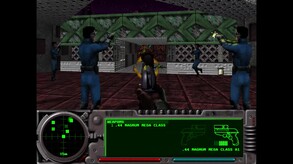
From the team that brought you Aleph One, the classic sci-fi FPS Marathon 2: Durandal from Bungie on Mac revived for modern hardware by the fan community.
Revenue comes from in-game items and microtransactions, which our price-based model doesn't estimate. Copies below reflect the player base, not paid sales.
Media

About
Genres
Stats
Languages: English
Engagement
Reviews
Themes across 41 recent reviews and how positive each mention is. A keyword signal, not full sentiment analysis.
Reviews
more marathon with better level design the story isnt as good as M1 tho and the removal of some enemy types is kinda disappointing Also the enemies spawning on you or right behind you was really annoying whenever it happens I still enjoyed my time despite with the flaws
Bom jogo
Definitely my favorite in the series, lots of fun action and satisfying problem solving through the campaign. Coop is a blast, even in 2026. Worth playing for the incredible story alone.
Related
Related
Trends
Concurrent players on Steam, sampled daily since tracking started.
Hours played at review time, across 41 reviews with recorded playtime.
positive critical· bar length = how often the theme comes up
и потом эти люди сделали halo, но эта игра дерьмо ♥♥♥♥♥♥
This is the first time I've played to the end of a proper classic FPS game, and I've got to say Marathon 2 is a really good introduction; the levels are fun and the majority of them you can figure out what to do (which was one of my main concerns going in), the guns feel really good, goes to show that good sound effects and visuals effects go a long way. It might take some adjustment if your used to how modern shooters feel, but once you get past that intial hurdle the game is a really good experience, would recommend.
Durandal my beloved <3
Classic Marathon 2, developed and published by Aleph One Developers, stands as a compelling revival of one of the most ambitious first-person shooters of the mid-1990s. Rather than a simple port, this version is a careful reconstruction powered by the Aleph One engine, preserving the original Marathon 2: Durandal experience while making it functional and accessible on modern systems. What emerges is a game that feels both like a preserved artifact and a living piece of software, maintained by a dedicated community that clearly understands the importance of its legacy. What immediately sets Classic Marathon 2 apart from many shooters of its era—and even from many modern ones—is its commitment to storytelling. Instead of relying on cutscenes or voice acting, the narrative is delivered through in-game terminals scattered across its sprawling levels. These text logs are dense, philosophical, and often cryptic, weaving a story centered around artificial intelligence, existential questions, and alien civilizations. The AI Durandal remains one of the most memorable characters in classic gaming, not because of cinematic presentation, but because of how intelligently and unpredictably it communicates with the player. This approach may feel unconventional today, but it rewards patience with a depth rarely seen in the genre. The gameplay itself reflects a design philosophy that prioritizes exploration and player agency. Levels are intricate and often maze-like, filled with interconnected pathways, hidden areas, and environmental puzzles. Unlike modern shooters that guide players with explicit objectives and markers, Classic Marathon 2 expects you to pay attention, experiment, and occasionally retrace your steps. Combat is deliberate rather than chaotic, with a selection of weapons that feel distinct and satisfying despite their simplicity. Enemy encounters require positioning and awareness, especially as the game progresses and introduces more complex threats. One of the most significant strengths of this release is how the Aleph One engine modernizes the experience without erasing its identity. Players benefit from higher resolutions, smoother performance, customizable controls, and cross-platform compatibility. These enhancements make the game far more approachable than its original version, particularly for newcomers who might otherwise struggle with outdated technical limitations. Multiplayer functionality is also included, offering both cooperative and competitive modes that echo the early days of networked FPS gaming, even if the active player base today is relatively modest. That said, the game’s age is impossible to ignore. Visuals remain rooted in sprite-based design, with environments that can feel repetitive and lacking in detail by modern standards. Navigation can occasionally become frustrating due to the absence of clear direction, and the interface does little to ease players into its systems. The reliance on text for storytelling, while intellectually engaging, may not appeal to those who prefer more cinematic or immediate forms of narrative delivery. Despite these shortcomings, Classic Marathon 2 succeeds because it stays true to what made it special in the first place. It doesn’t attempt to compete directly with modern shooters, nor does it dilute its complexity for the sake of accessibility. Instead, it offers a distinct experience that emphasizes atmosphere, narrative depth, and thoughtful design. For players interested in the evolution of first-person shooters or those willing to engage with something more methodical and introspective, it remains a remarkably rewarding journey. Rating: 8/10
[h1]Certified Hood Classic[/h1] Marathon 2: Durandal is an exceptional game. I've been playing it for a few years, even before it got ported to Steam, and it's definitely my favorite boomer shooter ever, possibly favorite game ever. There's nothing quite like it or like either of the other Marathon games. So here's a "brief" overview. At least, I'll attempt to keep it brief. [h2]Story In A Boomer Shooter?[/h2] What other boomer shooters place such heavy emphasis on their lore and worldbuilding, their narrative and central characters? It differentiates itself from mindless run-and-gun games from around the same time by doing so. Part of me imagines it was motivated by the Mac exclusivity, as Mac users were an entirely different audience, consisting largely of academics, college students, so on. Something more... "sophisticated," so to speak, was what the doctor ordered. Bungie itself also consisted of staff with backgrounds in philosophy and history, which made this direction a natural fit, especially following up Pathways Into Darkness, which kinda required some good story as an FPS-RPG hybrid (maybe the first of its kind?). Irregardless, Marathon and, of course, Marathon 2 fill a perfect niche for somebody like me, of combining the fast-paced, punchy action of retro shooters while treating video games as an artistic medium to deliver a high concept, hard sci-fi storyline. M2D takes the plot of the first Marathon and expands its scope to an interstellar scale, moving beyond the confines of the UESC Marathon to the surface of Lh'owon, miles beneath the planet's surface, back into space on Durandal's repurposed Phfor spacecraft "Boomer," all with the backdrop of a prolonged proxy war between two rival, rampant AIs as you seek to liberate the enslaved S'pht in search of their eleventh clan. It doesn't delve into abstract storytelling interpreted through metaphor present in the first game a lá the Gerrit White Terminal, which is a shame, I liked that element about Marathon, but it makes Marathon 2's narrative a bit easier to follow, which might be a boon for some people. And the aforementioned, heightened scope softens the blow by making the events taking place feel so much more expansive and impactful. Hopefully this wasn't too spoiler heavy since I do think a huge part of the enjoyment of this game is piecing things together yourself across the different terminals, which function essentially like text logs. As they say, limitation is the mother of invention, but such a methodology of telling the story might be a bit cumbersome for some. I don't think it's that big a deal, though. All the same, a fantastic story that you should at least look up if you're unwilling to play or complete the game. Thematically pungent, deeply mature for its time. [h2]Combat[/h2] Marathon 2 only improves on the combat by giving more of a purpose to the Zeus energy pistol against armored and mechanical enemies and adding one of the best shotguns in video game history and letting you dual-wield it. Giving certain enemies resistances or weaknesses incentivizes the player to swap weapons with regularity to preserve ammo and do the most damage in an efficient manner, pretty standard boomer shooter fare in this regard... Except for the reloading. Marathon 1 introduced reloading to FPS games (ignoring The Fortress of Dr Radiaki, sorry Gilbert Austin), and Marathon 2 continues that here. It adds a layer of depth and tension to shooting not present in games like Doom, and it's a good mechanic at mitigating Marathon 2's stagnant enemy variety relative to the first Marathon. Marathon 2 didn't add many enemies at all tbh, just the F'lickta and role replacement types of enemies. The Drinniol are entirely gone, too, sadly. I like to think they led a successful slave revolt and freed themselves from the Phfor during the seventeen years that Mjolnir Recon 54 was in stasis. But I digress. Underwater combat is a new addition in this game, and while certainly impressive for 1995, it's still underwater combat at the end of the day. You might not be able to spell "functional" without "fun," but calling it the latter would be a misnomer. You can't move fast enough underwater to gain significant enough momentum to make punching F'lickta to death a brief affair, which leaves you just holding both mouse buttons as you dual-wield your fists (lol) as you whale on them hoping they don't get you stuck in a corner or something. It's not ideal. But other than that, combat in Marathon 2 is really fun. While extremely satisfying and it has a thru the roof cool factor, the super shotguns in Marathon 2 are much more well-balanced than, say, Doom II, and excessive usage of it is spaced out enough to make every instance of going ham with the shotguns an utter blast. Otherwise, not much has changed combat-wise from Marathon 1 other than I think there being less invulnerability powerups around. Overall, it's an improvement over the first and a fun game to just shoot things in, emphasis on story or not. [h2]Visually Striking[/h2] Marathon 2: Durandal is a really pleasant looking game at nearly all times. Aside from a couple boring looking levels here n there, it, in large part, is a vibrant, colorful game thar improves massively over the first Marathon. Things don't get as dark, which significantly alters the atmosphere, but what's lost in the shuffle is a fair trade, imo. Part of the game's great visuals that I'll never get over are the skyboxes. Utterly gorgeous. The surface of Lh'owon has a deep purple sky littered with stars, and the reddish moon above the alien architecture in the distance gives every outdoor level a grand feel. Same for during the day with the bright, lemonade yellow skies on the planet's surface. Space also looks really nice outside of the Phfor spaceships. I play using the 2007 XBLA graphics pack which is free elsewhere on the Steam store. I highly recommend it, as the visuals are absolutely stunning. Extremely hi-res and smooth. Some might prefer the original graphics, and there're elements I do prefer, but by and large, Freeverse XBLA sprites/textures are the goats. No matter which you choose to use though, Marathon 2 is still a great looking game stylistically to this day. [h1]Conclusion[/h1] All in all, Marathon 2: Durandal is an extremely easy recommendation on my end for anybody who likes boomer shooters or retro FPS games more broadly speaking. Fantastic story, just as fun as any other shooter from the time, and literal eye candy. Nab an OST from the Steam Workshop and you'll be absolutely golden.
..
Muito melhor que o 1°
Audience
Estimated from the language of this game's reviews — a proxy for where players are, not official Steam demographics.