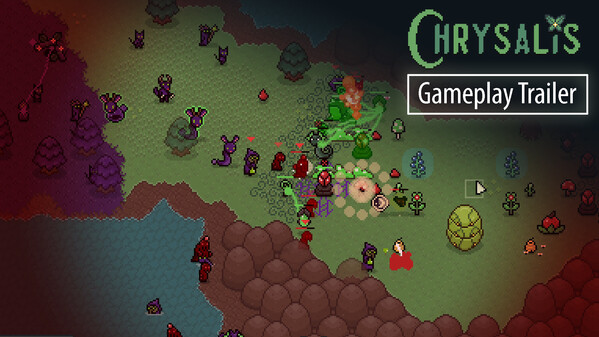
Defend your Chrysalis from growing hordes of monsters in this hybrid game that combines elements of tower defense, survival, and roguelike RPGs. Explore procedurally generated levels, possess and control animals, and grow deadly gardens. How far can you get before the next wave of monsters?
Modeled estimate, not a reported figure. How we estimate →
Media

About
Stats
All-time low is the lowest price we've recorded for this game since we started tracking it.
Languages: English
Engagement
Hours played at review time, across 40 reviews with recorded playtime.
Reviews
Themes across 40 recent reviews and how positive each mention is. A keyword signal, not full sentiment analysis.
positive critical· bar length = how often the theme comes up
Reviews
So close to being a great game... I think it needed a little bit more content, and in my personal opinion more levels that ramp up in difficulty slower. It's not an easy game, and it doesn't really play intuitively. You want to collect followers and level them up, make them stronger, etc... but they're pretty bad and die constantly, so they end up really just being fodder instead. It's a game about fighting for currency, you always feel starved of enough anima to keep up.
Enchanted a Bunny Lord, formed a bunny gang, turned them all into mutants, planted a garden, freed the forest of corruption. Good Stuff.
Chrysalis, developed and published by Metamorph Games, is a unique and ambitious fusion of tower defense, roguelike, and real-time strategy design that succeeds in creating an experience unlike most in the genre. Rather than simply having players build static defenses and watch waves of enemies fall before them, Chrysalis invites them into a more active and organic ecosystem of creatures, plants, and symbiotic relationships. You assume the role of a Wisp, a small spiritual entity entrusted with protecting a sacred Chrysalis that acts as the heart of life in an increasingly corrupted world. The premise sounds simple—defend your Chrysalis from encroaching monsters—but what unfolds is an intricate cycle of exploration, possession, and adaptation that continually reshapes how each run plays out. At its core, the game operates on a rhythm divided into two alternating phases: exploration and defense. During exploration, you drift freely across lush, procedurally generated environments, gathering resources, discovering new species, and forging bonds with the creatures and flora that inhabit the land. These symbiotic relationships are the lifeblood of the game. Rather than commanding armies in the traditional sense, you possess living organisms—plants, animals, or hybrids—each with their own behaviors, abilities, and evolutions. This mechanic transforms the player from an omnipotent overseer into a living participant within the ecosystem. The creatures you inhabit gain experience, develop mutations, and can even merge with other entities to create entirely new hybrids. Every decision—what to possess, what to evolve, and how to allocate resources—ripples through your strategy when the defense phase begins, where all your choices are tested in the crucible of survival. When the waves of corruption arrive, Chrysalis reveals its tower defense roots, though not in the conventional sense. Your possessed allies and flora take on defensive roles, repelling enemy swarms that seek to destroy the Chrysalis. Instead of watching passively, you are constantly in motion, leaping between allies, casting buffs, or directly attacking in your current form. The result is a blend of action and strategy that requires both tactical awareness and mechanical precision. The game thrives on its sense of tension—every second spent defending feels like a race against time as enemies grow more numerous and aggressive. When a possessed creature dies, you’re forced back into your fragile Wisp form, scrambling to find a new host before the defenses collapse. This constant risk-reward balance gives the combat a nerve-wracking edge and reinforces the roguelike ethos that no run is ever safe until the final wave has been survived. The game’s depth is amplified by the progression systems it introduces. Growths and Spirits, collectible enhancements found throughout each run, allow you to tailor your playstyle and evolve your defenses over time. Growths provide passive bonuses that strengthen your Wisp or the creatures under your control, while Spirits imbue them with elemental properties that drastically alter their behavior and abilities. A simple plant may start as a weak defender but, after several upgrades, can become a devastating source of poison or fire damage, depending on how it’s infused. These layers of customization give each run a sense of ownership and unpredictability. The Mutation system, which allows players to combine species into new hybrids, is particularly fascinating; it feels like a miniature genetic experiment, forcing you to think about synergy, adaptation, and sacrifice. The procedural generation ensures that no two runs play the same, and the variety of creatures and environmental layouts pushes players to adapt strategies constantly rather than rely on memorization. Aesthetically, Chrysalis captures a delicate balance between serenity and dread. The art direction combines a painterly approach to nature with the stark intrusion of corruption, creating worlds that feel both alive and imperiled. The tranquil beauty of exploration phases gives way to visual chaos during defense sequences, as corrupted creatures pour in and the environment darkens. The soundtrack mirrors this duality—gentle, meditative melodies accompany your exploration, only to transform into tense, pulsating rhythms during combat. Sound design is subtle yet effective, giving weight to every strike, transformation, and loss. The visual identity of the game complements its central theme: life and decay, growth and destruction, perpetually intertwined. While Chrysalis’s vision is impressive, it’s not without imperfections. The steep learning curve can overwhelm newcomers, as its blend of mechanics requires time to fully grasp. Systems like Mutation, Spirit management, and resource economy take several runs to master, and some explanations in the tutorial feel too brief for how deep the gameplay goes. Progression between runs can also feel uneven; losing all accumulated resources upon defeat, while fitting for a roguelike, may frustrate players who crave a steadier sense of advancement. Occasional interface quirks and quality-of-life gaps—such as limited automation for repetitive actions—can interrupt the otherwise smooth experience. Yet even with these flaws, the core gameplay loop remains compelling, and each failure brings new knowledge and strategies for the next attempt. Chrysalis shines brightest when its systems converge into moments of emergent storytelling. A creature you’ve nurtured from the start of a run might become the linchpin of your defense, surviving wave after wave only to fall heroically in the final moments. The dynamic between creation and loss gives the game an emotional weight uncommon in its genre. It’s not just about defending a base; it’s about tending an ecosystem and accepting the inevitable cycles of change and decay that come with it. Every run feels like a self-contained narrative—a struggle for survival, a burst of growth, and, sometimes, a quiet failure that seeds the next attempt. In the end, Chrysalis stands as one of the most inventive hybrids in the modern indie strategy scene. Its fusion of real-time control, roguelike unpredictability, and ecological themes creates something that feels both mechanical and organic, cerebral and emotional. The game demands patience and experimentation but rewards them with depth and satisfaction. For players drawn to strategy games that break boundaries and challenge conventions, Chrysalis offers a mesmerizing journey through evolution, adaptation, and survival. It is a game about life itself—not as something static or safe, but as a constant process of change, growth, and transformation under pressure. Rating: 8/10
Meh, I cannot recommend it. The game is a roguelike with no meta progression and it becomes really boring and tedious to get past first levels to try beating later levels. I did not beat the last level and I did not look up any strategies for the game, only tried to work out with what I saw. After few levels you get to the point where your growths get one shot and I could no longer make any worthy defense, Even after I got several growth upgrades. When I have built any growth defence points far from chrysalis, they are always gone without any trace, even when I use the perk to prevent them from being affected by corruption. Biggest letdown for me were mutations. Lets say you have a snake or its evolutions and want to mutate it with any other creature to give it more skills besides poison nove... well you cant because all mutations remove the nova skill and your only hope is to find a creature that was already muatated with the snake to begin with. In almost all cases you get your useful skills removed from your creature when mutating it with other ones. The only option to get good mutations is to be lucky and get cleansing skill to cleanse and posess/recruit already mutated animals. I should also mention that there is no preview of which skills does the mutation use so often when experimenting you end up with fine creature turning into garbage. Next thing is that levels are somewhat randomised and you may get really unlucky to have whole level full of some ice elemental mutations that constantly freeze your whole party, slowing the objectives immensly. You may make your team freeze immune for the level but then it becomes useless in the next level where enemies are not freezing you. In the end I only had fun in the first and maybe second run. I felt no replayability value on next runs and 8 hours i got seem like too much already. TLDR: - Roguelike with no meta progression - One run takes hours and there is no way around it - First levels are really boring and later levels totally overwhelming - Map and mobs are randomized but game does not feel replayable - Mutating (crafting) your mobs is lackluster - Perks I can collect and buy do not feel impactful enough to make a "build"
A quirky game that fails to meet your low expectations constantly. This is meant to be an ARPG crossed with a Tower Def. But the core mechanics of the game push you away from the tower def aspect, as you have to buy towers that cost the same resource as upgrading your unit/s. This would have been fine if you got to keep the towers in each level, adding to the tower defence aspect. Instead a 2nd resource is introduced exclusively for placing & upgrading towers, but is meaningless because you are already conflicted on what to spend your 1st resource on, as it is used by everything. The unit upgrades and morphs are also very lacklustre. Each different unit of which there are not many, have at most 3 upgrades, 2 if they are lucky. Morphing is almost always far worse than not morphing. Elements are far from balanced, with ice greatly being king above all. Not only do units not get frozen from the annoying aoe crystals, but your units reliably freeze enemies, dealing damage & preventing damage & enemy skills. Compared to regeneration that gives an extra 1hp per 5 sec and 1 sec off a 120 sec cooldown... Or a fire aoe that never triggers & does minimal damage even when it does trigger. Now maybe you don't care and just want a simple game to relax to. Maybe you want to turn your music on, while you play etc. Oh but YOU CAN'T!!! Because there are no options to adjust or even turn off audio. Frankly there are no options at all unless you include the 2 options you get to be something. So you better damn like the game in it's exact state, because there is no way you are changing it to suit your personal circumstances, needs or desires. And if you don't like the fact you need to click exactly on the target like was common in games 20 years ago, And you can't just right click in the general direction & have it auto acquire the closest target, as became common in all games almost 20 years ago. WELL BAD FKN LUCK!!!! Wait for 90% discount, unless you just love the art style etc Seriously its not worth more than $2
Feels quite sluggish. The gameplay loop isn't rewarding enough to keep playing after a few tries. The controls are quite klunky for the controller, very easy to missclick stuff and doesn't work at all in some cases (like at the edge of the world). I really like the idea of the game but not the execution. Sad to not be able to recommend this.
Love it! Just wish it was more rougelite than roguelike.
I really love the concept of this game but I wish there was just a little more content to explore and unlock. I know this is controversial in rouge like games, but I personally love a meta progression system. I also would love more upgrades and branching paths within the game. The loop between open world exploration and collection and then tower defense is novel, but could just use a little more content to fill in the experience. Overall, I'm a big fan and hope that the devs would continue to add more branching options.
Really hope it will get more metaprogression. It's a lot of fun but would be great to have some more stuff to play around with in between games to make it even better. Stuff like certain builds getting buffs or starting with some items/ resources might be a good start.
An incredible indie game seamlessly combining my favorite genres - creature collecting, tower defense, rogue-lite progression. Totally worth the price.
Related
Related
Trends
Modeled estimate over time, reconstructed from Steam's monthly review histogram.
Momentum
Pace estimated from the game's recent review growth (our daily snapshots) at its own sales-per-review ratio — a momentum signal, not booked sales.
Audience
Estimated from the language of this game's reviews — a proxy for where players are, not official Steam demographics.
Related
| A Hand With Many Fingers | $30.3K | 511 | 85% | $4.99 |
| Pixel Ripped 1978: An Atari Adventure | $30.3K | 51 | 78% | $24.99 |
| Requiem: Avenging Angel | $30.3K | 120 | 82% | $9.99 |
| Discovering Space 2 | $30.3K | 90 | 72% | $9.99 |
| Alpha Mike Foxtrot VR - AMF VR | $30.3K | 90 | 56% | $9.99 |
| Twisted Arrow | $30.3K | 90 | 90% | $14.99 |