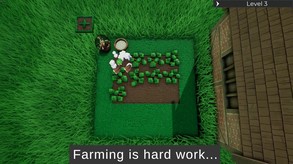
A farming / automation game, that allows you to progress from a poor hard-working farmer with just a few old tools to a lazy rich guy that watches his machines do the work for him while he tries to optimize production.
Modeled estimate, not a reported figure. How we estimate →
Media

About
Genres
Stats
All-time low is the lowest price we've recorded for this game since we started tracking it.
Languages: English
Engagement
Hours played at review time, across 40 reviews with recorded playtime.
Reviews
Themes across 40 recent reviews and how positive each mention is. A keyword signal, not full sentiment analysis.
positive critical· bar length = how often the theme comes up
Reviews
This is a relatively simple automation and, more so, optimisation game. Seems like a good entry into the genre because there is no urgency, no danger. What I consider the main gimmick of the game, the Shrinker, is about making more and more of the same few resources as fast as possible with the limited space you have. You don't unlock a ton of new tools and resources, very little actually. I would say the time it take to level up and unlock new stuff is exponential, quick at the beginning then you'll start to wait for resources more and more while trying to optimise and lower the wait time. The game is well priced for the amount of content, even though you can continue playing longer if you want to optimise more with everything done at level 20.
34 hrs in and the game is done. Not bad for a $5 or under game. There are alot of little feature that could be fixed to make things easier like copy paste and such but I still like the game.
Cool game, I havent gotten super far yet so I have no opinions on the late game but the automation is really fun, the UI is simplistic yet pleasing, for 5 bucks its mega werf. Also just want to say to be careful when youre saving and quitting because it gets rid of any items in a crafting table.
セールで208円で購入 非常によく出来たゲーム 工場系の楽しさのコア部分をザクッと楽しめる。 分量はそこまで多くなく、はっきりと終わり?限界があります。 明確な終わりがあるのはちょっと工場系のゲームでは特徴的かも
Assembly Planter is a quietly absorbing automation-focused simulation that merges the slow rhythms of farming with the cerebral satisfaction of factory optimization. Developed and published by Timon Herzog, the game positions itself firmly within the automation sandbox genre, yet distinguishes itself by prioritizing compact design, modular thinking, and deliberate progression over spectacle or narrative drama. From the outset, it makes clear that the true reward lies not in visual flourish or storytelling, but in watching an intelligently designed system function smoothly with minimal intervention. The experience begins at its most humble, placing players in control of a small plot of land where every action is performed by hand. Planting, harvesting, and processing crops initially require direct involvement, reinforcing an intimate understanding of each resource loop. This early manual phase is intentionally slow and repetitive, not as a flaw but as a foundation. By forcing players to engage directly with every step, the game ensures that the later transition to automation feels earned. When the first machines finally come online, the sense of relief and empowerment is palpable, and that contrast becomes one of Assembly Planter’s most effective design choices. Automation unfolds gradually through the construction of machines, conveyors, filters, and processors that can be chained together into increasingly complex production lines. Rather than encouraging sprawling factory layouts, the game nudges players toward efficiency and spatial awareness. Land is limited, and careless expansion quickly becomes impractical. This is where Assembly Planter’s identity truly emerges, pushing players to refine workflows instead of simply scaling them. Each new machine is less about raw output and more about how it can be integrated cleanly into an existing system. The defining mechanic that elevates the game beyond typical automation fare is the ability to compress entire machine setups into compact units. This system allows players to design intricate production chains and then condense them into single blocks that can be reused, repositioned, or combined with other modules. It transforms factory design into something closer to a puzzle, where elegance and density matter just as much as throughput. The most satisfying moments often come not from unlocking a new machine, but from redesigning an old setup into something leaner, faster, and more self-sufficient. Progression is measured and methodical, with new systems unlocking at a pace that encourages experimentation rather than rushing toward an end goal. Crafting times, especially for advanced components, reinforce the importance of automation by making large-scale manual production inefficient. Later-game mechanics such as material transmutation introduce powerful shortcuts, but they also demand careful logistical planning, ensuring that convenience never replaces strategy. The game consistently rewards foresight and patience, appealing strongly to players who enjoy long-term optimization over immediate gratification. Visually, Assembly Planter adopts a minimalist three-dimensional presentation that prioritizes clarity over detail. Machines are easy to read, conveyor flows are immediately understandable, and feedback is communicated through motion rather than excessive effects. While the aesthetic may feel plain compared to more stylized simulation games, it serves the gameplay well, keeping attention focused on system behavior rather than decoration. Sound design follows a similarly restrained approach, offering subtle mechanical cues that reinforce the meditative tone without overwhelming the player during extended sessions. Interface and controls are built with practicality in mind. Placing, rotating, and modifying machines feels precise, and the inventory system supports frequent iteration without unnecessary friction. The game does little hand-holding beyond basic introductions, trusting players to learn through experimentation. While this can lead to occasional confusion—particularly when compacting complex systems—the overall design encourages problem-solving rather than reliance on tutorials or prompts. Assembly Planter does not attempt to create emotional arcs or narrative stakes, and it never pretends otherwise. Its appeal lies entirely in the satisfaction of mastery, in the quiet pride of building something efficient from almost nothing. Watching a once-chaotic farm transform into a tightly controlled, nearly autonomous machine is the central pleasure, and the game leans fully into that fantasy. Steam user reception reflects this focus, with many players praising its depth, creativity, and the sheer joy of optimization despite its modest scope. In the broader landscape of automation and simulation games, Assembly Planter stands out not by doing more, but by doing less with intention. It strips the genre down to its most satisfying elements and rebuilds them around compactness, precision, and thoughtful design. For players who enjoy tinkering, refining systems, and losing hours to incremental improvement, it offers a deeply rewarding experience. While it may not capture the attention of those seeking narrative or visual spectacle, it succeeds admirably as a focused, intelligent sandbox where efficiency itself becomes the ultimate goal. Rating: 7/10
Followed the tutorial. Says a seed planted should grow in 5s. It didn't. Literally the first thing you do, didn't work. Avoid. (Yes, tutorials are to teach you how to play. If the VERY FIRST step isn't clear, then the game sucks)
My PC suddenly crashed (black screens, not responsive, no clue why) and I'm happy to share that the game has an autosave feature. Some things in the game seem to make no sense when it comes to ratios, but given the casual setting its alright. Has a hint of Factorio ratios/automation/management and Compact Machines mod from Minecraft if you're familiar with that.
"Assembly Planter" ist ein echt spaßiges Mix aus Automation und Farming. Richtig gepackt hat’s mich, als der "Shrinker" dazukam, ab dem Moment war mein innerer Perfektionist auch komplett befriedigt. Es macht einfach Laune, seine Maschinen immer weiter zu optimieren und die Produktion perfekt abzustimmen. Für alle Achievements braucht man ungefähr 26,5 Stunden, je nachdem, wie effizient (oder chaotisch) man spielt.
I often get overwhelmed by the big automation/crafting games; the early parts are fun, but then you have to tear most of your base down and rebuild it because you need to plumb new resources in; lather, rinse, repeat. Never mind the monsters and robots attacking or whatever. Assembly Planter is not that. It's a bite-sized chill-vibes automation game, and its big feature (miniaturization with no wire delays) means your complex machines actually take up less and less space, not more. A less-obvious feature, but a key one for the mood it evokes, is that almost everything you build is net-positive. Many automation games have you scrambling to keep up with the resources you need. Not here. Often you just need a bit to kick-start the loop, and then it becomes self-sufficient. I got to the end of the game in less than thirty hours, and a non-trivial amount of that time was just leaving it running in the background to accrue resources. For a game that has a regular price less than that of a fast-food hamburger, that feels like just the right amount of time. Yes, it could have a better UI; yes, the music loop is quickly annoying. But I had a really good time playing through it, and that time was almost completely stress-free. That's just what I wanted. Maybe you want that too?
"Assembly Planter" to ciekawa, farmerska gra z elementami automatyzacji. Grę zaczynamy od małego pola ziemi, z którego możemy zdobyć nasionka i zasadzić w celu zdobycia rożnych materiałów. Z czasem, kiedy już odblokujemy możliwość tworzenia maszyn, możemy wszystko zautomatyzować i cieszyć się zdobywaniem surowców bez naszej ingerencji. Po pewnym czasie gra wymaga od nas więcej, ale z pomocą przychodzi możliwość "shrink", czyli skurczenia wielu maszyn w 1 bloku. Dzięki temu możemy stworzyć potężną fabrykę surowców z roślinek 🪴 Ocena: 9/10❗ Polecam! 🌳
Related
Related
Trends
Concurrent players on Steam, sampled daily since tracking started.
Audience
Estimated from the language of this game's reviews — a proxy for where players are, not official Steam demographics.
Related
| COVID: The Outbreak | $29.6K | 97 | 71% | $13.99 |
| Tayutama:It's happy days | $29.6K | 52 | 100% | $29.99 |
| REPOSE | $29.6K | 184 | 93% | $6.39 |
| Avalom: Ancestral Heroes | $29.6K | 88 | 66% | $17.99 |
| Wantless : Solace at World’s End | $29.6K | 330 | 90% | $3.95 |
| Periapsis: Eclipse | $29.6K | 52 | 75% | $14.99 |
Related
| 7 Days to Die | $425.3M | 403.5K | 87% | $44.99 |
| Mount & Blade II: Bannerlord | $309.8M | 293.9K | 88% | $49.99 |
| Squad | $166.3M | 240.4K | 81% | $39.99 |
| Don't Starve Together | $164.6M | 539.5K | 95% | $14.99 |
| Satisfactory | $164.4M | 275.8K | 97% | $27.99 |
| Kerbal Space Program | $154.7M | 144.7K | 96% | $39.99 |