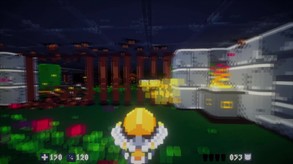
Arkos is a first-person fantasy shooter with destructible voxel environment inspired by the classic retro shooters from 90-s
Modeled estimate, not a reported figure. How we estimate →
Media

About
Stats
All-time low is the lowest price we've recorded for this game since we started tracking it.
Languages: English, Russian
Engagement
Reviews
Themes across 40 recent reviews and how positive each mention is. A keyword signal, not full sentiment analysis.
Reviews
Приятный и простой ретро-шутер от первого лица.
I can appreciate wanting to create a mashup of Wolf3D and Heretic but this game does so much wrong I couldn't stomach more than 3 Episodes. For starters, visually, this game is vomit inducing, it's incredibly hard to tell where you are in relation to the rest of the level, everything looks the same on top of the overuse of voxels and samey textures leads to disorientation and it's quite frankly terrible. Also, as you progress, just getting through the levels requires a lot of wall humping and it felt like shades of late game ROTT which is very NOT GOOD. There's a severe ammo economy issue, this might have been because I was playing on insane but I was routinely running out of ammo making puzzles or rooms that required the teleport staff impossible. To compound this all of the weapons are very bad and near indistinguishable from each other to the point where the only good feeling weapon is the ammo hog, using anything else feels terrible. Idk, got about halfway through Ep 3 and dropped it, I just can't with this. There are definitely ways to improve it though so maybe the sequel will be better.
Related
Related
Trends
Modeled estimate over time, reconstructed from Steam's monthly review histogram.
Hours played at review time, across 40 reviews with recorded playtime.
positive critical· bar length = how often the theme comes up
Really fun short boomer shooter. You are Arkos, the founding member of Nickelback, betrayed by Chad "Wizard" Kroeger you need to exact your revenge and start the best band in the universe (Creed). Now that you know the story (which is breathtaking), let's talk about the graphics: they're nice. Movement is good, but I wish it was faster. Also the music is fantastic. The gameplay is repetitive, but as the game is short (4-6 hours max) you won't notice it. I recommend it 'cause it's cheap and fun. Apparently a sequel is in the works... I'll play it if I'll be able to afford it. Cheers.
This game is close to a recommendation, it's not that it's bad, it's more that it's not very good. It plays worse than the original [b]Doom[/b] but better than [b]Wolfenstein 3D[/b]. The latter had really aged with the release of the former, so that's not a compliment. The game is comprised of a bunch of episodes which contain a few small levels. You can plow through an episode in half an hour or so, so a short game. The level design is a bit more interesting than [b]Wolfenstein[/b], but the game all takes place on the same height level, so there's no ramps, stairs or anything geometric going on that could lead to a better experience. There's a couple of cool guns, like one where you can right click to teleport to where your bullet currently is. Another weapon is rapid fire and has unlimited ammo when standing on lava. The game is pretty easy, I was halfway through episode 5 when I had my first death. The enemies themselves fire slowly and aren't much fun to fight. The difficulty improves over time, but it doesn't come in a way that I find fun. You get swarmed by more enemies in confined spaces, making it harder to kite them around. I would have liked more space to fight with more interesting enemy attacks. The save system is annoying because you have to restart the level when you die, you can't save scum. I couldn't be bothered repeating the level I died on (even though it wouldn't have taken that long) which shows how take it or leave it I was with the experience by that point. Walls that hide hidden doors -something that is usually just used as secrets in other FPS games are sometimes the critical path forward. It can be slightly annoying, however the stages are very small, so pressing on every tile of wall doesn't really take that long. There are some lesser known, short FPS games that are quite retro that I did enjoy ([b]Chop Goblins[/b], [b]Extraneum[/b] and [b]A.W.O.L.[/b], [b]SharpShooter3D[/b] for instance), and this [i]is[/i] one of the better ones, but just didn't quite cut it for me. I think I will pick up the sequel regardless because many have said that it's a significant step up, and I don't feel it would take much for [b]Arkos[/b] to be something that I could quite enjoy.
Grając w tę grę odniosłem wrażenie że chciała zrealizować wszystkie motywy gatunku jak najmniejszym kosztem. Sekrety? Wystarczy przebiec się po każdej ścianie wciskając i interakcję i są sekrety. Przeciwnicy to w większości wyzwanie w stylu biegnij do tyłu i strzelaj, albo biegaj w kółko i strzelaj. Pierwsza broń to różczka, druga broń to różczka która szybciej strzela, ammo jest generyczne dla wszystkich broni więc ponownie nie ma zachęty do eksperymentowania. Levele żeby być jeszcze mniej ciekawe nie mają w sobie żadnej wertykalności. Arkos, podobnie jak nielubiany przeze mnie Project Warlock mam wrażenie wpatrzyły się za bardzo w Wolfensteina 3D. Rozumiem retro ale są pewne granice. Trzeba przyznać że Arkos urzekł mnie swoim voxelowym artstylem. Ma też w sobie przyjemną destrukcję otoczenia (nic z niej nie wynika gameplayowo, ale hej przynajmniej jest ładna). Poza tym daję pewne punkty za próbę zrobienia magicznego fpsa, co jest motywem którego chętnie zobaczę więcej. Finalnie nie mogę polecić.tej gry chyba nikomu. Nie znam chyba bardziej zatwardziałego fana gatunku od siebie a nawet mi nie siadł.
ARKOS, developed and published by RetroSouls, is a compact first-person fantasy shooter that proudly embraces the spirit of early 1990s dungeon crawlers while introducing a distinctive voxel-based visual identity. Rather than chasing modern realism or sprawling open-world design, it focuses on delivering a tightly constructed, old-school action experience centered on spellcasting, labyrinthine corridors, and methodical exploration. Players step into the role of a white wizard named Arkos, venturing deep into dangerous strongholds in search of a powerful artifact once wielded by his missing mentor. The narrative framework is simple and direct, serving primarily as motivation for the descent into increasingly perilous environments, but it effectively anchors the adventure in a classic fantasy quest structure. Visually, ARKOS sets itself apart through its fully voxel-based world. Every wall, enemy, projectile, and environmental object is built from volumetric blocks rather than flat sprites or high-polygon models. This gives the game a tangible, almost sculpted aesthetic that feels reminiscent of early 3D fantasy shooters like Heretic or Hexen, while still maintaining a distinct personality. The voxel approach is not purely cosmetic; certain environmental elements can be destroyed or altered during combat, adding a layer of physical interaction to the dungeon spaces. Watching chunks of walls break apart under magical fire reinforces the sensation that the world has weight and presence, even within its stylized framework. Gameplay revolves around deliberate exploration and focused combat encounters. Levels are structured in episodes, each consisting of interconnected rooms, corridors, hidden chambers, and occasional puzzle-like progression gates. The design leans toward linear navigation but rewards attentive players with secrets tucked behind destructible walls or hidden pathways. Combat emphasizes spellcasting through a set of magical staves, each offering different firing behaviors and tactical rhythms. While all weapons draw from a shared mana pool, they differ enough in range, power, and attack style to encourage situational decision-making. The pacing feels measured rather than chaotic; enemies are positioned to challenge positioning and movement rather than overwhelm through sheer numbers. Boss encounters serve as climactic moments within each episode, demanding careful movement and consistent damage output. These fights are often less about elaborate mechanics and more about mastering the fundamentals of dodging, resource management, and precise aim. The simplicity of the mechanics works in the game’s favor, as it reinforces the retro design philosophy—success comes from skillful execution rather than layered systems or extensive upgrades. Exploration between combat segments often includes light environmental puzzles, key-hunting, and secret discovery, maintaining a steady rhythm that alternates between tension and curiosity. The audio design complements the visual and mechanical nostalgia. The soundtrack features energetic, synth-driven compositions that evoke classic MIDI-era shooters while still feeling cohesive within the fantasy theme. Sound effects for spellcasting, enemy attacks, and environmental destruction are punchy and clear, enhancing feedback during combat. Together, the audiovisual presentation creates a cohesive retro atmosphere that feels intentional rather than derivative. ARKOS is not a sprawling epic, and its runtime reflects its focused design. The experience is concise, likely spanning only several hours for a full playthrough, but it maintains engagement through its steady progression and secret-hunting incentives. While enemy variety and level complexity may not match larger genre entries, the game succeeds by committing to its core identity. It does not attempt to modernize the boomer shooter formula with extensive customization trees or cinematic storytelling; instead, it refines a straightforward concept and executes it with clarity. Ultimately, ARKOS stands as a love letter to classic first-person fantasy shooters, reinterpreted through a voxel lens. Its strengths lie in its consistent atmosphere, satisfying magical combat, and compact but thoughtfully constructed levels. For players who appreciate retro-inspired shooters with a focused scope and stylized presentation, it offers a polished and confident experience that honors its influences while maintaining its own distinct voice. Rating: 7/10
A nice and simple retro FPS. Nothing too demanding. It knows what it wants to be and it sticks to it. Episode 5 onwards really fumble the level design at times, as opposed to the basic but effective nature of the first 4 episodes. Still, good value for how cheap the game is, especially on sale. I have high hopes for the sequel.
Безвкусная попытка выехать на эстетике бумер-шутеров. Невероятно однообразные уровни, полтора типа врагов и 3 типа оружия заставят вас зевать уже через полчаса игры. Отдельного упоминания стоит металлизированный саундтрек, который вообще не вписывается в яркий фентезийный контекст игры.
Nice Voxel graphics, weapons feel good but beware that soft locks may happen
всё четко
Momentum
Pace estimated from the game's recent review growth (our daily snapshots) at its own sales-per-review ratio — a momentum signal, not booked sales.
Audience
Estimated from the language of this game's reviews — a proxy for where players are, not official Steam demographics.
Related
| Relic Odyssey : Ruins Of Xantao | $38.3K | 111 | 95% | $14.99 |
| Cowboy 3030 | $38.3K | 111 | 88% | $14.99 |
| Blackwind | $38.3K | 74 | 59% | $24.99 |
| Store Wars: Multiplayer Shop Simulator | $38.3K | 118 | 96% | $9.09 |
| Stayin' Alive | $38.4K | 285 | 74% | $5.99 |
| SEX, Stocks & Cocks | $38.3K | 111 | 86% | $9.99 |