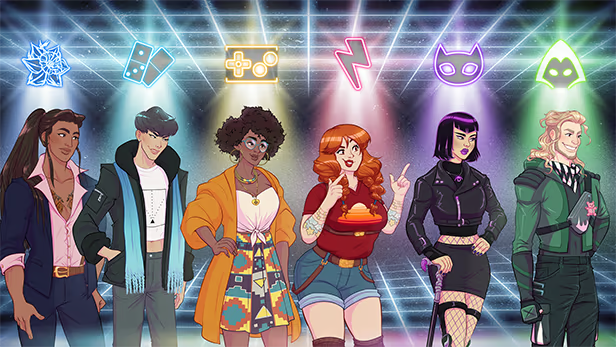
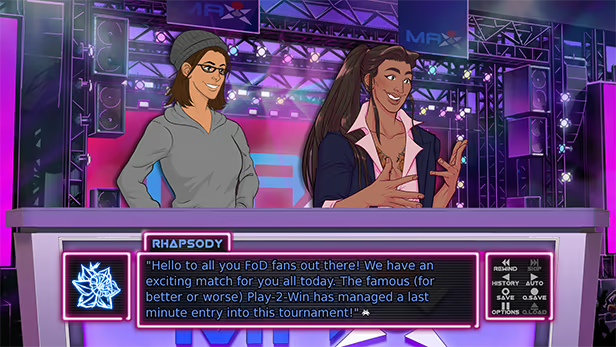
Arcade Spirits: The New Challengers is the follow-up to 2019's Arcade Spirits, a visual novel of love and pixels, in which you seek friendship and romance while working in an arcade. Now the tables are turned, as you seek friendship and romance while PLAYING in an arcade!
Modeled estimate, not a reported figure. How we estimate →
About


Stats
All-time low is the lowest price we've recorded for this game since we started tracking it.
Languages: English**languages with full audio support
Engagement
Hours played at review time, across 40 reviews with recorded playtime.
Reviews
Themes across 40 recent reviews and how positive each mention is. A keyword signal, not full sentiment analysis.
positive critical· bar length = how often the theme comes up
Reviews
A great sequel to Arcade Spirits, The New Challengers is charming, fun, and heartfelt. A love letter to games and those who play them.
I was a modest fan of the first one, but I'm very glad I took a chance on it because that lead me to playing The New Challengers. I enjoyed TNC so much more than the first game, and having an imported save from that title made it an even better experience. The writing feels far more natural in this game, more honest and real. The original had an issue where it would sometimes come off as "clearly written dialogue" rather than something a person would think to say. While I went into it being hesitant about all of the new characters in TNC, they did all grow on me over time to various degrees. My favorite of the main crew is Zapper, and Domino is my least favorite. What really surprised me however was the customizable rival, and the ability to romance them. I'm a sucker for a good enemies to lovers story, and I was able to get exactly what I wanted here. I don't know what the friendly rival is like, but I loved how the hostile rival was written and how we interacted. Ultimately I loved the game, and it feels like playing the first Arcade Spirits was merely a prelude to the amazing experience that I had with The New Challengers.
Leaving a review for an indie game I liked, and you should too. Reviews help small indies massively.
гейство, инклюзивность и разнообразие. сама игра не очень, белые цисгендерные мужики ужасны и противны. но то что можно создать лицо-фигуру героя\героини\чмовтретьемлице занятна как возможность. Ещё оформление под 90-ые прикольно смотрится и музыка приятная (но пожалуй из начала игры, дальнейшая меньше запоминается).
[b][i]Arcade Spirits: The New Challengers[/i][/b] is a visual novel. It is somewhat retrofuturistic - what if the arcades survived the 80s? The premise is that the mostly-customisable protagonist decides to take the next step and follow their passion of competitive esports, in particular, the Fist of Discomfort 2, which is a mix of DotA and Street Fighter. With the help of their newly-installed AGI companion, they meet a casual group of gamers and fight for their dreams together. [h2]It is an excellent visual novel and I wholeheartedly recommend it.[/h2] While the game focuses on the esports and social interactions, it also touches the adjacent subjects, such as MTX, DRM, and the increased presence of the far-right grifters in the gaming spaces. The avatar's appearance is fully customisable, though it is unavoidably a young and non-disabled person. There are some personality quirks, such as the inclination to fart out "inspirational" monologues or a certain late-game drama episode, which are unavoidable. Otherwise, there is an amazing range of options and the overall progress is tracked. Regarding the save file import, the game automatically imported something at the start and I was (still am) unsure which one of the completed games it was. I assume the latest completed playthrough. The writing is expressive and consistent, with each character having a specific speech style and the range of topics they are interested in. The (skippable) FoD2 mini-game, which is essentially 8 rounds of rock-paper-scissors, is fun enough to play, though takes place 1-2 times per chapter/level. The art is beautiful, especially the companions' and main NPCs' sprites, with multiple poses and expressions. The unique counter-ultimate sprites highlight the companions' personalities and combat styles. The backgrounds are less appealing, but functional. The CGs do not feature the PC, as I understand, due to the variety of possible appearances, and there are few CGs overall. The fonts use the same main colour as the character speaking and there is a small icon next to the text. I would say that too many (fortunately, not all) lines are voiced. The music and sound effects are adequate, neither amazingly good nor horrifyingly bad.
I went into Arcade Spirits: The New Challengers expecting an improvement over the first game, and in a lot of ways, it absolutely is. The sprites and overall presentation are noticeably better, and the story feels much more ambitious. There’s a lot going on narrative-wise, sometimes almost too much, but I still found myself really invested in the characters and their relationships. I especially liked seeing returning characters and connections to the first game. It made the world feel more connected and rewarding for people who played the first. That said, I do understand most of the criticism surrounding the game. One of my biggest issues was the handling of certain character interactions, especially Jynx’s first interaction and the way the protagonist responds to Domino’s depression. Some moments that were clearly meant to be emotional or supportive ended up feeling insensitive or awkwardly written instead. The main character technically has an arc, but they often came across as boring or emotionally tone-deaf, which made it harder to connect with them. I also wasn’t a huge fan of being forced to create your own rival character. My issue is not really the idea itself, but more so the execution. Because the rival is made with the same character creator used for NPCs, they often end up feeling less distinct or memorable compared to the main cast. If the rival had been a fully premade character, the developers could have pushed the design and personality much further, which probably would have made them feel more unique and important to the story. Similarly, the character creator itself felt a bit off stylistically — the created characters don’t really blend naturally with the game’s existing art style, which can look a little jarring. Another thing that bothered me was how the game sometimes handles the player's understanding of things. There are moments in which characters almost mansplain things to you and act like the player has no understanding of gaming or nerd culture, even though the protagonist is supposed to be part of that world already. I understand what the writers were trying to do, and the first game had a similar issue, but here it sometimes felt even more forced and a little preachy. There’s also quite a bit of SJW-style dialogue throughout the game, which definitely will not work for everyone. (though I assume if you play these sorts of games, you more than likely agree with the characters' viewpoints) Still, despite my complaints, I genuinely enjoyed the experience overall. The writing can be corny at times, but I actually think it’s stronger than the first game in many ways. The characters and story kept me interested the whole way through, and I can absolutely recommend it, even if I can understand why it’s been divisive among players.
Arcade Spirits: The New Challengers starts off with a great art style that is both retro and futuristic. The synthy soundtrack captures the whole arcade mood perfectly. The game is divided into eight well-portioned chapters and can be played in chunks. The dialog is really well written and the characters all develop a unique profile as the game progresses. Unfortunately, not all of the dialog is dubbed (budget?), but the voices work really well. I didn't enjoy the mini-game, but can be skipped every time I found the story rather uninteresting. The middle section in particular is slow, but the brilliant finale makes up for it. The game is quite woke. That's not a problem for me, but it sometimes felt a bit forced. The romance part also adds little to the game and is an - optional - extra that is more of an add-on than essential. With a playing time of ten hours, it is also a little too long due to the weak middle section. I don't regret buying and playing Arcade Spirits: The New Challengers, but I wouldn't do it again.
Thank you Locksley and Zapper for reminding me that I am bisexual
Arcade Spirits: The New Challengers is a thoughtful, inclusive, and refreshingly character-driven visual novel from Fiction Factory Games, expanding on the original Arcade Spirits while forging its own identity. Rather than functioning as a mere sequel, it reframes the series’ universe—an alternate timeline where arcades remained culturally dominant—through the lens of competitive gaming, personal reinvention, and the emotional complexities of belonging. You play as a customizable protagonist starting over after a life setback, joining an up-and-coming esports team known as the Good Clean Gaming crew. The setup blends personal stakes with broader social commentary, asking what it means to compete, collaborate, and define self-worth in a digital world driven by passion and performance. From the opening scenes, the writing makes it clear that this is a story about people first and games second, and that human connection—not victory—remains the ultimate prize. Choice remains the heart of the experience, but the sequel deepens role-playing possibilities through its personality and identity systems. The game once again uses the Feel-Good Management System, tracking emotional tendencies—confident, steady, kind, analytical, chaotic—and shaping dialogue choices and narrative direction based on how you express yourself. Rather than punishing players for picking the “wrong” tone, it encourages authenticity, allowing personality to influence relationships, reputation, conflict resolution, and story outcomes. The New Challengers also continues its commitment to romance flexibility, supporting multiple dating options, friendships, aromantic playthroughs, and nonbinary or queer identities without reducing representation to token gestures. This fluidity allows the protagonist’s journey to feel personal, tailored, and respectful, making the emotional arcs resonate more powerfully. Narratively, the game excels through its ensemble cast, each written with depth, flaws, insecurities, and evolving motivations. Members of your team—whether they’re rising esports hopefuls, nervous newcomers, seasoned competitors, or quirky arcade regulars—are not caricatures or simple archetypes. They have hopes, fears, histories, and vulnerabilities that unfold gradually through slice-of-life scenes and personal storylines. The writing balances sincerity with humor, weaving in witty banter, gaming culture references, social satire, and heartfelt confessions without feeling overloaded. Conflicts are rarely framed as heroes versus villains; instead, they explore burnout, self-doubt, jealousy, ambition, creative conflict, and the pressures of competitive environments. This maturity gives the narrative emotional realism even within its lighthearted setting. Structurally, the game improves pacing over its predecessor by integrating minigames, choice-driven match outcomes, stat-based narrative branches, and a more defined campaign arc through tournament progression. Competitive matches aren’t mechanically complex—they’re more narrative decisions than traditional gameplay—but they work thematically, reinforcing teamwork, strategic thinking, and personal growth. The tension during tournaments isn’t about reflex skill but emotional investment: whether relationships are strong enough, whether characters trust each other, and whether the team has healed or fractured under pressure. These sequences also highlight how success isn’t always synonymous with winning, a message that distinguishes the game from more conventional esports narratives. Visually, The New Challengers embraces a bold, colorful art direction filled with energetic character portraits, expressive animations, and detailed environments that evoke neon-soaked arcades, modern gaming venues, cozy hangout spots, and community event spaces. The interface feels polished, stylish, and readable, supporting long reading sessions comfortably. Character designs reflect diversity in ethnicity, gender presentation, body type, age, and fashion, contributing to the game’s commitment to inclusivity not just as theme, but as visual identity. The soundtrack enhances the experience with upbeat electronic rhythms, contemplative tracks for emotional conversations, and retro-inspired arcade tones that celebrate gaming history without resorting to nostalgia for its own sake. If the game stumbles, it’s usually in areas tied to genre expectations rather than execution. Players seeking high mechanical challenge, branching combat gameplay, or deep tournament simulation may be disappointed, as esports serve more as narrative framing than interactive system. The writing, while heartfelt and polished, can feel verbose for those not accustomed to text-heavy storytelling. A few tonal shifts—from comedy to drama or from introspection to meta-commentary—may feel abrupt, especially in a first playthrough. And like many visual novels with multiple character routes, the pacing of some story arcs may resonate more strongly than others depending on personal taste. However, these limitations never overshadow the game’s strengths. Arcade Spirits: The New Challengers thrives because it understands its emotional core—the longing for community, affirmation, shared passion, and a safe place to grow. It reflects real anxieties tied to modern gaming culture—accessibility, competition fatigue, parasocial dynamics, online toxicity—but counters them with empathy, collaboration, and genuine care for its characters. It’s an uplifting game not because it avoids conflict, but because it believes conflict can lead somewhere meaningful. For players who value narrative depth, character choice, diverse representation, cozy humor, and emotionally rich storytelling, The New Challengers stands as a standout visual novel—welcoming, warm, clever, and surprisingly introspective. Whether you’re new to the series or returning for another heartfelt journey, it offers a thoughtful reminder that games—and the people who play them—matter most when they bring us together. Rating: 8/10
👍
Related
Related
Trends
Modeled estimate over time, reconstructed from Steam's monthly review histogram.
Momentum
Pace estimated from the game's recent review growth (our daily snapshots) at its own sales-per-review ratio — a momentum signal, not booked sales.
Audience
Estimated from the language of this game's reviews — a proxy for where players are, not official Steam demographics.
Related
| PERFECT CELLS PROJECT | $55K | 254 | 81% | $9.99 |
| Trombone Champ: Unflattened | $54.9K | 159 | 99% | $19.99 |
| Saki and the Crucible of Debauchery | $54.9K | 282 | 94% | $8.99 |
| Empathy: Path of Whispers | $54.9K | 163 | 59% | $19.99 |
| Myst V: End of Ages | $55K | 278 | 64% | $9.99 |
| Ultimate Booster Experience | $54.9K | 343 | 75% | $4.99 |
Related
| 7 Days to Die | $425.3M | 403.5K | 87% | $44.99 |
| Euro Truck Simulator 2 | $421.6M | 932.1K | 97% | $19.99 |
| Mount & Blade II: Bannerlord | $309.8M | 293.9K | 88% | $49.99 |
| Palworld | $279.6M | 445.8K | 94% | $20.99 |
| Clair Obscur: Expedition 33 | $263.7M | 178K | 95% | $47.99 |
| The Forest | $254.8M | 678.5K | 96% | $19.99 |