Amphora, developed and published by Moondrop, is a hauntingly beautiful indie puzzle game that stands out as much for its visual artistry as for its quiet, contemplative storytelling. It begins with a simple concept: you are an unseen spirit tethered to an ancient amphora, silently guiding the life of a young girl through her most pivotal moments. There are no words, no dialogue, and no explicit explanations—only images, sounds, and subtle motions that build a narrative out of gestures and atmosphere. The game unfolds through a sequence of dreamlike vignettes, each serving as a fragment of a larger story about love, fate, and the unseen forces that shape human existence. Amphora belongs to that rare group of games that treat interactivity as poetry, relying on visual metaphors and physical puzzles rather than traditional storytelling to express emotion and meaning.
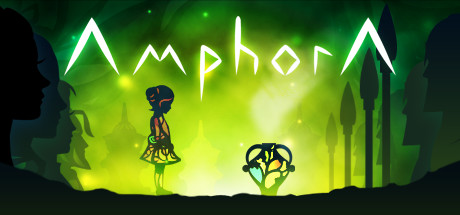
The most striking aspect of Amphora is its art style, which instantly sets it apart from most puzzle games. Moondrop draws inspiration from shadow theatre, stained glass windows, and mythological motifs, creating a world that feels both ancient and ethereal. The screen is bathed in deep, warm hues—purples, oranges, and golds—that blend together like a moving tapestry. Every scene feels handcrafted, as though painted on glass, with each character and object rendered as a dark silhouette against luminous backgrounds. The effect is simultaneously simple and mesmerizing, transforming even the smallest actions—like tying a thread between two objects—into something graceful and deliberate. The visual storytelling invites players to interpret the world as they see it, turning every level into a moving painting that communicates emotion without uttering a single word.
The gameplay mechanics, while deceptively simple, form the foundation of Amphora’s unique rhythm. You control a spectral wisp linked to the amphora and use it to manipulate the environment, often by drawing glowing threads that connect objects together. These connections behave according to the game’s physics engine—ropes swing, objects fall, and chains hold or snap depending on how you interact with them. Each level presents a different situation: helping a tortoise cross a finish line, lighting fireworks, shielding a character from danger, or setting up a series of events that unfold like a miniature play. The puzzles are intuitive once you understand their logic, yet often ambiguous at first, demanding careful observation and a willingness to experiment. There are no explicit tutorials or text prompts; the game trusts you to learn through play and discovery. This design choice strengthens the immersion, making every solved puzzle feel like a small epiphany rather than a mechanical victory.
However, this wordless elegance also contributes to Amphora’s occasional frustrations. The lack of clear instructions can sometimes leave you wondering what the game expects from you. Objectives are implied through visual cues rather than stated outright, and while this ambiguity can make for rewarding discoveries, it can also lead to moments of confusion and trial-and-error repetition. The physics-based interactions are not always precise—sometimes an object connects at an awkward angle or moves unpredictably, breaking the flow of an otherwise meditative experience. These small inconsistencies reveal the limits of the game’s systems, especially when compared to the meticulous artistry of its presentation. Yet even when the mechanics falter, the emotional undercurrent remains strong enough to carry the experience forward. The imperfect physics almost feel appropriate in a story about impermanence and the fragile nature of guidance.
Narratively, Amphora manages to say a great deal without ever speaking. Through its succession of scenes, it tells the story of a girl growing up under the watchful care of the amphora spirit. You witness her youth, her encounters with love, moments of fear, and ultimately, the passing of time itself. The recurring presence of the amphora serves as a metaphor for unseen guardianship—the idea that some things in life are guided by forces beyond comprehension. Each scene feels personal, even mythic, evoking fables and folktales that transcend language. The transitions between stages are subtle and fluid, giving the impression of a life unfolding as naturally as the turn of a page in a storybook. The emotional resonance lies not in dramatic events, but in the simple, universal moments it captures: companionship, separation, and change.
The game’s soundtrack deepens this emotional journey with understated beauty. Composed with soft strings, flutes, and ambient tones, the music drifts gently in the background, reinforcing the story’s mood without overwhelming it. Each melody feels organic, almost like it’s breathing with the player’s actions. The absence of spoken dialogue or explicit sound effects allows the music to carry the emotional weight of the experience, blending seamlessly with the visuals to form a cohesive, dreamlike rhythm. This combination of sound and imagery makes Amphora feel less like a conventional game and more like an animated fable performed on an invisible stage.
While Amphora’s charm is undeniable, its brevity may surprise players expecting a more extensive adventure. The entire experience can be completed in roughly two hours, and the replay value depends largely on your appreciation for the artistry rather than mechanical challenge. It’s not a game built for mastery or competition but for quiet reflection. Moondrop’s focus is clearly on emotional engagement rather than duration, and in that respect, the short length feels appropriate. Each puzzle, each scene, is a self-contained moment of expression, and when the credits roll, the story concludes with the kind of graceful finality that mirrors the closing of a myth.
Ultimately, Amphora is less about problem-solving and more about feeling. It is a game that asks you to observe, to listen, and to engage with its world as if deciphering a silent dream. It may frustrate players who prefer clear objectives or longer gameplay loops, but for those who appreciate games as art—experiences that communicate through atmosphere, symbolism, and design—it is a quiet masterpiece. The imperfections in its mechanics pale beside the sincerity of its vision. Amphora stands as a delicate and thoughtful creation, a game that reminds us that beauty can exist in stillness, and that the most profound stories can sometimes be told without a single word.
Rating: 7/10