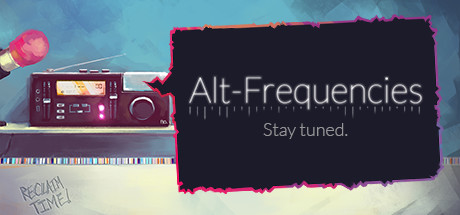
An audio mystery set in a time loop. Record, rewind time and broadcast snippets of radio shows to expose radio hosts, conspiracy theorists and politicians.
Modeled estimate, not a reported figure. How we estimate →
Media
About


Genres
Stats
Languages: English*, French*, German*, Italian, Spanish - Spain*languages with full audio support
Engagement
Reviews
Themes across 40 recent reviews and how positive each mention is. A keyword signal, not full sentiment analysis.
Reviews
As someone who unfortunately went completely blind a few years ago, I have been on the hunt for blind-accessible games. I've had [i]Alt-Frequencies[/i] for quite some time, but between life and medical circumstances and Steam's own inaccessibility problems, I just never tried it until this week. The game is definitely accessible, but I found some significant quirks with regard to navigation. It's hard to say too much about the story without spoiling important parts of it, but in a nutshell, you are part of a resistance movement to stop the government from implementing a potentially dangerous scientific experiment to solve your nation's most important problems. You control a radio which can both receive and transmit signals, and you use the content of the individual stations to contact the hosts of other stations as a means to disseminate information. The story is relatively short and can be completed in just a couple of hours if you aren't keen on unlocking all of the achievements. But given the slight variance in how things unfold based on which stations get the most important information, there's still reason to replay certain chapters, if not the entire story, after the initial run. The sound design is [b]AMAZING[/b]. The voice acting for all of the different radio personalities really makes you feel like you're listening to professional DJs, and the sound effects, voices, and distortions used in the various station identification promos is pretty much spot-on with any modern radio station. I love this level of immersion. The default controls are simple enough but can also be remapped, though I curiously could never get my controller to work. However, this game is easy enough to play with the keyboard, so I can overlook this, though someone who is disabled and either not as well-versed with key locations or with another impediment to keyboard usage may need some help getting this going if the controller isn't working. [i]Alt-Frequencies[/i] fulfills its promise of accessibility to blind users, but there are some quirks that you should be aware of. Upon first launch, I couldn't even get basic keyboard navigation to work. I have yet to understand why. I needed to use Alt-F4 to exit the game and relaunch several times to get it to work, and even then, subsequent launches could be plagued by the issue. A similar issue occurs upon finishing the story; the game returns to the main menu, where basic navigation stops working again. I had to use Optical Character Recognition (OCR) to figure out that the game had in fact gone back to the main menu. And it does seem like the physical navigation is working, but the game's text-to-speech support stops announcing what you're doing. This behavior was observed with both Windows Narrator (on Windows 10 Professional) and NVDA. Also, forget the Steam overlay; all navigation simply breaks if the overlay is enabled, and even the arrow keys won't function properly. Your mileage may vary, but I couldn't even get out of the main menu without disabling the overlay. My guess is that there's a conflict between the TTS engine and the Steam overlay, but this will take the developers researching it to find the true cause. Once you get the game going, however, everything accessibility-wise works beautifully. Controls are responsive, and everything works as it should. Even the insertion of your recorded clips into the pre-arranged radio segments is mostly seamless, which I'm sure was not an easy feat to accomplish. My only real gripe in terms of gameplay is that I wish there were a few more radio stations to flip through. The storyline conversations are genuinely interesting, and there's a great soundtrack here that could have been fleshed out with a few more songs. All in all, [i]Alt-Frequencies[/i] delivers an engaging narrative with impressive audio and stellar voice acting. I have no complaints at all with the sound design; it's as flawless as that of any AAA title. I did find one quirk, however. In Chapter 4, Part 2, after sending a certain sound clip to Ennis, he will move the story along; however, sending him subsequent audio clips will replace the one which triggered the storyline progression, but he will continue reusing his reaction to the initial clip, no matter what audio clip has replaced the first one. If that's confusing to read, it's hard to say more without spoiling that section. But if/when it happens, you'll understand what i'm saying. All of this said, [i]Alt-Frequencies[/i] is worth your time, blind or sighted. The issues that I have described may not happen on your machine, but be aware of them, just in case. But if great audio design is a strong point for you, as well as an interesting (if somewhat short) story, give it a try. 7.5 / 10
Related
Related
Trends
Concurrent players on Steam, sampled daily since tracking started.
Hours played at review time, across 40 reviews with recorded playtime.
positive critical· bar length = how often the theme comes up
lol This one is unique and made me laugh a few times. It was a gift and I'm so glad they got it for me. I may not would have tried it. I'm so glad I did. I want to go back for achieves, but I enjoyed the short journey of sound, mind, record, play. Please read other reviews. I just wanted to let y'all know I thought it was worth a play. With it leaving STEAM soon, I recommend you try it if it sounds like something you may like. It may not be for everyone, but it was for me. :D
Alt-Frequencies, developed by Accidental Queens in collaboration with ARTE France and published by PID Games alongside Dear Villagers, is a strikingly unconventional narrative experience that places sound, voice, and information at the very center of its design. Rather than relying on visuals, environments, or traditional exploration, the game unfolds almost entirely through radio broadcasts, asking players to listen closely, think critically, and actively manipulate the flow of information in order to progress. It is a game that feels closer to interactive audio drama than conventional adventure, yet it uses interactivity in ways that only games can. The premise is built around a mysterious three-minute time loop that has trapped the entire world. While everyone else unknowingly repeats the same short span of time, the player is granted awareness of the loop and the ability to intervene. This intervention takes the form of a radio tuner that can access a wide array of stations, each broadcasting its own slice of reality: news programs, conspiracy shows, activist debates, personal confessions, political propaganda, and absurd late-night chatter. Every broadcast resets with each loop, but what changes is how the information travels between stations, reshaping conversations and reactions in subtle but meaningful ways. Gameplay revolves around listening and editing rather than movement or combat. Players can record short audio clips from any station and then rebroadcast those clips on other channels in subsequent loops. This deceptively simple mechanic forms the backbone of the entire experience. By placing the right piece of information in the right context, you can alter what a host says, expose hidden truths, trigger new dialogue, or redirect the narrative toward its next revelation. Progress feels less like solving a puzzle in the traditional sense and more like piecing together a complex web of cause and effect driven by language, timing, and perspective. What makes Alt-Frequencies particularly compelling is how naturally its mechanics reinforce its themes. The game is deeply concerned with media, misinformation, and the power of storytelling in shaping public opinion. Every decision about which clip to share is also a commentary on how narratives are constructed and distorted. A single sentence, when broadcast on a different station, can be interpreted in radically different ways, leading to consequences that ripple through the loop. The player is never simply uncovering a mystery; they are actively participating in the spread and manipulation of information, blurring the line between investigator and instigator. The cast of characters encountered through the airwaves is surprisingly rich and memorable. From earnest journalists and paranoid conspiracy theorists to politicians, activists, ordinary citizens, and even surreal comedic voices, each station feels distinct and alive. Strong voice acting is essential here, and the performances succeed in giving personality and emotional weight to characters you never see. Humor, tension, warmth, and unease are all conveyed purely through tone and dialogue, encouraging players to engage their imagination rather than rely on visual cues. Visually, the game is intentionally minimal. The interface consists primarily of a radio dial, waveform displays, timestamps, and optional text transcripts. This restraint is not a limitation but a deliberate design choice that keeps attention focused on listening. The inclusion of full transcripts is also a major accessibility feature, allowing players who are deaf or hard of hearing to experience the entire story without compromise. In this regard, Alt-Frequencies stands out as a thoughtfully inclusive design that aligns accessibility with artistic intent rather than treating it as an add-on. The time loop structure creates a rhythm that is both engaging and, at times, restrictive. Each loop is brief, encouraging experimentation and quick iteration, but it also means revisiting familiar audio segments repeatedly. For most of the experience, this repetition serves the narrative, reinforcing the idea that small changes can produce different outcomes. However, some players may find the structure limiting, particularly when progress hinges on identifying a very specific clip placement rather than exploring broader alternative paths. Narratively, the game remains largely linear despite its interactive framing. While players have freedom in how they discover information, the story ultimately funnels toward a defined conclusion. This can slightly undercut the sense of agency the mechanics initially suggest, but it also ensures that the story remains focused and coherent. The experience is relatively short, often completed in a single evening, yet it leaves a strong impression due to the density of its ideas and the originality of its presentation. Ultimately, Alt-Frequencies is less about challenge and more about engagement—engagement with voices, with ideas, and with the ways information shapes reality. It succeeds not by offering complex systems or visual spectacle, but by trusting players to listen carefully and think critically. For those interested in narrative experimentation, media critique, and games that challenge traditional notions of interaction, Alt-Frequencies is a standout example of how sound-driven design can create a compelling, thoughtful, and genuinely unique experience. Rating: 8/10
It thinks it's a lot cooler than it actually is.
It's a shame this game is going to get taken down from the store, it isn't perfect it any regard but it has some super interesting mechanics and you can tell a lot of effort and thought was put into it. The puzzles were never hard enough to need a guide but were still not too easy as to feel unsatisfying. Definitely more than worth the $0.79 it is on sale for right now if anyone wants to pick it up before it's off the store in late January
Great game, found a few bugs while trying to grab the last few achievments while replaying. Really liked the recording and playback mechanic. VERY SAD THIS IS BEING DE-LISTED!!! WHY DEVS!?
The concept of sifting through radio programs for clips to send to others and capturing their responses before the time loop erases everything is super interesting. But in practice, playing Alt-Frequencies is more like looking for a needle in a haystack... that keeps repeating until you find it. Oddly enough, I left the game feeling better about the experience than I did while actually playing it. Alt-Frequencies has more than just the concept going for it. Though digging into the particulars of a nation-wide time loop is doing some of the heavy lifting here, watching radio personalities and their guests react to it is what was really captivating. I can't recommended trying to solve Alt-Frequencies's puzzles. I got no satisfaction out of that. But if you're the sort of person that enjoys things in retrospect as much or more than you do in the moment, then this one's well worth the couple of hours it takes to muddle through.
Interesting concept and good story. Game is very short and it doesn't let you experiment too much with random things, but for the 2 hours it took to complete it, I'd say it was enough.
The game feels more like a refined yet incomplete experiment. The gameplay is genuinely striking—capturing fragments of audio within time loops, like a sonic detective. That concept alone is five-star worthy.The narrative successfully builds a lonely yet urgent atmosphere. But just as you’re ready to dive deeper, it ends abruptly, leaving you with a rushed conclusion and a sense of incompleteness. It proves its creativity, yet sadly fails to fully expand on it. A beautiful poem—beautifully started, but never fully realized. 6.5/10
An interesting game worth getting on sale. The voice acting was really good and the story was interesting enough. I can't really justify it for full price however as the story leaves a lot to be desired still and could have been expanded upon. The game is pretty short as well, so there isn't enought time to even develop the story or get to know the characters. Interesting gameplay for sure, even if a little bit clumsy at times. I managed to softlock the game in the very first minute of the tutorial which itself wasn't made well in my opinion. It literally told me to "press the button you have assigned to do this action" instead of telling me what button that action is assigned to by default. That is a weird way to go about introducing the mechanics of any game - I haven't changed the settings prior either. On top of that, there was no way to view what button was mapped to the action the game wanted me to perform, so I had to restart the game once again. The above mentioned things are however just petty details that I had no problem of getting over in order to finish the game. TL;DR buy on sale if you like time loop stories, if not then spend your money elsewhere
Momentum
Pace estimated from the game's recent review growth (our daily snapshots) at its own sales-per-review ratio — a momentum signal, not booked sales.
Audience
Estimated from the language of this game's reviews — a proxy for where players are, not official Steam demographics.
Related
| 7 Days to Die | $425.3M | 403.5K | 87% | $44.99 |
| Mount & Blade II: Bannerlord | $309.8M | 293.9K | 88% | $49.99 |
| Palworld | $279.6M | 445.8K | 94% | $20.99 |
| The Forest | $254.8M | 678.5K | 96% | $19.99 |
| Stardew Valley | $243.2M | 1M | 98% | $14.99 |