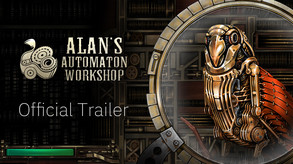
Alan's Automaton Workshop is an open-ended programming puzzle game. Start a new business with Alan Turing and his groundbreaking innovation: the Turing Machine. Build unique automatons, and solve all kinds of problems from clients.
Modeled estimate, not a reported figure. How we estimate →
Media

About

Genres
Stats
All-time low is the lowest price we've recorded for this game since we started tracking it.
Languages: English, Traditional Chinese, Russian, Simplified Chinese
Engagement
Hours played at review time, across 48 reviews with recorded playtime.
Reviews
Themes across 47 recent reviews and how positive each mention is. A keyword signal, not full sentiment analysis.
positive critical· bar length = how often the theme comes up
Reviews
TL:DR I would [b]conditionally[/b] recommend this game solely for the sandbox, which according to the developer is available on completion of the second chapter...[i]once it's actually implemented[/i]. As for the actual campaign story, that requires an advanced understanding of machine language programming and basic circuit design knowledge most individuals will not have, yet will need by the time you reach Chapter III, Task 4 (Multiplier). Unlike other Zach-like games, you will not have access to enough mechanical devices required to easily design the automaton for that, and will be tasked to invest a lot of free time to solve each puzzle. [hr] I am a fan of Zachtronic puzzle games but my relationship with them has been hit and miss. The workspace was either too small to design things on (my constant lament of "being asked to build a car engine within a closet" comes to mind), not having enough components to complete a task, or being asked to have a required degree of knowledge a person of average intelligence wouldn't have (and a reason why I've been pushing Valve to put a target audience rating to ensure such things do not happen). Of them all, Opus Magnum (OM) checked all the right boxes. The workspace was huge, there were many gadgets to use to solve puzzles, and it did not require any previous level of skill or expertise to complete. I loved OM so much I've completed the game three times and made my own puzzles to share with others. When Alan's Automation Workshop (AAW) was released, it looked so much like OM in storytelling and look despite not being a Zachtronic's game, I had to give it a try. Heck, it even said in the offering description it comes with a sandbox to create your own puzzles to solve. Let me start with the pluses first. It's a good looking game with bright and colourful steampunk art that helps tell the story of a man in the mid 20th Century who meets up with Alan Turing in his automation shop for a job and ends up being his business partner. Together, the two men travel around building automatons that can do the work of human beings. The characters in the story have facial expressions that match their emotions. The writing of the story is engaging enough to want you to complete the puzzles so the tale continues, much like OM. The workspace where you design automatons to solve the puzzles is enormous. Trust me, you're going to need that space, and why the pluses end at that point. The first negatives of the game is that unlike OM, you don't really have a lot to work with in terms of gadgets. There's at best only three gadgets to work with for each task, one of which (the register) you're not going to find much use for. The pieces themselves don't fit very well together in the same manner as OM does. I don't know if it's because OM is an alchemy puzzle game while AAW is based on bare metal engineering, but if you've played OM as much as I have you're not going to have a problem finding ways to get OM's gadgets to play nicely together because they're designed to actually fit together like a puzzle. On an AAW workspace, the parts sit together but they do not actually look like they work together. The muscle and nerve that makes that happen and thus your automaton to work is the diagram draft window. If you're familar with floatcharts in programming, this isn't too far off. There are state nodes that trigger the functionality of each gadget which are connected by conditional transitional lines that control the direction of mechanical flow. The interface to alternate between design and hardware placement don't work well together, with a dividing pane you cannot adjust easily to see more of one in favour of the other. The gadgets themselves don't have names that describe their function well. An integrator for example is a mathematical accumulator that really should be called that, an accumulator. The register is a rotating dial similar to a rotary phone wheel. Such naming can lead to confusion for the uninitiated. Speaking of uninitiated, the game does require you to have some skillsets only electronic circuit designers and hardcore machine language programmers will have.I am not kidding when I say this is bare metal engineering. You will need to know what an adder is. You will need to not only know how a binary multiplier works, but also deal with the carry bits that come from a base-2 numbering system. The fact you will not have access to a lot of gadgets (3 at the most for the binary multiplier puzzle) will make you feel like you're not only being asked to build a car engine, but you'll be ask to build it using atoms and molecules and not engine parts. This is not a game for the average joe: even my 20 years of high level programming in several languages did not prepare me for this. The sandbox would be a place I normally would go to to study such parts in greater details and with my own test data, but sadly it's not in the game. Despite saying in the offering description there is a sandbox and a level editor, it's actually not implemented yet. According to the developer it will be soon but it makes me wonder if perhaps the description shouldn't have mentioned it until it was actually there. It was, after all, one of the reasons why I purchased AAW. I like sandbox playing and designing my own contraptions. Don't get me wrong. I actually enjoyed playing this game, despite having to invest a might pretty big chunk of my free time in order to solve each puzzle. There is a feeling of great accomplishment that comes from solving something that really tasks the hell out of me to do, but I've hit a learning curve at the multiplier and it will probably be copying other player's solutions from here on. I just don't have the brains for it and why I gave it a conditional recommend for those of you with bigger brains and a higher tolerance of mental anguish. I still want that damn sandbox though.
The Dark Souls of Zach-likes*. Looking at games from TIS, over Exapunks to Human Resource Machine I'd say this one is on the very-hard end of the difficulty curve. Levels take longer to complete, require more clicking, and more routine in dealing with low-level logic programming than all of the Zach originals. It is also very satisfying to - finally - finish one. Iterating on solutions and improving them is even more of a challenge. The massive drop in completion rate from people finishing Act 1 (70%), Act 2 (35%) to finishing Act 3 (6%) serves as a data point for this. Building finite state machines from very basic inc/dec operations and simple comparisons is something that makes expressing rather easy to verbally describe ideas very complicated. In that sense, it feels more like writing assembling code than TIS ever did. Combined with the UI, which is very functional and well implemented but a bit cumbersome at times, this means each level needs more focus and structure than Zach ever wanted you to put into your programs. All levels in Alan are just that tiny bit more complex, more tedious, more deliberate, and more.. effort than in other games in the genre, and "getting things to work" is a way bigger aspect of this game than "getting it perfect". At least for the first 25 hours. In summary, I'd highly recommend this game, even if only for you to find out and explore the borders of what you actually find fun in a Zach-like. Maybe they should have built an easier game and left some of the harder, bigger, constructions for the post-game challenges. But the purity of vision was strong on this one so it's no surprise it rates lower than other entries. It's surely not something everyone will finish, but I think everyone can take something away from this one. -- *Well, not everyone will call this one a Zach-like but the description seems fitting enough for a headline. Alan is missing some key components that make up a Zach, namely the online runtime/elements-used/size comparisons that most of these games feature. While there are targets for runtime and component usage the game's sheer weight and inherent complexity do not lend its self well to micro-optimization and I can very much see why they skipped building this part.
✔美觀的介面 ✔優良的操作手感 ✔機械連貫運轉的動畫 除了我的腦袋實在是扛不住邏輯轟炸外,這遊戲沒啥問題(┛`д´)┛ 程式語言的難度可見一斑(´・ω・`)
Incredibly good game. Knowledge in programming helps somewhat but the puzzles are still hard due to a lack of basic functions. For example, there is no method of adding two numbers - you have to do that yourself. And if a number is greater than 9, you have to figure out how to handle two digit numbers. You need a lot of abstract thinking and concentration for the harder puzzles, especially if you try to optimize it for maximum scores. Most of the time you can force your way through a puzzle by simply not using loops, etc. but that results in a clusterfu** of a diagram and very low points, so optimizing imho is a core mechanic. The aesthetics of the artwork are beautifully done, but you can see that from the screenshots. edit: just finished the game with all levels optimized. about 70h (most of it was optimizing or keeping the game open while thinking about a solution, testing etc. the usual development stuff). I hope we get DLCs in the future, i'm hungry for more!
if you like logic puzzles that employ real world circuit engineering. I'm stuck on binary multiplication for several months now.
절대로 보통 코딩게임이라고 생각하지 마십시오. 펀치카드 뚫고 진공관 쓰고 하는 그 시대의 코딩입니다. 어셈블리어에도 있는 기본적인 합산/감산조차 제공하지 않으며 숫자 따위는 장식이고, 숫자 간 크기 비교와 같은 간단한 작업을 위해서도 쑈를 해야 하는 수준의 코딩입니다. 다만 그만큼 프로그래밍하고 나면 기존에 코딩에서 당연하게 사용하던 기능들에 대한 고마움을 느낄 수 있습니다. 이건 확실합니다.
почувствуй себя тупым
难度曲线比较适合编程小白。关卡完成之后的机械运转实在是太爽了
Great programming game. For a middle-level programmer like me, it gets challenging at around the second half of chapter 2 The presentation is the best I've seen in a game of that type (The actual devices gears and cogs actually turning while working are a cherry on top)
元々あった日本語MODを改変してbuild40419向けの日本語MODを作りました。 [url=https://uu.getuploader.com/itsuhika/download/19] https://uu.getuploader.com/itsuhika/download/19 [/url] 元データ製作者様:Azrael [url=https://github.com/kikw/AAW-Language-Mod-Jpn] https://github.com/kikw/AAW-Language-Mod-Jpn [/url] ライセンス:CC BY-NC-SA 4.0 (CC4.0のBYってこれでいいんだよね?) [hr][/hr] 有限オートマトンのパズルゲーム ノードと状態遷移を使って有限オートマトンを設計し、処理を完遂させるのが目的。 ノードには機械1つにつき1動作が記述可能、一方で「機械AにはAを書く」などの絶対指定が必要など少し癖強め。 1ノードにつき機械1動作なので比較的把握しやすく、なかなか面白いと思いました。 難点としては2章までがチュートリアルで、3章から難易度が跳ね上がる点です 問題自体の難易度もさることながら、終盤になるとそもそもの規模が大きくなりすぎて遷移図自体がぐちゃぐちゃになったりならなかったり、 最後の数問は辛くて攻略ガイド見ましたがまぁ、大規模でコピーも難しかったです とりあえずオススメ
Related
Related
Trends
Modeled estimate over time, reconstructed from Steam's monthly review histogram.
Momentum
Pace estimated from the game's recent review growth (our daily snapshots) at its own sales-per-review ratio — a momentum signal, not booked sales.
Audience
Estimated from the language of this game's reviews — a proxy for where players are, not official Steam demographics.
Related
| Recursive Ruin | $92.9K | 320 | 80% | $14.99 |
| Krush Kill ‘N Destroy 2: Krossfire | $92.9K | 453 | 73% | $9.99 |
| Anoxemia | $92.9K | 435 | 63% | $8.99 |
| Time Flies | $92.9K | 347 | 97% | $14.99 |
| Doom Sweeper | $92.9K | 819 | 74% | $4.99 |
| MAGLAM LORD | $92.9K | 112 | 63% | $39.99 |