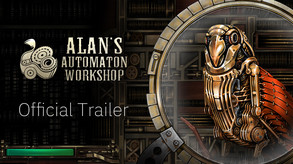
Alan's Automaton Workshop is an open-ended programming puzzle game. Start a new business with Alan Turing and his groundbreaking innovation: the Turing Machine. Build unique automatons, and solve all kinds of problems from clients.
Modeled estimate, not a reported figure. How we estimate →
Media

About

Genres
Stats
All-time low is the lowest price we've recorded for this game since we started tracking it.
Languages: English, Traditional Chinese, Russian, Simplified Chinese
Engagement
Hours played at review time, across 48 reviews with recorded playtime.
Reviews
Themes across 47 recent reviews and how positive each mention is. A keyword signal, not full sentiment analysis.
positive critical· bar length = how often the theme comes up
Reviews
I'm very happy that lately I've come across different niche games that are different from the usual games of different genres. This game is one of them. Very interesting level design and game style that attracts attention. No less interesting puzzles come across on your way. Even though I just started playing, it already feels like the developers put a lot of effort into creating this game.
Finite State Automata: the Game If you're a computer science or computational mathematics major, the processes will look very familiar very quickly. And if you're a fan of "Zach-likes" (logical programming-esque games in the same style as those made by Zachtronics), you'll find another game to fill that space here. It's pretty good; the writing and artistic styles are very nice (especially the art). The UI, controls, and features are well defined and structured (I've seen some zach-likes that are rough around the edges to control, and this one isn't). It's by no means perfect, but it's not bad enough to be a deal breaker for me. The only main shame I have is that you spend most of your time staring at a paper texture and a state diagram and not the devices you're controlling (which have some appealing steampunk design). The feedback from the devices isn't as satisfying as other titles and you don't have a great chance to just watch the machine do its thing (there's some screen clutter that can't be fully cleared away). One feature of Zachtronics games that I would enjoy being brought to this title is the ability to record an animation of your device doing its thing as a .gif. Though with how much happens behind the scenes in the state diagrams, some of those .gifs would be quite boring. And a fair warning: there can be some tedium for the solutions where you know what to do, but you have to do it in a very slow, arduous manner. But that's more a side-effect of the state automata structure of the core gameplay, which limits complexity of individual actions. Maybe you'll see that as part of the challenge, but if it sounds like it'd sour the deal for you, well, you've been warned.
While the game looks great, I do not recommend it. I love the art and feel of this game, the narrative did not grab me but I only played to level 2-3. AAW uses a variation of block coding, e.g. Human Resource Machine, used to teach coding to beginners. However unlike the traditional block coding, AAW charting system is tedious use--so many steps, too many pull down menus, take soooooo looooooong. I know how to solve the problem in my head but charting that out on AAW is a long and tedious process. I feel like I spend 90% of my brain power on attempting to chart rather than solve coding problems. The process is made worse by the art. While the art is absolutely gorgeous it gets in the way. Your workspace to chart is cluttered with steampunk gizmos that take so much real estate that it makes me feel so cramped.
The UI feels more challenging than the puzzles. Trays slide in and out randomly. Devices blend into the busy background and are too large to see all at once. Manipulating edges, conditions, and actions starts to feel really tedious by chapter 3, even with keyboard shortcuts.
[b]TL;DR: I'm sad to say that I really can't recommend Alan's Automaton Workshop. I absolutely adore programming games of all kinds, but I'm struggling to find much to like in this one.[/b] ------ Right away, we need to discuss this game's most glaring issue: visual clarity. Take a moment and try to parse what's happening in any of the screenshots on this page. Feeling a little lost? Yeah, same here. Buttons and menus constantly slide in and out of every edge of the screen, seemingly at random. Important UI elements frequently get lost in the onscreen clutter. Combined with the jittery and complex movements of the automatons, these issues create a major disconnect between the puzzles and the visual feedback provided for correct and incorrect solutions. Watching a solution play out in AAW is rarely satisfying and often confusing - a fatal flaw in any programming game. ------ Sloppy visuals, of course, are not a dealbreaker. Plenty of puzzle games succeed and even thrive on minimal or messy UIs. Regrettably, AAW also falls short in the gameplay department. The key to creating an enjoyable programming game is providing some functionality not found in real software. Most successful games in the genre offer players a sense of empowerment through simplified design processes, intuitive tools, and unique instruction sets that offer capabilities and challenges not found in typical programming languages. AAW, on the other hand, is almost painfully by-the-books in its execution. At the end of the day, this is a game about creating UML diagrams for finite state machines. For the uninitiated, that essentially boils down to drawing a flowchart for some process with a predictable set of outcomes. It's a pretty common exercise assigned in undergraduate programming classes. Unfortunately, like most homework, it's not much fun. AAW fails to recognize this on a conceptual level; it just isn't game-like enough to keep things interesting. While I can usually visualize my solutions almost immediately, building the flowcharts in-game is a long and frustrating process not unlike actual work. Any satisfaction I might find in solving the puzzles dissipates long before I finish my designs. ------ The developers obviously put a great deal of time and effort into this game, but, to be frank, Alan's Automaton Workshop feels like engineering busywork incarnate. There's probably a decent puzzler lurking somewhere in here... it's just too hard to see it underneath the layers of needless complexity. The gameplay is tedious, the UI is deeply flawed, and the writing is nonsensical. However, I think the premise could have some potential if done right. I'd be happy to try a sequel with a streamlined UI and more emphasis on the fun factor.
The game would be fun if it wouldn't be so tedious to build logic in it. The UI is garbage unfortunately, everything from zoom to the huge non-functional nonsense cluttering the screen. The complexity in this game is not figuring out a solution but rather having to re-build 80% of what you already did in the previous level. The ability to modularize components would help this game a lot,similar to Touring Complete. Unfortunately at the current state of it I would not recomend it. Cloud saves? Forget it, lose your save & start from scratch.
I've played through much of the game which (seems) like it's split across 5 "Chapters" with ~8 levels each. If you've ever had to draw up finite state automata diagrams for a math class and thought "wow this was neat, I wish I had a bunch more of these" then this is the game for you. If you haven't, then this is a game where you draw very detailed flow charts which update a machine one step at a time until it eventually finishes its goal. I think there's a lot to like about the game and some stuff to dislike. First the bad: The UI, as others have said, is kinda "noisy," visually speaking, but I dont really mind that as much as the tedium of checking a lot of boxes for some conditionals. I think a "check all" button for the arrows/conditionals would go a long way. Also I would like to see my flowchart and all my mechanisms operating a the same time, I think this is fixed at least a little by allowing us to zoom out a bit more in the top screen. The story itself isn't particularly compelling either. It seems like the writers are trying to go for some like, very very superficial social commentary about information and the way that it's created and received by the public? It's not so simple to fix the story, but I personally think that [spoiler]the drama between our two main characters opposing philosophies for change could've been played into a lot more rather than just immediately resolved at the start of Chapter 5[/spoiler] The most minor thing is probably that it's a little buggy and rough? E.g. sometimes when I'm creating arrows a *very large* arrow will appear sort of off to the side. There's also the spelling errors that are not *common* but still present. E.g. "Conditional" is misspelled in the encyclopedia/tutorial book. Now the things I felt mixed about (Im not sure if they're good or bad). A lot of other reviews I've seen would include these things under the bad, but I'm not so sure. The first is a startling lack of documentation. For a Zachtronics game (finally, a comparison to what definitely seemed to inspire the creators of this game), we'll either have a tutorial about what each individual piece and command we can use does or it's otherwise very intuitive. Not AAW. AAW gives you the briefest barest bone tutorial about how to create flowcharts and whenever they introduce a new "mechanism" in the game it's on you to figure out how to use it. I can understand how this can make the game feel sort of... inaccessible? At the same time, though, I feel like it plays into the overarching gameplay philosophy of this game which is knowledge and success through trial and error. I personally found it fun to be introduced to a new mechanism [spoiler]like the computing machine at the end of chapter 3 or the differential gear in chapter 4[/spoiler] and use the various commands that their corresponding state note methods have to reverse engineer the way that these mechanisms operate. That being said, there is one level in particular that sorta still violates this philosophy and that's the [spoiler]binary addition level. If someone doesnt already know how to add two binary numbers, I don't think it's fair to assume for them to come up with the algorithm purely from the way that we add numbers in vertical columns in base 10. Maybe the devs assume that their target audience will just... know how to add in binary, but it's not something that you could really come to through trial and error, I don't think.[/spoiler] The second thing that I feel... mixed about is the weirdly steep difficulty spike that happens in chapter 3 (at least for me and one other commenter who complained about binary multiplication). Chapters 1 and 2 feel sort of like... tutorials that give you freedom to just play around with the various mechanics that they've introduced. Chapter 2 in particular feels like an end to that tutorial, a kind of "let's test to see you've been paying attention." Chapter 3, on the other hand, is when the game stops giving you the easy puzzles and ramps it up. I found it enjoyable to have these multi-day attempts to work on a machine, but I can see others wanting a more uniform difficulty increase. Especially because in chapter 4, the difficult ramps way way down for all but one of the levels. On the one hand the difficulty decrease is a nice break from the gauntlet of chapter 3 and a chance to just focus on the new gimmicks of the chapter which keep things interesting, but on the other it's just more weird difficulty jumps. There's one more thing I think I need to address before moving on, and that's the fact that it's likely that you have your solution to a puzzle envisioned long before you the actual flowchart which takes a long time to construct (I think by design). The time thing is mitigated by creating more general machines and flowcharts rather than hardcoding everything, but it could still possibly take a long time. For me this wasn't so much of a problem because I found the process of creating the flowcharts and testing them constantly to be almost meditative. I think it's a general philosophical problem with puzzle games, the time it takes for a player to come up with a solution vs the time it takes to implement it. It just so happens that this game, at least in the first half which I really have to stress, you come up with the solution much faster than you can implement it. This changes in certain chapters down the road and certain levels in particular really make you think "how do I even *start* doing this [spoiler](looking at you 4-7)[/spoiler]"? I think the best solution to this is to create a rough flow chart that handles a lot of the cases you're given to test if your machine works at first, and then incrementally edit it to handle edge cases (which is something you'll be doing later probably anyways because it becomes much more difficult to predict the nature of the edge cases with the more complex tasks) so that, by the time you have a complete solution, you've finished implementing it. This goes back to what I think the game philosophy is. Clearly for me, this mixed segment was kind of a positive segment in disguise. I can see why some people might not like a lot of these things in the game, but I did for these reasons. How you feel about these things I've listed will make or break your view of the game, I think. Some last thoughts about something in this game I found kinda weird and that others might find "cringe": Grace. I wish I could ask the game devs why they felt the need to put a sexualized clockwork robot-woman in the game. She's mostly used for like, comic relief, but if all they wanted was a comic relief character we could've just had [spoiler]a robot goat following us around with the same dialog, maybe call it Matthew?[/spoiler]. Otherwise she's just like, almost a drone-like worker without any hint of independence (at least where I am in the game which is part way through chapter 5). She's just a kinda weird addition. All in all I feel like *I* was the target demographic of this game. I liked creating FSA diagrams for school, I enjoy a meditative mechanical experience in realizing a conceptual idea. I feel like there's enough "short term" goals to not make the flow charts feel like a slog (by this I mean that a sufficiently general machine is going to have a lot of subroutines to complete its goal, and making these subroutines is really quite quick and satisfying to see actually work when you're testing constantly). If this all sounds appealing and you can get passed that one kinda weird thing, I 100% recommend this game.
If you're a fan of defunct Zach Tronics games, especially Shenzen IO and TIS 100 this one will get your gears turning. Difficulty is nice, understand relatively tough (except chapter one, which is easy), chapter two is already a lot harder, but ok; level three is considerably harder, I'm currently on its last puzzle, and damn that's good. THere are 5 chapters in total, I excpect the last two chapters to not be that much harder than the third judging from the percentage of people finishing them, though that would be very fun if they were. Keep these stats in mind, the number of people finishing these chapters : [list] [*] chapter I : ~75% [*] chapter || : 35% [*] chapter ||| : 6% [*] chapter |V : 4.5% [*] chapter V : ~4% [/list] Have fun !
Pros: Nice graphics Cons story is nice but does not help at all and could be removed to improve the flow of the game. Dialog tells you nothing. Doesn't make a lot of sense the way the programming works. Any help is deliberately confusing and generally does not help. Screen is so cramped with things that are not relevant it all gets in the way and is confusing. Buttons are huge and programming area is cluttered. Would be much better if the great graphics attempt wasn't so large it pushed game areas into bad positions. A little fun if you take it in small doses and get it Very Very cheap.
I love the look and appeal of this game but just cannot cope with the UI. I want to program Alan's Automatons, but I just can't really stand how long it takes to drag out lines and connect them. I'm an actual programmer and this would be a lot easier to just write in a programming language. Unfortunately there are just better programming games out there.
Related
Related
Trends
Modeled estimate over time, reconstructed from Steam's monthly review histogram.
Momentum
Pace estimated from the game's recent review growth (our daily snapshots) at its own sales-per-review ratio — a momentum signal, not booked sales.
Audience
Estimated from the language of this game's reviews — a proxy for where players are, not official Steam demographics.
Related
| Recursive Ruin | $92.9K | 319 | 80% | $14.99 |
| Krush Kill ‘N Destroy 2: Krossfire | $92.9K | 453 | 73% | $9.99 |
| Anoxemia | $92.9K | 435 | 63% | $8.99 |
| Time Flies | $92.9K | 347 | 97% | $14.99 |
| River City Girls Zero | $92.9K | 299 | 65% | $14.99 |
| Doom Sweeper | $92.9K | 819 | 74% | $4.99 |