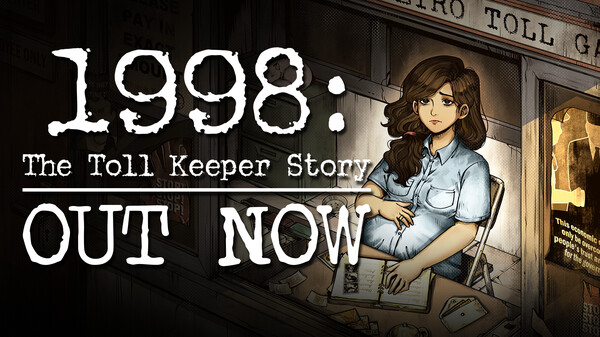
A narrative simulation game where you play as a mother-to-be working as a toll keeper in the fictional country of Janapa, a nation on the brink of chaos. Navigate daily challenges and make difficult moral choices to survive—all for the sake of your unborn child.
Modeled estimate, not a reported figure. How we estimate →
Media

About
1998: The Toll Keeper Story is a narrative simulation about survival, motherhood, and moral weight during a nation’s collapse, inspired by one of the darkest chapters of Indonesia's history.
You play as Dewi, a pregnant woman working as a toll keeper, caught in the middle of growing civil unrest and financial turmoil in the fictional Southeast Asian country of Janapa. The nation is crumbling—protests erupt, prices skyrocket, and trust in authority fades. Every shift, you inspect vehicles, verify documents, and decide who gets to pass—all while trying to stay safe, keep your job, and protect your unborn child.
You’re not a hero or a fighter—just a regular human being trying to endure overwhelming hardship. But even your smallest decisions carry consequences. Will you follow every rule, or look the other way when someone begs for help? Can you stay strong through fear, uncertainty, and pressure?
Features:
A Story of Survival and Motherhood: Make difficult choices not just for your safety, but also for your unborn child.
Narrative Simulation Gameplay: Check vehicles, documents, and identities while managing rising tension and limited resources.
Small Decisions, Heavy Consequences: Every action matters: who you let through, who you turn away, what rules you follow or bend.
Distinct 90s-Inspired Visual Style: Fusing dot textures, old-paper aesthetics, and a blueish filter, the art direction echoes printed materials from the 90s—grounding the game in the mood and texture of its era.
Inspired by True Events: This game is set during the 1998 Asian financial crisis, with Indonesia’s situation serving as one of the primary inspirations. Set in a fictional Southeast Asian country, it explores the fear, chaos, and uncertainty of the era, challenging you to navigate through moral dilemmas where survival demands difficult sacrifices.
Genres
Stats
All-time low is the lowest price we've recorded for this game since we started tracking it.
Languages: English*, Indonesian*, Simplified Chinese, Traditional Chinese, Japanese*languages with full audio support
Engagement
Hours played at review time, across 41 reviews with recorded playtime.
Reviews
Themes across 41 recent reviews and how positive each mention is. A keyword signal, not full sentiment analysis.
positive critical· bar length = how often the theme comes up
Reviews
If you not in this type of game buy it in the deep discount. Cause the story is very short. But as Indonesian gamer, I like this game, cause Iam in my junior high school when this thing happen. From the gameplay is improvement from the initial demo, UI and tutorial is much more clear. There is a few ending that you got, with how you react in the gameplay session
Papers Please, but in the era of Indonesia's peak corrupt government times and you're a pregnant toll keeper with family and friends. The story is emotional and tragic, in that some people WILL go missing and some will have to sacrifice something for the future. This is a good game documenting how awful Indonesia corruption history was and how the students led the revolution to this day.
A very snackable game with an appetizing story. For a certain demographic the story will trigger and hit you like a truck (it did for me). Especially for how relevant this is to the current situation of our country lmao. Art's fantastic. Gameplay was simple. Gotta find the time to play the extras next. Solid 8.75/10
On the one hand, I do like this game. But on the other hand, it feels like Papers Please but like it's more skewed to give you a happy ending and much, much shorter. I feel like the devs needed to do more to separate it from the original and also make you feel like you had some control on the story or there were more consequences for your actions.
入国ではなく車の料金所ゲーム? 一周しましたが超絶BADエンドでした。ED何種類くらいあるんだろう? いまのところバグもなくとても楽しいです。 ぺパプリライクですがぺパプリよりはだいぶ優しい難易度だと思います。 しかし妊婦さんなのに排気ガスでゴホゴホしたりしていてとても心配!! 旦那もなんか頼りないし… 猫ちゃんが唯一の癒し
this game so good laaa it really potray the history in my country
以前はアルストツカの入国審査の仕事を務めていましたが紆余曲折あり、ジャナパに移住してきました。 今では子供に恵まれてもうすぐ出産間近です。 決して豊かな生活では無いけれど、夫と共働きで、子供を迎える準備をしています。 驚きました。 この国では賄賂なんてものは無く、上司の顔を見ずに済むし、上司も私の事を気にかけてくれます。 今は料金所での仕事をしていて、入国審査をしていた時とは比べ物にならないくらい楽で…ゲホッゲホッ…
1998: The Toll Keeper Story is a deeply personal and emotionally heavy narrative game that explores political collapse and economic hardship through the perspective of an ordinary worker simply trying to survive another day. Rather than focusing on large-scale warfare or heroic rebellion, the game narrows its attention to the quiet desperation experienced by civilians trapped inside a crumbling society. This grounded approach gives the experience an unusual level of emotional realism, transforming seemingly routine tasks into tense moral dilemmas filled with anxiety, fear, and uncertainty. The story follows Dewi, a pregnant toll booth employee working in the fictional nation of Janapa during a period of severe political and economic unrest inspired by the Southeast Asian crisis of the late 1990s. Her daily responsibilities initially seem simple enough: collect toll payments, inspect documents, and process vehicles passing through the checkpoint. However, as the country spirals deeper into instability, even these ordinary duties become emotionally exhausting. New regulations appear constantly, protesters flood the roads, food prices rise, corruption spreads, and citizens grow increasingly desperate. Through Dewi’s perspective, the game captures the terrifying feeling of watching society slowly unravel while still needing to wake up every morning and continue working to survive. One of the game’s greatest strengths is how effectively it builds tension through gradual escalation. Early shifts feel manageable, with only occasional signs of unrest appearing around the checkpoint. Over time, however, the atmosphere becomes increasingly oppressive. Desperate civilians plead for help, counterfeit money becomes common, suspicious travelers appear more frequently, and government oversight grows harsher. The game never relies on exaggerated spectacle to create emotional impact. Instead, it focuses on small moments of pressure and uncertainty that slowly accumulate until every interaction feels emotionally draining. This restrained storytelling approach makes the unfolding crisis feel disturbingly believable. Dewi is an exceptionally well-written protagonist because she feels painfully human throughout the entire experience. She is not a revolutionary leader or action hero, but a tired working woman carrying the physical and emotional burden of pregnancy while trying to protect her family from forces completely outside her control. Her vulnerability shapes every decision players make. Financial struggles, concerns about healthcare, and fear of losing her job remain constant sources of stress. The game succeeds because it places players inside the mindset of someone trapped between survival and morality, where even small choices can carry devastating consequences. The moral decision-making system is one of the most compelling aspects of the game. Players constantly encounter situations where there is no truly correct answer. Should a struggling family without proper documents be allowed through the checkpoint? Is it worth accepting bribes when your own family barely has enough money to survive? Can you risk showing compassion if government authorities are watching closely? The game avoids simplistic morality systems and instead presents choices that feel messy, uncomfortable, and emotionally complicated. Most decisions involve sacrifice in one form or another, reinforcing the central theme that survival during societal collapse often demands painful compromises. The storytelling is subtle and highly atmospheric. Rather than delivering heavy exposition directly, the game reveals the state of the country gradually through overheard conversations, newspaper headlines, environmental changes, and the behavior of people arriving at the toll booth. Familiar faces begin disappearing. Rumors of violence and arrests spread quietly. Tension builds not because the game constantly explains what is happening, but because players witness ordinary life deteriorating piece by piece. This understated narrative style creates a far stronger emotional effect than dramatic cutscenes or excessive dialogue ever could. Visually, the game adopts a retro-inspired presentation that perfectly matches its bleak atmosphere. Grainy textures, muted colors, and soft lighting effects create a constant feeling of exhaustion and unease. The toll booth itself becomes almost claustrophobic over time, reinforcing Dewi’s growing emotional isolation. While the graphics are relatively simple, the art direction is highly effective because it captures the mood of economic decline and social instability so convincingly. The sound design contributes enormously to the game’s emotional tension. Distant protests, traffic noise, radio broadcasts, and subdued music constantly remind players that unrest exists beyond the booth walls. Silence is used especially well during emotionally difficult moments, making certain interactions feel painfully intimate and uncomfortable. The audio never becomes melodramatic or manipulative, instead maintaining a grounded realism that strengthens immersion throughout the experience. The gameplay mechanics themselves are relatively straightforward, focusing primarily on document inspection, conversations, and branching narrative decisions. Players looking for deep simulation systems or complex management mechanics may find the core gameplay somewhat repetitive over extended sessions. However, this simplicity ultimately works in the game’s favor because it keeps attention focused entirely on emotional storytelling and moral pressure rather than mechanical complexity. The repetitive nature of the work itself even reinforces the exhausting routine Dewi experiences daily. Another particularly effective aspect is how the game portrays authority and systemic abuse. Supervisors, government officials, and law enforcement figures create a constant sense of discomfort through intimidation, corruption, and exploitation. The writing handles these themes seriously, showing how ordinary people become trapped within systems that gradually strip away dignity and security. Several scenes are emotionally difficult to watch because of how realistically they portray fear, helplessness, and emotional exhaustion. 1998: The Toll Keeper Story is not designed as a traditional power fantasy or exciting political thriller. Instead, it focuses entirely on the emotional reality of surviving inside a collapsing society where ordinary people are forced to make impossible decisions every single day. By narrowing its perspective to one pregnant worker trapped inside an increasingly hostile system, the game creates a remarkably intimate and emotionally impactful narrative experience. The game succeeds because it approaches its subject matter with empathy and restraint. It does not sensationalize suffering or rely on exaggerated drama to make its point. Instead, it quietly shows how political instability affects the lives of ordinary civilians trying to protect their families and preserve their humanity under unbearable pressure. The result is one of the more emotionally mature and thought-provoking narrative games in recent years. Rating: 9/10
Great game! I hope the developers will release more games like this in the future. I'm from Vietnam. ♥♥
日本語版は未プレイ。 Papers, Pleaseのフォロワーといえるが、こちらの方がより家族の物語、そして史実の表現に注力している感じがする。 妊娠というある意味、社会の経済性、合理性から外れた状態の主人公を据えることで、Papers, Pleaseの倫理と経済生活の葛藤のほかに、社会と個人の葛藤をも描いている点が秀逸。 ゲームとしての難易度は高くなく、長さもそこまでないが、このストーリーは体験する価値がある。
Related
Related
Trends
Concurrent players on Steam, sampled daily since tracking started.
Audience
Estimated from the language of this game's reviews — a proxy for where players are, not official Steam demographics.
Related
| Codename: Panzers, Phase Two | $151.7K | 284 | 92% | $14.99 |
| Elroy and the Aliens | $151.7K | 472 | 97% | $17.99 |
| Asterix & Obelix: Slap them All! | $151.7K | 345 | 62% | $24.99 |
| Only You | $151.7K | 844 | 94% | $6.99 |
| Irotoridori No Sekai HD - The Colorful World | $151.7K | 267 | 96% | $34.99 |
| Welcome to Doll Town | $151.8K | 427 | 46% | $12.99 |