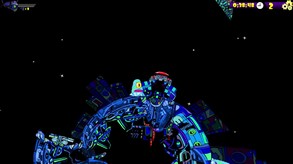
Zorbit’s Orbits by Happyrock Studios is a platformer that immediately distinguishes itself through its central mechanic: gravity is no longer a constant, but a shifting force that reshapes how every level is approached. Instead of moving across flat planes, players guide the titular character across small, spherical worlds where each surface exerts its own pull. This creates a constant sense of motion and reorientation, turning even the simplest jump into an exercise in spatial awareness. The concept is easy to grasp but surprisingly difficult to master, giving the game a strong identity from the outset.
What makes the experience compelling is how naturally it introduces this unconventional movement. Early levels are structured to gently familiarize players with the idea of curved terrain and shifting perspectives, allowing time to adjust to the sensation of running along the sides and undersides of circular environments. As the game progresses, however, the design becomes increasingly ambitious. Players are asked to leap between orbiting bodies, navigate tight spaces where gravity changes mid-action, and maintain momentum while constantly recalculating their position in relation to the environment. At its best, the game creates a satisfying rhythm where movement feels fluid and deliberate, rewarding players who can anticipate how gravity will affect their trajectory.
The level design plays a crucial role in sustaining this momentum. Many stages feel thoughtfully constructed, combining platforming challenges with a subtle puzzle-like quality. Instead of simply reacting to obstacles, players often need to plan their approach, considering how each jump will carry them along a curved surface or into the orbit of another structure. This layering of mechanics gives the game moments of genuine brilliance, where success feels earned through understanding rather than luck. There is a sense of discovery in learning how to manipulate the environment to your advantage, and these moments highlight the creativity behind the game’s design.
However, this same complexity can also work against the experience. As levels become more intricate, the shifting gravity can feel less intuitive and more disorienting. Situations with overlapping gravitational pulls or tight timing windows can lead to repeated failures, not because the player lacks understanding, but because the execution becomes overly demanding. The game occasionally crosses the line from challenging to frustrating, relying on precision that feels slightly at odds with the inherent unpredictability of its mechanics. This can interrupt the otherwise engaging flow, making progress feel inconsistent.
Control responsiveness is another area where the game struggles to maintain balance. While the basic movement is generally solid, the added layer of rotating gravity introduces moments where jumps feel less precise than expected. Small miscalculations can have exaggerated consequences, especially in later stages where hazards are less forgiving. In a game that requires constant adjustment to a changing frame of reference, even minor inconsistencies in control can become amplified, leading to a sense of tension that isn’t always enjoyable.
Visually, Zorbit’s Orbits embraces a bright and clean aesthetic that prioritizes clarity. The spherical worlds are distinct enough to remain readable despite the constant rotation, which is essential for maintaining player orientation. While the art style doesn’t push boundaries in terms of detail or atmosphere, it serves the gameplay well by keeping distractions to a minimum. The audio complements this approach, providing a light, unobtrusive backdrop that supports the action without drawing attention away from it. Together, the presentation elements create a cohesive but understated experience.
In terms of content, the game offers a focused set of levels that explore its core mechanic without straying too far beyond it. There is enough variety to keep things interesting for a few hours, but the experience remains tightly centered on its gravity-based platforming. Replayability largely depends on the player’s desire to refine their performance or revisit particularly challenging sections, rather than on additional modes or expansive systems. This makes the game feel complete in its scope, though somewhat limited in longevity.
Ultimately, Zorbit’s Orbits is a game defined by its willingness to experiment with the fundamentals of platforming. Its gravity-shifting mechanic introduces a fresh perspective that can feel both exhilarating and demanding, offering moments of genuine satisfaction when everything aligns. At the same time, its uneven difficulty and occasional control issues prevent it from fully realizing its potential. It stands as a creative and memorable entry in the indie platformer space, best suited for players who enjoy mastering unconventional systems and are willing to embrace a bit of frustration along the way.
Rating: 6/10