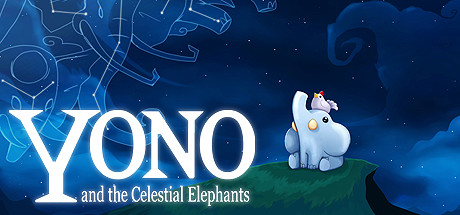
Yono and the Celestial Elephant is a grand adventure, featuring carefully designed puzzles, treasure hunts, a sprinkling combat and a world full of people.
Modeled estimate, not a reported figure. How we estimate →
About

Stats
All-time low is the lowest price we've recorded for this game since we started tracking it.
Languages: English*, Swedish*, French*, German*, Spanish - Spain*, Simplified Chinese*languages with full audio support
Engagement
Hours played at review time, across 41 reviews with recorded playtime.
Reviews
Themes across 41 recent reviews and how positive each mention is. A keyword signal, not full sentiment analysis.
positive critical· bar length = how often the theme comes up
Reviews
이게 도대체 어떻게해야 재밌다는걸까 90% 할인할 때 샀는데도 돈이 아깝다
[h1][b]Yono and the Celestial Elephants[/b][/h1] [h3][b]Time Played:[/b][/h3] 6.2 Hours [h3][b]Last Played:[/b][/h3] 3rd of May, 2026 [hr][/hr] Given my time to play anything befitting of the spring season was dwindling, and I wanted a gentle palette cleanser after the near-impossibility that was besting the “Puzzle 2” challenge in Lumines Arise, I thought this would be just what the hypothetical doctor ordered. It unfortunately was not... [h3][b]Yay:[/b][/h3] + Even the title screen was immediately-enrapturing to me. + You get started with minimal setup. + The game is audible at comfortable-to-my-autistic-ears system volume. + “Secret Forest Jar Shrine” + The early humour charmed me... + ...alongside other aspects of the game, like the [Spoiler]Minecart transition scene[/Spoiler] + This can be a plus, or a minus depending on who you are, but no achievements are present. Having just suffered to get the final needed one in Lumines Arise, this was quite welcome to me. + The various pot form-factors, and colour schemes were enjoyed. + While some may see the lack of resolutions higher than 1920 X 1080 to be a downside, the graphics have little detail that would benefit from higher resolutions. + Colourful + I liked the art-style, too. + Multiple skins exist to buy and equip. + You can pick most of the wildlife up. + [Spoiler]Some of the stations for the underground train all embody the place they lead to[/Spoiler] + [Spoiler]You can headbutt the queen.[/Spoiler] + While not based around the passage of time, or nature, like the Legend of Zelda “Oracle of...” games, every season is embodied by an area. [h3][b]Meh:[/b][/h3] ~ “Perhaps there is some darkness lurking under the surface, that you are fated to confront”. Double-space included. ~ The Knightingale Tavernkeep also says “Strenght”. [h3][b]Nay:[/b][/h3] - Combat could have been wholly-cut from the game without affecting much. All non-boss encounters boil down to “headbutt, hold stick away, turn back, and stunlock everything to death before it can even do the pre-smack animation.” - All non-boss enemies are also slightly-higher-HP reskins of one another, the only attack being “wait, and smack once”. - Some not-so-sunny topics ranging (racism, subjugation, slavery, execution, torture) come in out of nowhere after the totally-lighthearted opening, which caused a fair deal of tonal whiplash by my measure. - A lot of the quests involve you running to an area, grabbing a thing, running to the destination, grabbing an item, turning around, and going back to where you came from. This felt less like “Adventure” to me, and more “logistically-unsound errand running”. - Headbutt and trunk blast were both inconsistent at times. - The only thing you can buy with the coins are costumes. I would have liked abilities, like a coin magnet, speed increase, lack of movement penalty when full of water, and the like. - As well, the prices of these skins are both way too high, necessitating heavy farming if you want them all... - ...and the turntable at the barbers is automatic, meaning you need to wait for it to pan (way too slowly for my tastes) to see the part facing away... - I accidentally soft-locked a room in the first dungeon with a boss, as it's not clear you can step over onto a box in the first room you need to light all torches. This happened again with a later chest, only I was able to open it, even though it was below me. - No aim indicator is present to show where something will fall when thrown, making certain parts way more finicky than needed, and see you fighting the alignment more than the enemies. - Over 70% of my play time was from reading dialogue. - Dying in a dungeon means you go back to the previous building you exited... - Most of the puzzles from the moment you get to the first proper dungeon involve sliding ice blocks that only stop when they hit a wall onto switches. I do not enjoy those kinds of things, and the total over-use here was a large point of contention, even if I only needed to consult a walkthrough for 2 of them. - As well, the delay between smashing yourself against a block, and it actually moving was way too high. - No abilities, nor items are gained from finishing dungeons. Yes, you have various things you can suck up, but none of these can be taken with you. - The switch type introduced in the final dungeon cannot be targeted by pressing Y, when you're expected to trigger it from afar. - [Spoiler]Your two companions suddenly change appearance for no apparent reason after the second dungeon, and this is never mentioned.[/spoiler] - One of the block puzzles in the final dungeon was thought to be needlessly-complicated, and almost completely archaic, which is to type, “unenjoyable”. - [Spoiler]The plot could have ended the second you leave the queen's castle, yet continues for not other reason than that it can, leading to everything thereafter feeling incredibly-contrived by my measure. Adding to this discontent is the fact the betrayal of Yono's character is the only reason the final dungeon happens to begin with.[/Spoiler] - I probably, after all of this, should have expected it to more “stop” than “end”, with none of the plot threads concluding in any fashion, but...nope...[Spoiler]the queen has the fastest change of heart in anything I've ever played, read, or seen, the companion characters seemingly age several decades in minutes, while the queen looks the same, and the entire thing basically equated to “Ignore every bit of dialogue Yono just said, because this is the end of the game.[/Spoiler] [hr][/hr] [h3][b]Verdict:[/b][/h3] While it may have initially charmed me, the longer I played, the more I realised this was trying to be the Legend of Zeldaphant, only almost-completely-failing to inspire the same levels of engagement, variation, excitement, and sense of discovery I get when playing any game in that series that isn't called “Breath of the Wild”. Nothing within was hugely-offensive, or made me stop playing, but when the things I enjoyed faded almost as soon as you get to the second city, and only continue going down from there, being saved from the lowest two ranks does not equal a recommendation. [h3][b]Placed in:[/b][/h3] 4: Mundanely-Middling.
Cute and fun. Sometimes buggy but overall okay. Works well on Steam Deck.
Yono and the Celestial Elephants has such a unique premise and art style. For a short game, it has a lot of character and is an interesting puzzle game for those who find it interesting.
While at first, it might seem like a simple, shallow game - it is not. Though it never looses its jankyness in graphics and controls, which can be mildly frustrating, it more than makes up for it in world building and in some legitimately thought provoking concepts (the origin of Sundergarden; musings about war and peace; challenging notions about power, control and freedom). It doesn't cover everything equally and some plot points come across as very abrupt, but all in all, a very enjoyable game.
Норм, "Всегда Мечтал Почувствовать Себя Слоном в Посудной Лавке". А Здесь будет кошка, люди, которые будут пролистывать страницу, могут погладить ее. /> フ | _ _ l /` ミ_xノ / | / ヽ ノ │ | | | / ̄| | | | | ( ̄ヽ__ヽ_)__) \二つ
Yono and the Celestial Elephants is an adventure puzzle game developed by Neckbolt and published by Plug In Digital. Inspired heavily by classic top-down adventure titles, particularly games like The Legend of Zelda, the game blends exploration, environmental puzzles, light combat, and a heartfelt story set in a colorful fantasy world. What immediately distinguishes Yono and the Celestial Elephants from many similar adventure games is its unique protagonist: instead of playing as a sword-wielding hero, players control a small, magical elephant who has descended from the heavens to protect the land. This charming premise gives the game both its identity and many of its gameplay mechanics, resulting in a whimsical yet surprisingly thoughtful adventure. The story revolves around Yono, a celestial elephant who appears once every thousand years to help maintain balance in the world. When Yono awakens in the peaceful village of Longneck Village, the surrounding lands are already suffering from tension between different races and growing threats from hostile forces. As the newly awakened guardian, Yono must travel across forests, towns, temples, and underground ruins to restore harmony and protect the inhabitants of the realm. Along the journey, Yono meets several intelligent races including humans, robots known as Mekani, and undead beings referred to as the Bonewights. Each faction has its own history, culture, and perspective on the conflicts shaping the world, and the narrative uses these interactions to explore themes of prejudice, misunderstanding, and coexistence. Gameplay follows a traditional top-down adventure structure focused on exploration and puzzle solving. Players guide Yono through interconnected regions, discovering new locations, solving environmental puzzles, and uncovering hidden secrets. The puzzles often revolve around Yono’s unique abilities as an elephant. Using his trunk, Yono can push and pull objects, spray water, operate mechanisms, and manipulate environmental elements in creative ways. These mechanics serve as the foundation for many of the game’s puzzles, which require players to observe their surroundings and figure out how to interact with the environment using Yono’s abilities. For example, players might need to extinguish flames blocking a path, activate ancient machinery, or carry objects across rooms to trigger switches. Dungeon exploration plays a major role in the adventure. Throughout the world, Yono discovers several temples and ruins that function as puzzle-focused dungeons. Each dungeon introduces new mechanics and challenges, gradually increasing the complexity of the puzzles as players progress. These areas often require careful observation and logical thinking rather than quick reflexes, making the experience feel closer to a puzzle adventure than a combat-driven action game. While some enemies appear within these dungeons, combat remains relatively simple, allowing the focus to remain on exploration and problem-solving. The world itself is filled with side activities and optional tasks that add depth to the experience. Players can assist villagers with small quests, uncover hidden collectibles, and discover lore scattered throughout the environment. These interactions help flesh out the cultures of the various races living in the world and provide additional context for the larger story. Many of these side moments are delivered with humor and charm, reinforcing the game’s lighthearted tone even when addressing more serious themes. One of the most appealing aspects of Yono and the Celestial Elephants is its narrative approach. While the game initially presents itself as a cheerful fantasy adventure, it gradually introduces more thoughtful ideas about prejudice, conflict, and understanding between different groups of people. The interactions between humans, Mekani, and Bonewights reveal long-standing tensions and historical grievances that mirror real-world social issues. Rather than presenting a simple battle between good and evil, the story encourages players to consider the complexity of these conflicts and the importance of empathy and cooperation. Visually, the game embraces a bright and colorful art style that complements its whimsical premise. The environments are filled with vibrant forests, cozy villages, mysterious ruins, and serene landscapes that feel welcoming and imaginative. Character designs are simple but expressive, and Yono himself is an especially endearing protagonist. His animations emphasize his playful personality, whether he is spraying water with his trunk or happily trotting through a village. Although the graphical presentation is not technically complex, its charm and clarity fit the tone of the game perfectly. The soundtrack also contributes to the relaxed and adventurous atmosphere. Gentle melodies accompany exploration through villages and forests, while more mysterious tracks appear within ancient temples and underground ruins. The music supports the emotional tone of each location without becoming overwhelming, allowing players to focus on puzzle solving and exploration while still feeling immersed in the world. Despite its strengths, Yono and the Celestial Elephants is a relatively short adventure. Most players can complete the main story in around four to six hours, which may feel brief for those expecting a longer experience. Additionally, the combat system is fairly simple and may not satisfy players looking for intense action. Enemy encounters tend to serve more as obstacles within puzzles rather than as major gameplay features. However, the game’s emphasis on puzzles and storytelling means that these limitations rarely detract from the overall experience. Another minor drawback is that some puzzles may feel repetitive toward the later stages of the game, particularly for players who quickly master Yono’s abilities. While the dungeons introduce new variations, the core mechanics remain consistent throughout the adventure. Even so, the creative use of environmental interactions keeps most challenges engaging and satisfying to solve. Ultimately, Yono and the Celestial Elephants succeeds by delivering a charming and thoughtful adventure that combines classic puzzle exploration with an endearing protagonist and meaningful storytelling. Its accessible gameplay, colorful world, and imaginative design make it appealing to players of many ages, while its deeper themes add emotional depth to the journey. Though it may not be the longest or most mechanically complex adventure game, it offers a memorable experience that stands out through its creativity and heart. Rating: 8/10
what a cute wonderful fun game
Геймпад xbox не работает.
I tried playing it with keyboard and controller and neither one could get the game to function properly. I couldn't play it.
Related
Related
Trends
Modeled estimate over time, reconstructed from Steam's monthly review histogram.
Audience
Estimated from the language of this game's reviews — a proxy for where players are, not official Steam demographics.
Related
| SKIPCHASER | $7.7K | 76 | 70% | $4.99 |
| Super Destronaut DX | $7.7K | 76 | 89% | $4.99 |
| New Folder | $7.7K | 52 | 90% | $3.99 |
| The Last Birdling | $7.7K | 76 | 96% | $5.99 |
| Returner 77 | $7.7K | 57 | 72% | $7.99 |
| Grandpa's Table | $7.7K | 90 | 99% | $4.99 |