WhichWayOut? from DIG Games is a compact puzzle platformer that builds its identity around uncertainty, precision, and a deliberately unforgiving approach to problem solving. It presents a simple objective on the surface—find a way out of each level—but the way it challenges the player is far less straightforward. Instead of relying on complex controls or layered systems, the game leans into spatial puzzles and restricted perception, asking players to think carefully about every movement and action in environments that are designed to obscure as much as they reveal.
The core mechanics revolve around a small set of abilities that gradually become more demanding as the game progresses. Players can create clones and use light-based tools to interact with the environment, and much of the puzzle design comes from combining these abilities in clever ways. Individually, these mechanics are easy to understand, but the game derives its difficulty from how they are applied under pressure. Timing, positioning, and sequencing become critical, and even a minor miscalculation can result in failure. The limited toolkit works in the game’s favor early on, keeping the focus clear, but later levels push these same mechanics to their limits, requiring precise execution rather than introducing entirely new ideas.
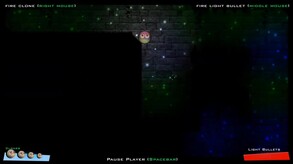
What truly defines the experience is its use of restricted visibility. The game intentionally limits what the player can see at any given moment, forcing reliance on memory and experimentation. This design choice adds a unique layer to the puzzles, as players are not just solving spatial challenges but also navigating incomplete information. It creates a constant sense of tension, where every step forward carries uncertainty. For players who enjoy figuring things out through trial and observation, this can be highly engaging. For others, it may feel unnecessarily punishing, especially when mistakes are not always clearly telegraphed.
The pacing reflects this philosophy of repetition and refinement. Progress is rarely immediate, and most levels require multiple attempts before a solution becomes clear. The game expects players to learn through failure, gradually building an understanding of each puzzle’s structure. This can make success feel rewarding, as overcoming a difficult section often comes after careful experimentation. However, the lack of checkpoints or forgiving systems can also lead to frustration, particularly when repeated attempts feel more like memorization than problem solving. The balance between challenge and clarity is not always consistent, and some sections can feel more punishing than insightful.
Visually, WhichWayOut? adopts a minimalistic style that complements its mechanics. The environments are dark and subdued, with simple shapes and limited detail. This aesthetic supports the theme of uncertainty, as the lack of visual clarity reinforces the gameplay’s reliance on perception. At the same time, the presentation can feel somewhat plain, as there is little variation between levels. The environments serve their functional purpose well but do not leave a strong visual impression, making the game feel more mechanical than atmospheric.
Sound design follows a similar approach. Audio cues are present and help signal interactions or outcomes, but they remain subtle and understated. There is little emphasis on music or dynamic soundscapes, which keeps the focus on the puzzles but also reduces the overall sense of immersion. The experience is quiet and controlled, relying more on player concentration than on sensory engagement.
In terms of structure, the game offers a linear progression through a relatively small number of levels. Each stage introduces a new variation or complication, but the overall framework remains consistent. Once all levels have been completed, there is little additional content to explore. Replayability comes primarily from revisiting puzzles to improve execution or to fully understand their solutions, rather than from new modes or alternate paths.
WhichWayOut? ultimately stands out for its commitment to a specific design philosophy. It is a game that values precision, patience, and experimentation, and it does not attempt to soften its edges for broader appeal. Its strengths lie in its focused mechanics and the satisfaction that comes from solving its more demanding puzzles. Its weaknesses stem from the same design choices, as the lack of clarity and unforgiving structure can make the experience feel frustrating or repetitive at times.
For players who enjoy challenging, methodical puzzle games that reward persistence and careful thinking, it offers a solid and sometimes rewarding experience. For those who prefer clearer feedback, smoother progression, or more varied presentation, it may feel overly harsh. It is a game that knows what it wants to be and commits to that vision, even if it limits its overall accessibility.
Rating: 6/10