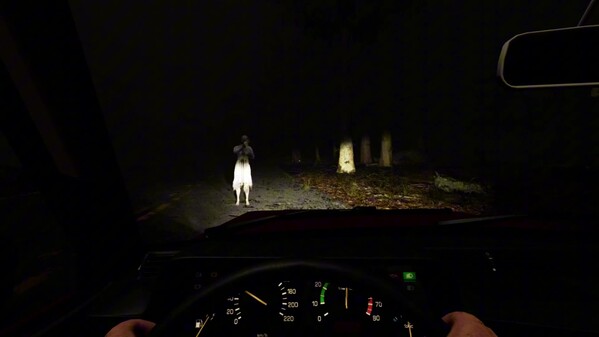
Stranded in a cursed forest, you must find four sacred relics to break the Ghost's curse. Use a cross to keep her at bay, a hammer to clear obstacles, and a GPS to navigate the forest. Survive until midnight, or become her next victim.
Modeled estimate, not a reported figure. How we estimate →
Media

About
Your car breaks down in the middle of a dark, forgotten forest. No signal. No help. Just silence… and the distant sound of something crying.
You were never meant to escape. Every step deeper into the woods draws her closer, the Banshee that haunts these lands. Can you survive the night, or will you join the others who vanished before you?
Find tools like a GPS to navigate the ever-changing forest. But remember, not everything you pick up is there to help.
To escape, you must find four sacred voodoo dolls hidden deep in the forest and bring them to the altar of an old church.
Complete the ritual and shatter the Banshee’s hold. But be warned, she won’t let you do it easily.
Not all paths are open. Use your hammer to break through barriers and uncover hidden routes, but it makes noise, and she hears everything.
The church is your final hope. It stands at the heart of the curse, waiting. Silent. Watching.
Survive Until Midnight
The Banshee becomes faster, stronger, and more relentless as time passes. Every hour brings her closer.
Use the Blessed Cross
A sacred cross is your only weapon. Time it right to push her back, or face the consequences.
Collect the Notes
Scattered throughout the forest are notes revealing the tragedy behind the curse. Piece the story together or stay in the dark.
An abandoned train sits frozen in time. It doesn’t move, but it watches. And it remembers.
Wail is a single-player survival horror experience where exploration, timing, and instinct mean the difference between breaking a curse, or becoming part of it.
Stats
All-time low is the lowest price we've recorded for this game since we started tracking it.
Languages: English*, Italian, German, Russian, French, Spanish - Spain, Indonesian, Japanese, Korean, Romanian, Simplified Chinese, Traditional Chinese +4 more
Engagement
Hours played at review time, across 40 reviews with recorded playtime.
Reviews
Themes across 40 recent reviews and how positive each mention is. A keyword signal, not full sentiment analysis.
positive critical· bar length = how often the theme comes up
Reviews
무조건 처음 문서,미션을 잘 보세요!! 안보고있다가 글자 사라지면 다시는 못봅니다 까먹으면 큰일남.. 해맬수도 있음 그거때문에 3트함 ㅋㅋ 맵이 넓은거 빼고는 킬링 타임으로 괜찮았음 3트 안했다면 1시간정도?? 걸렸을듯! 나쁘지않아요
너무 무섭냐링 ㅠㅠ
Pretty good jump scares! Needs a little bit more buildup for the jump scares. If you want a quick enjoyable scary experience give this one a go!
I really enjoyed the atmosphere and the jump scares were good. Only thing I'd mention is there's a lot of walking and I'm confused on whether there's a different ending than the one I got. Still had a good time with it. 3/5
Visually looks great, get a few stutters here and there but nothing major. Sounds are great and the movement overall feels good. The atmosphere and vibe are set very well, can't wait to see where development goes!
This game gave some really good jump scares, and I grew up on horror games! The ghost was creepy and trying to avoid her wailing screams was tense. Would definitely play more of this down the line.
A fun yet short horror experience with a lot of traversing through the wilderness using a GPS as well as a bit of exploration and a few jump scares.
Wail is an atmospheric survival-horror experience that leans heavily on dread, isolation, and slow-burn tension rather than spectacle or combat. Developed and published by DarkNest Games, it places the player in a hostile forest where danger is suggested long before it is seen, and where every sound, pause, and decision carries weight. The game’s design philosophy is rooted in vulnerability: you are not empowered, well-armed, or in control of the situation, but instead forced to survive through caution, awareness, and restraint. The narrative setup is immediately familiar yet effective. After a car breakdown leaves you stranded in a remote forest with no signal and no clear way out, it becomes apparent that the woods are bound to a curse far older than your presence. What begins as simple disorientation escalates into unease as distant cries echo through the trees, hinting at a supernatural force stalking the area. The story unfolds gradually through exploration rather than exposition, allowing the environment itself to communicate danger and history. Notes, abandoned structures, and strange landmarks quietly suggest past tragedies without ever spelling everything out, encouraging players to piece together the truth on their own. Gameplay revolves around exploration under constant threat. The forest is open enough to invite wandering, yet oppressive enough to make every detour feel risky. Your main objective—recovering sacred relics tied to the curse and returning them to a central altar—gives structure to the experience, but reaching those goals is rarely straightforward. Navigation tools such as a GPS provide limited reassurance, while practical items like a hammer or protective relics introduce meaningful trade-offs. Clearing paths may help you progress, but noise can draw unwanted attention, and defensive tools offer only temporary safety rather than permanent solutions. The game’s defining mechanic is its escalating sense of urgency. Time passes steadily toward midnight, and as it does, the supernatural presence haunting the forest becomes faster, more aggressive, and less forgiving. Early exploration allows for cautious planning, but later stages push players into tense improvisation as safe spaces shrink and mistakes become costly. This progression creates a palpable shift in tone, transforming curiosity into fear and eventually into desperation, without relying on constant jump scares. Wail’s antagonist is less a conventional enemy and more a force of pressure. The Banshee’s presence is often signaled through sound rather than sight, keeping players on edge even when nothing appears to be happening. This auditory focus reinforces paranoia, as players are never quite sure whether they are being watched or hunted. When encounters do occur, they are brief, dangerous, and designed to punish recklessness rather than reward confrontation. Visually, the game favors mood over technical sophistication. Dense foliage, limited visibility, and subdued lighting combine to make the forest feel claustrophobic despite its openness. The environment rarely changes dramatically, but subtle variations in terrain and landmarks help players orient themselves while maintaining a sense of sameness that reinforces disorientation. The presentation may lack the polish of higher-budget horror titles, but its consistency and restraint serve the atmosphere well. Sound design is one of Wail’s strongest elements. Ambient forest noises, distant wails, and sudden audio cues create constant tension, often doing more to unsettle than visual threats ever could. Silence is used deliberately, making players hyperaware of every footstep or rustle. Music, when present, is understated, allowing environmental audio to dominate and ensuring that fear emerges organically rather than being forced through dramatic cues. Replayability in Wail comes less from branching narratives and more from mastery. Learning the forest’s layout, optimizing routes, and understanding how the supernatural threat behaves over time can significantly change how subsequent playthroughs feel. While the core objective remains the same, player confidence and decision-making evolve, turning earlier fear into calculated risk. Still, the experience is relatively compact, and players looking for extensive content or mechanical variety may find its scope limited. Overall, Wail succeeds as a focused survival horror experience that understands the power of restraint. It does not attempt to redefine the genre or overwhelm players with systems; instead, it commits fully to atmosphere, pacing, and psychological tension. For players who enjoy being vulnerable, lost, and constantly uncertain—where survival depends on listening, observing, and knowing when not to act—Wail offers a haunting journey through a forest that feels alive with malice, long after the final echoes fade. Rating: 6/10
kötü
Wail was one of those games that landed squarely in the "it was alright" category for me. The premise is simple enough. You're stranded in a cursed forest and must find four sacred relics to break the ghost's curse before midnight. Along the way, you'll use a cross to keep the ghost at bay, a hammer to clear obstacles, and a GPS to help navigate the forest. If you don't manage to lift the curse before time runs out... you become her next victim. From a technical standpoint, I really don't have any complaints. The game played smoothly, I didn't run into any bugs or glitches, and everything functioned the way it was supposed to. The biggest issue for me was that the gameplay loop never really evolved. Most of your time is spent running through the forest, searching for relics, avoiding the ghost, and repeating that process until you've collected everything you need. It works well enough, but after a while it starts to feel a little repetitive. That said, there were definitely a few moments where the tension ramped up. Being chased through the woods while desperately looking for somewhere to hide made for some genuinely stressful moments, and those sections were easily the highlight of the game. As for the story, it just didn't leave much of an impression on me. It gets the job done, but it never really hooked me or made me eager to uncover what happened next. Overall, Wail isn't a bad game at all. It's a straightforward indie horror experience with a few solid scares, a simple objective, and enough tense moments to keep things interesting. It just doesn't do enough to separate itself from the many other indie horror games built around collecting items while avoiding a pursuing enemy. If you're simply looking for a short horror game to pass the time, I think Wail is worth checking out. Just don't go in expecting it to become your new favorite horror game.
Related
Related
Trends
Concurrent players on Steam, sampled daily since tracking started.
Audience
Estimated from the language of this game's reviews — a proxy for where players are, not official Steam demographics.
Related
| 7 Days to Die | $425.3M | 403.6K | 87% | $44.99 |
| Palworld | $279.6M | 447.5K | 94% | $20.99 |
| The Forest | $254.8M | 678.6K | 96% | $19.99 |
| Ready or Not | $238.1M | 339K | 78% | $49.99 |
| Sons Of The Forest | $201.1M | 315K | 88% | $29.99 |
Related
| Path of Sacrifice | $7.6K | 113 | 93% | $3.99 |
| Evil Holiday | $7.6K | 218 | 80% | $2.24 |
| 瓶中精灵 - Fairy in a Jar | $7.6K | 206 | 91% | $1.99 |
| Mexico, 1921. A Deep Slumber. | $7.6K | 55 | 87% | $19.99 |
| The Shopkeeper | $7.6K | 149 | 14% | $2.99 |
| Survive in Space | $7.6K | 224 | 68% | $1.49 |