Vector Velocity is a virtual reality parkour platformer developed by David Mulder and published by Volens Nolens Games, built around one central idea: movement should feel physical, immediate, and embodied. Rather than relying on traditional button-based locomotion, the game translates real-world gestures into in-game actions, turning the player’s body into the primary control interface. The result is a VR experience that attempts to blur the line between avatar and player, placing full-body motion at the heart of its design. It is less about navigating menus or mastering complex systems and more about physically engaging with the act of running, jumping, sliding, and climbing through digital space.
At its core, Vector Velocity is a time-trial style traversal challenge. Each level tasks players with reaching an endpoint as quickly and fluidly as possible, navigating a series of obstacles and environmental elements that demand precise timing and efficient movement. Instead of pressing a button to sprint, players pump their arms to simulate running. Jumping requires an upward motion, sliding involves a downward sweep, and various gestures trigger different parkour maneuvers. This direct mapping between motion and movement creates moments where the physicality of VR shines, particularly when chaining actions together into smooth, uninterrupted sequences.
The level design emphasizes verticality and flow. Platforms are arranged to encourage experimentation with different routes, rewarding players who learn to read the environment quickly and identify optimal paths. Rails can be ground along, slopes can be slid down for speed boosts, and ziplines offer bursts of momentum that carry the player forward. Success is not just about reaching the finish line but about doing so with rhythm and control. When the mechanics click, the experience can feel exhilarating, as if performing a choreographed series of athletic movements inside a stylized obstacle course.
However, the same physical design that defines Vector Velocity’s strengths also introduces its greatest challenges. Because movement is gesture-based, the precision of input depends heavily on the player’s physical coordination and the responsiveness of the VR tracking system. Small inconsistencies in hand movement can result in unintended actions or lost momentum. For newcomers to VR, this can create a steep learning curve, as the body must adapt to interpreting digital feedback through physical motion. The lack of traditional locomotion safety nets means that mistakes often break the flow, leading to moments of frustration.
The physics system plays a critical role in shaping the overall feel. Momentum carries forward naturally, and the game attempts to simulate weight and inertia, giving each jump and slide a tangible sense of presence. At times, this adds authenticity and immersion. At other times, it can make transitions feel slightly unwieldy, especially when precise timing is required. Mastery comes through repetition and muscle memory, as players learn to calibrate their gestures for consistent results. Over time, successful runs become less about guesswork and more about controlled execution.
Visually, Vector Velocity adopts a clean, functional aesthetic. The environments are not heavily detailed, but they are designed with clarity in mind, ensuring that players can quickly identify interactive elements and traversal opportunities. The focus remains on movement rather than visual spectacle. This simplicity works well within the VR space, preventing sensory overload and allowing players to concentrate on timing and coordination. The audio design supports the experience with subtle cues that reinforce successful actions and maintain immersion without overwhelming the player.
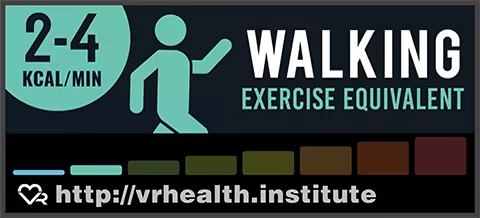
One aspect that distinguishes the game is its physical intensity. Unlike many VR experiences that rely on limited gestures or stationary gameplay, Vector Velocity demands sustained arm movement and active participation. Short sessions can feel invigorating, almost like a light workout. However, extended play can become physically tiring. This makes the game particularly well-suited to quick, focused sessions rather than prolonged gameplay marathons. The physical demand is part of its identity, though it may limit accessibility for some players.
Ultimately, Vector Velocity stands as an ambitious attempt to rethink locomotion in virtual reality. By centering its design on full-body gesture control, it offers a distinctive alternative to joystick-based movement systems. While not flawless in execution, it delivers moments of genuine flow and satisfaction when player movement and in-game physics align. For VR enthusiasts seeking an active, parkour-inspired traversal experience that emphasizes embodiment over traditional control schemes, Vector Velocity offers a challenging and physically engaging ride that highlights both the promise and complexity of immersive motion-based design.
Rating: 5/10