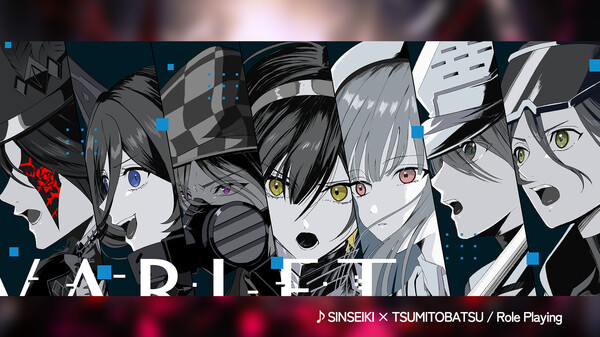
To be a "leader" that guides others forward, or to be an uncompromising "ruler"...VARLET is a school life RPG where, through encounters with troubled boys and girls who are also searching for themselves, you begin to uncover a version of yourself you never knew existed.
Modeled estimate, not a reported figure. How we estimate →
Media

About
VARLET is a school-life RPG about self-discovery, experienced through meeting others who struggle with the question of who they truly are, and grow through that very struggle.
Kousei Academy: where the protagonist has recently transferred.
Whispered rumors surround this place.
Another world where strange creatures dwell appears within the school...
...and once you've wandered in, there's no way back out.
After seeing this other world—a Glitch—with his own eyes,
the protagonist realizes several people have been replaced with monsters.
You must fight alongside your friends
to save the academy from imminent destruction.
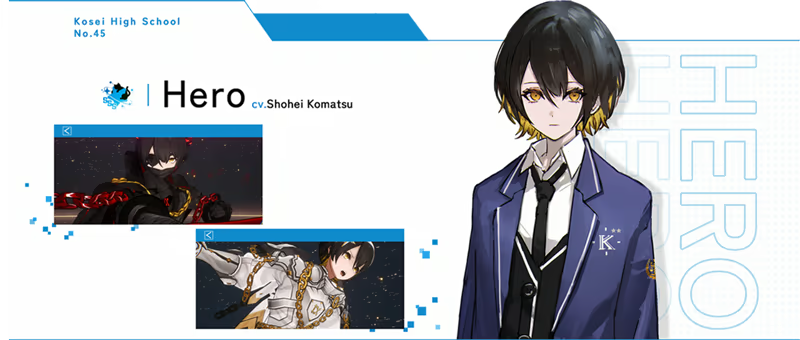
Hero (CV.Shohei Komatsu):
Your avatar in this world.Upon meeting a strange individual in a dream, he gains the power to start a revolution.
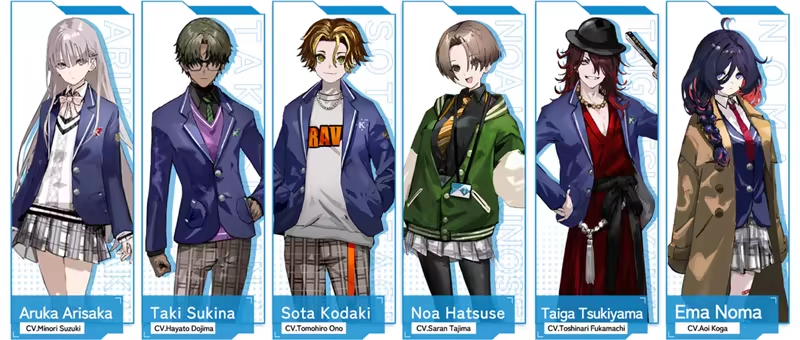
Playable members of the SSS (Student Support Services):
・Embracing Your Youth in School Life
Help other students deal with their problems as a member of the Student Support Services (SSS),and then go out with friends after school to make the most of your school days.
The bond between the two of you will grow stronger with each event you experience.
Be careful, though—becoming intimate with multiple people may cause problems…⁉
・Battles use a simple yet exhilarating Timeline Command system.
Take the lead as a “Leader” who supports allies in combat, or dominate the battlefield as a “Ruler” with powerful skills.
Use both fighting styles to seize victory!
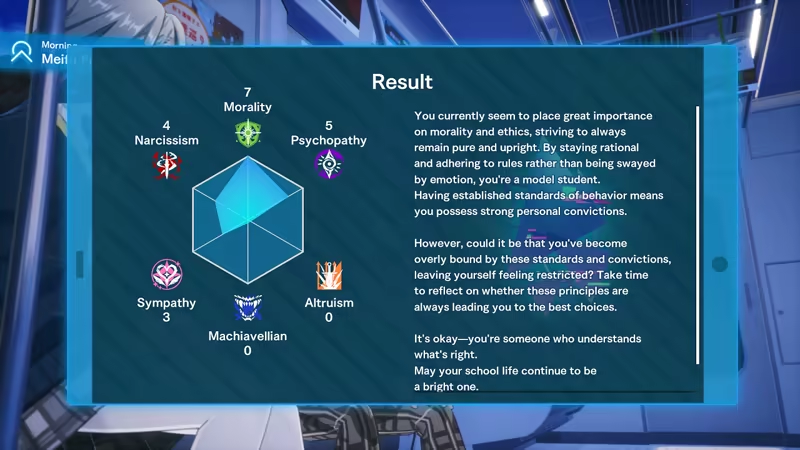
・Your choices will reveal your true self—.Triad Stats.
Light Triad: Morality, Sympathy, Altruism
Dark Triad: Machiavellianism, Psychopathy, Narcissism
These six stats will change according to the analyses you receive and choices you make during the game.

Triad stats can increase the number of dialogue options available to you and enhance the power of passive battle skills.
What course of events will your true self bring about?
Scenario: Gakuto Mikumo, Ryutaro Ito
Scenario Editing: Kazunari Suzuki
Character Theme Song Composer: wotaku, NILFRUITS, OSTER project, Yoshida Yasei, Tadano Kaede/A4., Hitoshizuku and Yamasankakkei, KANON69, Daibakuhasin
Music: Tsukasa Masuko
Be sure to wishlist 『VARLET』 and look forward to its release and additional updates!
Genres
Stats
All-time low is the lowest price we've recorded for this game since we started tracking it.
Languages: English, Simplified Chinese, Traditional Chinese, Japanese*, Korean*languages with full audio support
Engagement
Hours played at review time, across 40 reviews with recorded playtime.
Reviews
Themes across 40 recent reviews and how positive each mention is. A keyword signal, not full sentiment analysis.
positive critical· bar length = how often the theme comes up
Reviews
[後半に日本語レビューあり] [h1] A classic school RPG blending daily life and the unknown [/h1] This title fuses academy life with tactical battles. The player acts as the deputy counselor of the “Student Support Service,” listening to students’ troubles while confronting an otherworldly threat known as the “Glitch.” The seamless transition between daily and extraordinary life forms the core of its structure, where every choice and conversation shapes the protagonist’s personality. A defining element introduced early in the story is the “Triad Parameter” system. Six axes—Morality, Sympathy, Narcissism, and others—affect dialogue and skill growth, turning choices into reflections of who you wish to become rather than simple good-or-evil splits. During the academy phase, you build trust through interactions, after-school activities, and counseling sessions that interweave naturally into the main narrative. Combat follows a “Timeline Command Battle” format. Both ally and enemy turns are visible, allowing you to interrupt or chain actions to change the tide of battle. Compared to standard command RPGs, moment-to-moment judgment and foresight are vital. The timing of skills, who to support, and who to obstruct—each decision carries tension and consequence. While not particularly difficult, the system grows more strategic the deeper your understanding becomes. Each character carries inner conflict: the confident honor student, the quiet transfer student, the hot-headed delinquent. Though archetypal at first glance, successive events lend them genuine depth. As bond episodes unfold, their hidden flaws and impulses for self-change emerge, creating a natural sense of progression. The pacing is deliberately gentle, yet the slow, steady deepening of relationships feels rewarding and sincere. Visually, it contrasts subdued backgrounds with glowing effects, beautifully portraying the divide between reality and the otherworld. The companions—your so-called “colleagues”—each possess distinct charm, and their dialogue scenes remain engaging throughout. The soundtrack features vocal themes and character-specific BGM, with insert songs that amplify emotional peaks. The synchronization of sound and imagery reflects FURYU’s strong cinematic sensibility. On the downside, parts of the school phase can feel repetitive, as similar counseling events occur in succession. The story’s early pacing is restrained, taking time to reveal the protagonist’s and the organization’s background. However, once the midgame ties battles to the unfolding drama, immersion rises sharply. Toward the finale, the narrative converges on the core theme of [spoiler]“Who am I?”[/spoiler], giving emotional payoff to the journey. Overall, this work follows the structure of titles like Persona or Blue Reflection while emphasizing the tension of combat and the weight of psychological choice. It’s a grounded, performance-driven school RPG that showcases its appeal through direction, music, and character acting rather than spectacle. For players who appreciate character depth within a school setting, strategic turn-based battles, and audiovisual storytelling that prioritizes quiet resonance over flashiness, this offers plenty to savor. [h1] 学園と異界を舞台とした、仲間との関係を楽しめる王道RPG [/h1] 学園生活と戦術バトルを融合させた作品で、プレイヤーは「生活相談室」の代理室長として生徒たちの悩みを聞き、同時に“グリッチ”と呼ばれる異界の脅威に立ち向かう。日常と非日常が絶妙に交錯する構成で、選択や会話が主人公自身の人格を形作っていく。 特徴的なのはストーリー冒頭から触れる機会がある「トライアドパラメータ」と呼ばれるシステムだ。モラル・シンパシー・ナルシシズムなど、性格の6軸が会話やスキル成長に影響し、選択肢が単なる善悪の分岐に留まらず“自分がどう在りたいか”を問うものとして機能する。学園パートでは生徒との交流を通じて信頼関係を築き、放課後の行動選択や相談解決が物語に重なっていく。 バトルは「タイムラインコマンドバトル」方式。敵味方の行動順が可視化され、行動の割り込みや連携によって戦況が一変する。純粋なコマンドRPGよりも、瞬間的な判断と先読みが重要になる設計だ。スキルを発動するタイミング、誰を支援し、誰を妨害するか——その一手が勝敗を左右する緊張感がある。難度はそれほど高くないが、理解が深まるほど戦略性が増していくタイプのシステムだと感じた。 登場人物はそれぞれが葛藤を抱えており、強気な優等生や寡黙な転校生、激情型の問題児など、一見テンプレと思われながらもイベントの積み重ねでそこに深みを持たせている。絆イベントを重ねるごとに、彼らの“見たくなかった面”や“自己変革への衝動”が現れていく過程が魅力的だ。仲間たちの関係性を丁寧に見せるためかテンポは緩やかだが、ゆっくりじっくり関係が深まるさまは心地よい。 ビジュアル面では、彩度を抑えた背景と発光を思わせるエフェクトが融合し、現実と異界の対比を美しく描いている。また、「同僚」ともいえる仲間のキャラクター達は各々の魅力を備え、会話イベント等々も苦にはならなかった。音楽はボーカル入りのテーマ曲やキャラ別BGMが多く、特に感情のピークを支える挿入歌の完成度が高い。音と映像が連動する演出は、フリューらしい映像志向の強さを示していると感じる。 一方で、学園パートの一部は単調さがあり、同様の相談イベントが続くとやや作業感を覚えることもある。物語のテンポも序盤は抑え気味で、主人公や組織の背景が掴めるまで少し時間がかかる。ただし中盤以降は戦闘とドラマが結びつき、キャラクターごとのルート的展開に入ると没入度が一気に上がる。終盤には[spoiler]“自分が誰であるか”[/spoiler]という根幹のテーマに収束していく構成となっている。 総じて、本作は『ペルソナ』や『ブルーリフレクション』のような構造を踏襲しつつも、戦闘の緊張感と心理的選択を中心に据えた特徴を持つ。堅実に、演出・音楽・キャラ演技の総合力で魅せるタイプの学園RPGである。 学園モノにおけるキャラクター性の深掘り、戦略的なターンバトル、そして音楽と映像が一体化した演出。派手さよりも静かな余韻を重視した構成で、ゆっくりと人間ドラマを味わうタイプの作品であり、これらを重視するプレイヤーには、刺さる部分が多いのではないだろうか。 [quote][b]Check out our Steam curator ([url=store.steampowered.com/curator/36364102-Horny-Hentai-Festival/]link[/url]) , YouTube channel ([url=www.youtube.com/curatorhhf/]link[/url]), and X(Twitter) ([url=x.com/hhfcurator]link[/url])![/b][/quote]
Let’s talk about Varlet Overall, this game was a complete letdown. I’m genuinely relieved I picked it up on sale instead of paying full price, because even at a discount, it feels overpriced. Realistically this is a $15 $20 game at best. The experience itself is just….. underwhelming. The story has moments where it starts to get interesting but those moments are quickly interrupted by awkward transitions like the frequent black screens. Instead of showing characters walking away or letting scenes play out naturally the game cuts abruptly which really breaks immersion or even the randomly appearing phones or disappearing phones instead of animating them actually taking out and putting away. The music doesn’t help much either it often feels like generic background noise or simply put elevator music, I want something that’s memorable, excites me for battle or exploration not something that makes me yawn and on top of that the gameplay becomes repetitive very quickly such as the enemy designs, they lack variety and both the combat system and the running mechanic feel unnecessarily slow. It’s hard not to wonder where the budget actually went because it certainly doesn’t feel like it was invested in the core elements that make gameplay engaging. The repeated SSS events are another weak point they become tedious over time though oddly there’s something a bit comforting about their predictability. The dungeon mechanics suffer from the same issue such as repetitive and lacking depth. That said, the game isn’t without its positives. The character designs are genuinely charming and I enjoyed mechanics like flank attacks and the binding system they add a nice layer to combat. Some of the cutscenes are well done, and the even the anime theme before you start the game presented a nice touch. The first main boss fight stood out as well specifically because of its music it was easily one of the highlights. I also appreciated the bonding system particularly how the game suggests good locations to take characters to build relationships. However, this leads into one of my biggest disappointments: the so called “romance.” It barely feels like romance at all. As someone who enjoys RPGs with romantic relationship building, it’s frustrating to see the game lean on terms like “intimate” without actually delivering on that promise. For example, when I tried to pursue a relationship with Sota, it never progressed in a romantic way. Even as I reached Chapter 6 the dynamic remained stuck in a “we’re just bros” loop with him frequently talking about wanting a girlfriend. It felt misleading especially when the game presents these interactions as something deeper. Eventually it seemed like I hit a progression cap with no way to develop the relationship further which is fine if he would you know understand we are suppose to be “dating.” What makes this more frustrating is how the game handles bonding overall. It gives warnings about getting close to other characters, implying exclusivity yet doesn’t fully commit to making those relationships feel genuinely romantic. Whether this is due to gameplay restrictions or narrative choices or even timing of the game it ultimately hurts immersion. It makes it harder to feel invested in the life you’re building for your character when you already seemed to establish something. if a game is going to include a bonding system like this and claims "Intimate bonds" it should fully commit allowing meaningful romantic paths for all characters. As it stands it feels limited and inconsistent. More broadly it would have been great to see the game take more risks with its relationship options instead of playing it so safe. In the end, I wanted to love this game especially as a Persona fan and the idea that this game would allow Gay romance… I had the idea to simply 100% or even if it was just meh- till I found it that’s impossible in one play through since the game limits hangouts me mechanic and so you’ll have to start a new game to complete the achievements for bonding… oh and there’s no new game+ option so I just completely lost interest as I reached the last chapter because my interest and immersion just fell apart…. Varlet had potential but it falls short in too many key areas. Between the repetitive gameplay, lackluster execution, and disappointing relationship system, it’s hard to recommend especially at its current price point.
I went into Varlet with the mindset: 'Buy the soundtrack, get a free game'. But honestly? I couldn’t even enjoy the music this time. I was expecting something like Caligula, but the vocal tracks only trigger during boss fights—and because the combat is so brain-dead easy and short, the songs end before they even get going. It’s disappointing that even with zero expectations, the game still managed to let me down.
价格美丽,内容半成品,无需多言,骨折也不建议买
Had alot of fun with this one, though granted, I was using Cheat Engine to play at 30% faster speed mostly because the game felt too slow. It took me a surprising while to realise that this was made by the same people that made Monark, haha. When I saw the opening, I noted that it reminded me of Monark, the Character Songs for the boss battles which I loved also reminded me of Monark, though not quite at the same level. Then when the Player gains their Tyrant Form, that's when it fully clicked for me of the Monark connection. The characters and story isn't especially revolutionary, but I didn't need them to be, i enjoyed the game for what it was and enjoyed my time with them. The SSS activities were quite boring, though I get the desire to have gameplay connections to the context, the main enjoyable part of these were listening to character conversations, particularly loved that some future story characters / context is hinted at early on, things like Emri's appearance and Taiga's script, I had a bit of a laugh with some of the side characters like the failing actor who ended up in the power rangers show, or the 3 guys who discovered they were `dating` the same girl. Though it was probably just me enjoying the small things in a largely flawed experience. Animations are probably where I can obviously see the budget of this project, being somewhat rough in a number of places, I enjoyed the turn based combat mechanics of a timeline, breaks and interruption resource though as some other comments said, it's a simpler twist on Caligula's, which isn't a bad thing. The UI was quite stylish, it was clear what they were going for, particulalry during the Stun / Blitz Ultimates, though the animations there again let it down quite a bit. Maybe because of all the Slow Downs / hit stops, I ended up with alot of time to appreciate some of the VFX when I ended up liking quite a bit. I appreciated that the Glitch dungeons were often designed as puzzles rather than straight combat, where if you engaged in it properly, you could speed up how long you had to spend fighting, they were hard enough that sometimes I had to stop and think, but not too long to figure it out, which I appreciate since I can't enjoy being stuck on puzzles like I used to because of time. Less of a review and more of a message to the devs, I really enjoyed this game, and like Monark, I want to cheer on the mid-sized devs who create such games. Obviously not reasonably comparable to much larger budgets like Persona, this is a flawed game but at times, quite enjoyable. For people who do want to give it a try, I'd probably suggest waiting for a sale.
Get on a sale if you have any interest. It's not bad, nor is it great, and it's a bit pricey for what you're actually getting. If we go on a 0-5 scale, I'd put it at 3.5 as it just barely edges out of perfectly bland for me during the final chapters when things get a bit more interesting. My favorite part of the writing is it's not wasting my time like every modern Atlus RPG. I know some folks like that but when I can't exaggerate about cutting 60% of the writing and it only improving the game's story to no detriment then your game is overwrought. I don't want to compare this game to Persona 5 but I will anyway: The story is basically Persona 5: TEMU Edition. You see people have personal problems, dig into their digital psyches, and do a thing that involves beating enemies up. BUT, I was still slightly more interested all the way through this just 'cause unlike Persona 5, it didn't give me a strong start just to shatter all interest after the first dungeon's story. The graphics are fine. This is where I call it a Vita RPG that never made it to VIta. I kept doing all the SSS activities just to hear the music that players there. Don't recommend doing, however, as you can cap the SSS level before finishing Chapter 3. The soundtrack is good but you probably won't go out of your way to listen to it on the internetz very often. I can't say much about the combat because, honestly, it's not that interesting. You spam skills. You will very likely try to avoid fights as the game goes on 'cause you'll be overleveled far too soon. As for the walking-home friendships thing? Pick three characters, max. You simply can't be everybody's bestest buddy ever. Romance is virtually nonexistent if you're wondering about that, too. I know some of you might. For the Linux nerds: It was running fine on Linux Mint for me with the 575 and then sudden update to 580 NVIDIA Open drivers. Just don't tab out if you're a victim of the sudden freezing issue Proton/Wine games seem to be having lately.
I got tricked into playing Monark a second time
集结了jrpg里能想到的所有大芬
通关纪念,整部游戏都充斥着半成品的感觉。建模方面比罪恶王权好多了,也加入了羁绊剧情和修罗场(虽然很短)等元素。音乐和人设还是比较在线的了,但是游戏性方面是真的不太行,每天日常就是开声纳扫扫扫贴海报按对话,久了是真的无聊这部分。剧情方面给人的感觉就是想写东西然后各种赶,分支也没做啥差分,本来这个题材写个分支看看不同结局还挺不错的结果也没有。 这个定价400+结果就5g第一天看到直接无语了,对半砍可能还合理点吧。人设方面还是可以的,比较喜欢的就是女主或花(起码官方塑造应该是往这个方向的)对外冷对主角好。剧情登场的几个有立绘的女配也不错。 看了设定集只能说感觉还是比较失望和惋惜的,这作底子还是不错的结果搞成这样,furyu也是越做越拉了。
I bought this game at release with the thought process that it was a sort of spiritual successor to a previous Furyu-published game "Monark" so that bias will likely show. I'm neutral leaning towards Recommended. [b]Story[/b] At the start of each story chapter, you are subject to a short personality quiz, an appeal point similar to how Chess was for Monark. In regards to gameplay, it only really affects you in a small way. Whichever personality trait you have the most points in determines stat adjustments you will have going forward. There are six traits in total, 3 under the category of "Leader" and 3 being "Ruler". Similar to most other "new student" stories, your place in the story begins with joining the school's SSS, pretty much a helper's club, a common enough anime cliche. You act as the SSS's second in command to your cousin, who is the leader of the group, but she's pretty much just a mascot when it comes to story relevance. She does become more involved near the end of the game, but for over half of the game's runtime, she's just sitting there looking pretty. For your band of misfits, you have the following: Aspiring Streamer, Overworked Committee Member, Newly Popular Idol, Silver-Spooned Graffiti Artist, Troubled Filmmaker, and Low-Confidence Junior (kouhai). The story starts out innocent enough, you go around solving problems around campus, typical high school issues and then also those relevant to the special otherworld of this game: "Glitches". You interact with the "Glitches" that pop up as your combat segments for the game. Every chapter is spread out in in 8-part segments. The story only begins to become somewhat interesting near the end. [b]Gameplay[/b] The gameplay loop is split into two main phases: School Exploration that feels like tacked-on filler, and then the actual Story Content, where dungeon exploration and combat take place. Every so often you get to spend time together with one of your fellow club members, which is the way you're meant to develop your relationships with them. Unfortunately, you won't be able to see all the character stories in one playthrough, as there just aren't enough available days to do so. In the school exploration part of your day, you go around the school campus. Typically, you will have some sort of goals set by the SSS: things like finding lost items or placing digital flyers, with the occasional student help request. The way you go about searching for lost items gets monotonous very quickly: you tap a button to activate your "sonar" which will ping any interactable items or "Glitches". Usually, student help requests will be a combination of the two: locate a missing item and then go into a related Glitch to fight an enemy to complete the quest. Something I did really like, however, was all the different conversations taking place on campus (a feature that was also present in Monark) made even better by the fact that in Varlet, the campus is one big area, meaning that there are far less loading screens to deal with. If you're a fan of the school setting in these type of games you'll find it fun to walk around campus and see what sorts of conversations and cliches are going on. And just as a side note, some of the flavor text for the student help requests are also pretty funny/snarky. Throughout the course of the game, if you choose to not skip the campus exploration section and complete all the sub-missions, you will receive more stat boosters than you'll know what to do with. [b]Combat & Dungeon[/b] This game is not difficult. At all. The puzzles they do ask you to solve aren't really that complex, primarily having you activate switches to solidify corresponding tiles to walk on top of, or place blocks to activate pressure plates or block off sections. In the latter third, there are actual puzzles to solve, making use of color-coded switches and moving tiles, but even then it's not too difficult to solve. I honestly had more fun trying to find ways to position myself to "Flank Attack" the enemies placed around the map. Dungeons themselves are split into sections with save points between every "room", so you solve a nonexistent puzzle and do severely barebones combat, save, and repeat until reaching the end of the dungeon section. I feel like this save point design was moreso a band-aid fix meant to address any potential crashes. There's no Mana-type resource in this game, just HP, which stands out to me as even more casual command-battle games will still have a resource pool to maintain. Combat is timeline based, so some actions are faster or slower than others, but that's about as deep as it gets in regard to a speed stat. You will be doing one of three things when it comes to using damage skills: Pure DPS with some sort of boon/Cancel an enemy's cast/Break an enemy's guard. There are also healing/shielding and (de)buffs to ATK/DEF, but outside of bosses, I rarely found myself using them. Also, there is a stun bar, but again, this is usually only relevant to boss fights. If you manage to break the enemy's stun bar, you are able to "bind" them with certain skills, which enters your party into a short segment, "Blitz Mode" of freely whaling on the boss, which ends with a massive burst damage finishing move. Some might view this as a plus or a minus, but there is no gear progression in the game. Your base stats increase solely by level up, skill tree, and stat boosters. As a result of this, money is really only used to purchase healing items, so if you're playing well enough, money doesn't matter at all. The chests scattered about the dungeons aren't even worth the effort. You solve a simple puzzle and get healing items you won't use, stat boosters you won't need, or purely sellable items to increase your ever-growing pile of useless money. Experience gain is not party wide, mainly going to the three party members you do combat with, which is really just You and two other characters, as you're not able to move yourself out of the main party. However, this isn't too bad, as under-leveled characters will more or less slingshot their way back to level par when placed back into the party. I feel like this 3-man party design is moreso in line with that fact that you're only able to fully complete side stories for 2, maybe 3, characters in a playthrough. I feel the intention was for you to focus on one half of the playable cast in a playthrough. This game just isn't difficult in any sense, so there's no sense of achievement for overcoming a tough boss or figuring out a difficult puzzle. The only thing boss fights have going for them is the music, which for the most part, is fun to listen to. The main issue however, is that you will likely finish a fight before completing the song. [b]Closing[/b] As much as I would like to, I can't fully recommend this game. It's just far too middling and half-baked to recommend it for full price. The best things the game has going for it are the art, music, and voice acting. The story is decent enough, but nothing most out there likely haven't already seen before. The campus exploration can feel like a slog, although you can choose to skip it if you want, and there's no depth to combat. Instead of doubling down on what Varlet had the potential to be good at, they generalized the game to a point where it just exists. If you want to try out a similar Furyu game, I would highly recommend you give Monark a try before entertaining the thought of Varlet. Monark is a bit older, and it shows, but I think it's still the more finished product. I would say though, a 50% sale is a good enough price point for this game, it's a low stakes, low investment, for fun game. If you do choose to play Varlet, I would highly recommend you consider using CheatEngine for a speedhack, overworld movement is just too slow, 1.5x was my sweet spot. If you're going to buy a Furyu product, just go buy a figure.

Related
Related
Trends
Concurrent players on Steam, sampled daily since tracking started.
Audience
Estimated from the language of this game's reviews — a proxy for where players are, not official Steam demographics.
Related
| Life in Bunker | $201.2K | 332 | 59% | $15.99 |
| Hookah Haze | $201.2K | 1.4K | 93% | $8.99 |
| Pompeii: The Legacy | $201.3K | 261 | 82% | $11.19 |
| Serin Fate | $201.2K | 572 | 74% | $19.99 |
| The Rainy Port Keelung 雨港基隆 | $201.3K | 425 | 86% | $24.99 |
| Thrive | $201.2K | 1.7K | 92% | $4.99 |