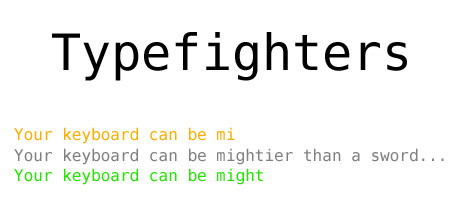
Typefighters (Steam Edition), developed and published by Christian Reuter, is an unusual experiment that transforms typing into a direct, competitive confrontation. At first glance, it appears to be a simple educational or skill-based title, but beneath its minimalist surface lies an intriguing attempt to turn a traditionally solitary practice into a multiplayer battleground. It is a game that celebrates precision, rhythm, and reaction, using words as ammunition and the keyboard as the sole weapon. Instead of enemies or elaborate environments, your opponent is another human being—or the clock—and every keystroke carries a kind of tactical tension. What makes Typefighters fascinating is how it tries to make something mechanical and mundane feel competitive and alive.
The premise is straightforward: two players face off in a battle of typing proficiency. Words or strings of letters appear on screen, and whoever types them correctly and fastest wins the exchange. The core mechanics are stripped down to essentials, with no fancy effects or distractions, creating an experience that feels both focused and intense. But what sets it apart from other typing games is its variety of modes, each designed to highlight a different skill. Some modes emphasize raw speed, while others introduce tactical layers such as timing, anticipation, and creativity. One mode may reward pure accuracy, while another challenges you to react to rapidly shifting prompts. This diversity prevents the gameplay from feeling repetitive and turns a simple premise into a surprisingly versatile skill test. For a game built almost entirely around words, Typefighters finds clever ways to stretch the concept beyond typing drills into something resembling a strategy match played in real time.
The game’s minimalist presentation reinforces its focus on mechanics. The screen is a clean canvas—just text, timers, and subtle indicators of progress. There are no elaborate backgrounds or distracting animations, and sound is limited to the rhythm of your typing and the occasional confirmation tone when a word is completed. This minimalism works in the game’s favor. By removing visual clutter, the player’s attention narrows entirely on precision and tempo. The design captures the meditative intensity of competitive typing: the world fades, your fingers move on instinct, and a misplaced letter can mean instant defeat. However, that same simplicity also limits its emotional engagement. There is little to look at, and after extended sessions, the sterile interface can begin to feel cold and repetitive. It is the kind of game that thrives in short bursts of concentrated play rather than long marathons.
Typefighters is at its best when played against another person. The competitive element adds urgency and unpredictability that no AI opponent can replicate. Each duel becomes a psychological contest as much as a mechanical one. You are not just typing quickly—you are reading your opponent’s rhythm, anticipating mistakes, and adjusting your own pacing to stay ahead. The tension of seeing a word vanish a fraction of a second before you finish typing it creates genuine adrenaline, the kind usually reserved for shooters or fighting games. However, this competitive potential is also one of the game’s greatest weaknesses. The online community for Typefighters is sparse, making it difficult to find active matches without arranging them manually. There is no robust matchmaking system or active ranked mode, and without consistent human competition, the game’s energy quickly diminishes. Against AI opponents, the challenge feels artificial, since the computer types at predetermined speeds rather than reacting dynamically. As a result, much of the brilliance in design depends on circumstances the game itself cannot reliably provide.
The variety of available game modes helps maintain interest, but balance between them can be uneven. Some modes, like the straightforward speed duels, work well because they rely purely on reaction and precision. Others, which introduce abstract rule sets or unpredictable mechanics, can feel less intuitive. There are modes that reward creativity—asking you to form words rather than simply type them—and others that emphasize endurance or rhythm. This diversity gives players ways to test more than just typing speed, but it also means that the fun can fluctuate dramatically depending on the skill level of both participants. When matched with someone of equal ability, Typefighters becomes exhilarating. When paired with a player far slower or faster, it can feel hollow, as the outcome becomes obvious from the start. The game has no built-in way to balance these discrepancies, so its competitive ecosystem thrives only when players manually organize fair duels or local matches.
While its design is functional and sharp, the overall experience feels more like a creative prototype than a fully realized game. The presentation and interface, though clean, are utilitarian. There is little in the way of personality or flair, and the lack of long-term progression, unlockables, or rewards limits its replay value. A sense of accomplishment comes only from improving your own performance or defeating an opponent. That purity can be appealing—there is something satisfying about a game that asks for nothing but skill—but it also means that once you have explored the different modes, there is little incentive to return regularly. The word lists themselves are varied but sometimes awkward, occasionally including odd entries like proper nouns or numerals that feel out of place in a typing duel. These inconsistencies can momentarily disrupt the flow, reminding you that the game’s foundation is still experimental rather than finely tuned.
Despite its limitations, Typefighters deserves recognition for its originality and intent. It is one of the few games that treats typing not as a tool or a side activity but as the central mechanic and competitive art form. There is a purity to its approach that makes it appealing to anyone who enjoys mastery-based challenges, whether for skill improvement or simply for the thrill of competition. It can be an excellent tool for sharpening typing reflexes, testing focus under pressure, or simply enjoying the satisfaction of perfectly executed precision. Its small install size, quick startup, and no-frills design make it an easy game to jump into when you have a few minutes to spare. For typists, writers, or anyone who enjoys the tactile rhythm of the keyboard, it offers a different kind of adrenaline rush.
In the end, Typefighters (Steam Edition) stands as a curious and admirable niche title—minimalist, focused, and unapologetically about one thing: the art of typing. It succeeds in moments of intensity, where two evenly matched players duel in a battle of pure reflex and concentration, and it falters when those conditions are absent. Its aesthetic simplicity and limited progression mean it will never be a mainstream favorite, but for those drawn to games that test precision and presence of mind, it offers a unique experience. Typefighters is not a game of spectacle but of flow, where your skill is laid bare on the keyboard, every letter a weapon, every word a victory.
Rating: 7/10