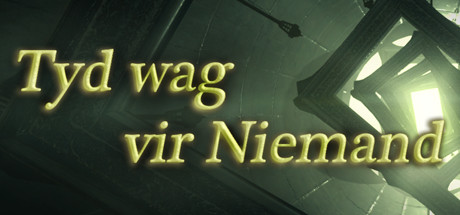
Tyd wag vir Niemand, developed by Skobbejak Games and Skermunkel and published by Skermunkel and Skobbejak Games, is a first-person puzzle-platformer built around the manipulation of time. Released on Steam in 2017, the game presents an ambitious central mechanic—slowing and restoring the flow of time—to navigate abstract environments filled with shifting platforms, mechanical hazards, and surreal architecture. While its core idea is imaginative and thematically cohesive, the experience ultimately reflects both the creative promise and execution challenges common in experimental indie titles.
The narrative framework is intentionally minimalistic. Players find themselves transported into a strange, fragmented world after interacting with a mysterious device, setting the stage for a journey that feels more symbolic than literal. Rather than unfolding through heavy dialogue or cinematic storytelling, the game communicates its tone through environmental design. Towering clock structures, suspended cities, and floating geometric constructs reinforce the theme of distorted temporality. The world feels disjointed yet cohesive in its aesthetic, evoking curiosity even when the narrative details remain sparse.
The defining mechanic—controlling the speed of time—is introduced early and remains central throughout. At any moment, players can slow the world to a crawl, allowing them to carefully maneuver past moving hazards or align with shifting platforms. Restoring time to normal speed reactivates environmental motion, often requiring precise timing to avoid falling or colliding with obstacles. This mechanic creates moments of satisfying synchronization when executed correctly. Thematically, it integrates well with the visual emphasis on clocks and mechanical motion, reinforcing the sense that time itself is both tool and obstacle.
Level design varies considerably in ambition and complexity. Some segments are inventive, requiring players to coordinate slow-motion jumps across rotating structures or traverse environments that shift unpredictably when time resumes. Other sections experiment with scale and perspective, placing players on surreal landscapes that challenge spatial awareness. At its best, the design captures a feeling of discovery and ingenuity. However, the quality of execution is uneven. Certain levels feel tightly constructed, while others suffer from imprecise hit detection or awkward camera positioning that complicates already demanding platforming.
One of the most frequently noted issues lies in the control scheme. As a first-person platformer, Tyd wag vir Niemand demands accurate movement and responsive jumping mechanics. Unfortunately, the controls can feel slippery or imprecise, particularly during segments that require tight jumps or exact positioning. Combined with the reliance on precise timing, this can transform what should be rewarding challenges into moments of frustration. The checkpoint system mitigates some of this tension by reducing backtracking after failure, but it does not entirely resolve the underlying control inconsistencies.
Visually, the game embraces a stylized and abstract aesthetic. Environments range from towering clockwork cities to open voids punctuated by floating structures. Textures and lighting effects vary in polish, sometimes appearing rough around the edges, yet the overall art direction succeeds in maintaining thematic consistency. The surreal presentation enhances immersion, even when technical limitations are noticeable. The soundtrack complements this tone with atmospheric compositions that underscore the strange, contemplative mood without overpowering gameplay.
In terms of pacing, the experience is relatively concise. A full playthrough can be completed in several hours, depending on player proficiency and tolerance for trial-and-error sequences. The limited runtime prevents fatigue from fully setting in, but it also means that the game does not extensively expand upon its central mechanic beyond its established framework. There is little in the way of branching paths or replay incentives; the focus remains squarely on progressing through the series of handcrafted levels.
Ultimately, Tyd wag vir Niemand stands as a concept-driven puzzle-platformer with a strong thematic identity and flashes of creative brilliance. Its time manipulation mechanic is genuinely compelling and integrated meaningfully into level design. However, inconsistent controls and uneven execution prevent the experience from fully realizing its potential. For players who appreciate experimental indie projects and are willing to navigate occasional frustrations, it offers moments of originality and visual intrigue. For those seeking highly polished first-person platforming precision, its imperfections may overshadow its creative ambitions.
Rating: 5/10